
Also, the string tree has something to do with the tension I guess? Then how come stringing thru body doesn't affect the tension? That's a much bigger angle and longer length.Or to turn the question around, why don't we have string throug heads? How can the small break angle across the nut in most basses be ok, even with a head lower than the fretboard?


Enjoy the benefits of a premium membership!
Upgrade Account
-
TalkBass has been independent since 1998. Add your voice.
Create a free account to reply to discussions, view embedded media, and browse with fewer display ads.
Join free Log in
Want zero display ads or expanded classifieds tools? Compare plans.
You are using an out of date browser. It may not display this or other websites correctly.
You should upgrade or use an alternative browser.
You should upgrade or use an alternative browser.
Floppy E String on A Short Scale?
- Thread starter Gare Boo
- Start date
More options
Who Replied?
- Oct 7, 2000
- 18,619
- 38,939
- Disclosures
- Endorsing artist: Musicman basses
Move up a gauge in strings, forget the flats if you like bright with good attack (I hate flats), and the next part you're probably not gonna like...
Start playing more softly.
I switched to short scale basses a little more than a year ago. My band tunes down a half step, and we do a handful of songs in drop D, which means C#. I used to play super aggressively and at first thought the short scale venture was going to be a no-go. I decided instead it was time for me to become more versatile in my playing, and I am blown away by the results of that.
Just by listening closely and adjusting, it became habit pretty quickly. Within about a month I had no more issues, and strangely enough have a rough time today imagining how I ever did. The tone of my drop D sounds just as awesome as any other note on my bass, my softer touch now happens unconsciously, without effort, and I am a much more versatile and articulate player than I was a year ago.
I highly recommend rethinking your playing style and readjusting. In my experience it's been much more beneficial and effective to work at changing me, as opposed to changing the bass.
And I can still dig in when I want to. That hasn't been lost at all. I just now have more of a choice.
Start playing more softly.
I switched to short scale basses a little more than a year ago. My band tunes down a half step, and we do a handful of songs in drop D, which means C#. I used to play super aggressively and at first thought the short scale venture was going to be a no-go. I decided instead it was time for me to become more versatile in my playing, and I am blown away by the results of that.
Just by listening closely and adjusting, it became habit pretty quickly. Within about a month I had no more issues, and strangely enough have a rough time today imagining how I ever did. The tone of my drop D sounds just as awesome as any other note on my bass, my softer touch now happens unconsciously, without effort, and I am a much more versatile and articulate player than I was a year ago.
I highly recommend rethinking your playing style and readjusting. In my experience it's been much more beneficial and effective to work at changing me, as opposed to changing the bass.
And I can still dig in when I want to. That hasn't been lost at all. I just now have more of a choice.


I have a short scale and I string it with 45-100 D'addario Prosteels so I know what you mean about having a floppy E string. The best way I found to combat it is to use a really thin pick, in my case a .50, and then it seems that I hit all the strings pretty consistently and I don't notice the flop.

Go up a string gauge, make sure you get a hex-core string set, and be mindful of your right hand technique. Lower tension is inherent to short-scales, some concessions must be made.

If you want the sound you get from rounds either try a heavier gauge or a string with a different core design. Strings can have a round core or a hex core for example. And that does have a little bit of influence on how the string feels. Flats do feel stiff compared to rounds but they also sound a lot differentHi. I just bought a Fender Mustang Player PJ bass(30" scale) with a top-loaded bridge. I noticed that the E string has less tension and is much floppier than on a regular bass. Is there a way to fix that? Maybe get a string-through bridge? Thanks!
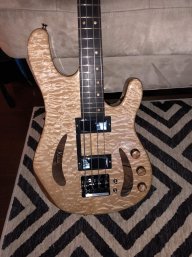

Try out a set of [Invalid or Expired Link Removed]. They are hex core (stiff feeling) and the heaviest gauge (tight) of round you will find. I use these on my short scale Les Paul Jr tuned to D standard, sometimes drop to low C. The low C is a little loose but D is very playable. When tuned to E the strings are almost too tight with my setup.


It sure would if one was available for a 30" scale bass. I use a 0.110 E string on my Birdsong basses which have string-through-body bridges, so they can use regular scale strings. I've got the Short Scale Stingray strung with the GHS strings previously mentioned in this thread; that 0.107 E string is the heaviest gauge I can find for a 30" scale. If anyone knows of any heavier roundwounds for short-scale bass, please provide a link. I searched extensively and came up empty. What Joe Nerve says about lightening up helps too. I also raised my action a bit, I prefer medium-to-high action.A 0.110 gauged E string will cure the problem.

Also, the string tree has something to do with the tension I guess? Then how come stringing thru body doesn't affect the tension? That's a much bigger angle and longer length.
None of that has anything to do with tension. Your string has to be at a certain tension to be at the right pitch. What that tension is depends on the mass of the string, which relates to thickness and length from nut to saddle. How the string is anchored at either end is not important.


Turnaround
Commercial User
The vibrating length remains the same, and it's the tension over the vibrating length that creates the vibration frequency (pitch). As others have said, use a heavier gauge string. The increased mass means that the string will have to have more tension to achieve the same pitch as a smaller gauge string.Also, the string tree has something to do with the tension I guess? Then how come stringing thru body doesn't affect the tension? That's a much bigger angle and longer length.
The string tree does not increase tension any more than stringing through the body. It increases the break angle over the nut and in doing so reduces the chance of the string vibrating in the nut causing buzz.

Or to turn the question around, why don't we have string throug heads? How can the small break angle across the nut in most basses be ok, even with a head lower than the fretboard?
Jens Ritter would like to have a word with you.
Turnaround
Commercial User
The increase in side-to-side movement was because of more string length to stretch. The same can be seen by increasing the length of string past the nut and/or saddle to the anchor point. The longer those distances the more the string will deflect side-to-side from the same applied force - there's more stretching.First of all, I am an engineer and very analytical and picky about my tone. In my experience, there was no audible improvement of the E string when going string through on my Jazz. The thinner strings sounded SLIGHTLY better, though.
I think the "witness point" argument/contribution will be offset by a bigger cross section string. In engineering, distribution of load is paramount in stable, durable design. The tight radius over the bridge will create internal tension and losses in the string, and there is an internal element that will strive for the string to move out, away from the pickups and body. The thick string would tend to remain LESS in the ideal witness point.
So your observation about increased motion might be reflecting that!
Hi. I just bought a Fender Mustang Player PJ bass(30" scale) with a top-loaded bridge. I noticed that the E string has less tension and is much floppier than on a regular bass. Is there a way to fix that? Maybe get a string-through bridge? Thanks!
Is it hard to play or does it not stay in tune? Can you hear it If all clears then leave it alone. it's not hurting anything....
They come with long scale .105s, which are not that light in the grand scheme of things. There are higher tension strings out there, but not a ton of them without going to flats (which I do on most of my basses, but which is still not something most people want to do).
The main problem is that factory setup places the strings far too low, IMO. Jack up the saddle adjustment screws one whole turn each, then move your saddles back to intonate. You'll find your strings feel better and your tone improves (unless you like fret clank and dirty notes, which a lot of people do, even without realizing it). If one turn is not enough, go even higher with the strings.
La Bella makes a set called D-Tuna. They are .111" round wounds designed to be downtuned on long scale basses. However, if used in standard tuning on a short scale bass, they make it feel "normal." Best round wound set for a short scale IMO. I think Rotosound might make a set of .110" rounds as well, but I forgot which set.
Also, there are slight technique adjustments that should be made on a short scale. Play one long enough, and you'll naturally adjust.
Don't feel tied only to strings that are available in short scale. IME, long and medium scale strings work fine. In fact, the strings that Fender put on your bass in the factory are standard long scale strings.
The main problem is that factory setup places the strings far too low, IMO. Jack up the saddle adjustment screws one whole turn each, then move your saddles back to intonate. You'll find your strings feel better and your tone improves (unless you like fret clank and dirty notes, which a lot of people do, even without realizing it). If one turn is not enough, go even higher with the strings.
La Bella makes a set called D-Tuna. They are .111" round wounds designed to be downtuned on long scale basses. However, if used in standard tuning on a short scale bass, they make it feel "normal." Best round wound set for a short scale IMO. I think Rotosound might make a set of .110" rounds as well, but I forgot which set.
Also, there are slight technique adjustments that should be made on a short scale. Play one long enough, and you'll naturally adjust.
Don't feel tied only to strings that are available in short scale. IME, long and medium scale strings work fine. In fact, the strings that Fender put on your bass in the factory are standard long scale strings.



Hi. I just bought a Fender Mustang Player PJ bass(30" scale) with a top-loaded bridge. I noticed that the E string has less tension and is much floppier than on a regular bass. Is there a way to fix that? Maybe get a string-through bridge? Thanks!
You might a thicker gauge string set. If you do opt for that, you may need an adjustment to your truss rod to prevent neck bow....
Jens Ritter would like to have a word with you.
View attachment 3751497
The break angle over the nut is probably very similar to that on many other basses...
The increase in side-to-side movement was because of more string length to stretch. The same can be seen by increasing the length of string past the nut and/or saddle to the anchor point. The longer those distances the more the string will deflect side-to-side from the same applied force - there's more stretching.
There is nothing controversial in that, I think. Again, any difference in how the string behaves at the transition/witness point must be quite small...


