Funny, with everything I have answered here over the past couple of years, I have been asked this question several times and avoided answering each time because tone is incredibly difficult to describe with words AND there are significant variations within each species (and even within the same tree).
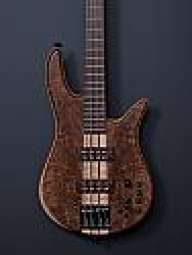
By way of example, when the shop was building Bass #3,000 (
http://www.fodera.com/Main/NewBornDetails.aspx?FeaturedItemID=19) I got to really work alongside him and Joey to tap test every piece of wood that went into that bass. We cut up a very large piece of Honduran Mahogany (over 15" wide and 10' tall) and the difference in tone between the top piece and the bottom piece was striking. It makes sense right? The wood near the roots of a tree (which has to bear the weight of what is above it) is invariably heavier and denser than the wood closer to the crown. YES, it was all Mahogany, but there were distinct differences in tone between the 5 pieces that were cut...so much so that Joey, Vinny and I could have easily "reconstructed" the slab by tapping each piece and placing it back in the order from which it was originally cut.
Since these differences are differences of gradation AND since they also occur in both the neck and fingerboard materials, after a customer has worked with us to select the species of wood for each component part, when it comes time to actually build the bass we work to ensure that the overall selection of woods compliment each other in a way that we think is both representative and appealing.
Going back to the Bass 3000 example...since it had a Brazilian FB that happened to have incredible depth to it in the lower frequencies, Vinny chose to compliment that characteristic with a Maple neck billet that emphasized these frequencies a little less than many others from which he had to choose from and was strong in the mids and highs. It's just like cooking. When you're making your pasta sauce, if the tomatoes are a little less ripe you compensate by adding a bit of sugar. This kind of expertise and attention to detail is one of the things that you are buying when you purchase a Fodera (or, hopefully, any high-end bass).
All of this said, here are some GENERALITIES about the "big four" body woods purely IMHO...
Alder - Fairly well balanced leaning towards the warm side of the tonal spectrum. Lows, mids and highs are all present. This wood has long been associated with the "Vintage 60's" sound -- especially when paired with a Brazilian Rosewood FB!
Ash - Tremendous variation here due to the varied densities between heavy, Northern Ash and (potentially) feather light Southern Swamp Ash. Unless weight is an issue, we always prefer to build with medium density Ash. At this density, Ash is brighter sounding than Alder with excellent, percussive sounding lows and clean highs. It tends to be a bit "scooped" in the mids. This wood (especially when paired with a Maple fingerboard) is associated with the "Vintage 70's" sound.
Mahogany - On the warmer side of the spectrum. "Rich" sounding and complex...if that makes any sense. The lows, mids and highs are all there but in a different way and different proportion than in Alder...Mahogany (to me) tends to have a fuller sound that speaks very naturally in the mids.
Walnut - Percussive in a way that is similar to Ash. Also somewhat scooped in the mids. Very clean, but not in-your-face-sounding highs. Overall, to my ears, Walnut comes across as a slightly warmer, more nuanced and subtle version of Ash...if that makes any sense, LOL!
Of course the very best way to get a sense of this is to get instruments with all of the different woods under your fingers on a regular basis. At least this is what I told my wife when she asked me why I needed 10+ Monarchs!
Listening to them regularly, the differences are immediately obvious, but putting these differences into words is, shall we say, very, very humanizing!
Enjoy the weekend...
J