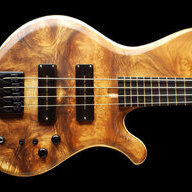
That emperor and Janek`s new bass both look great! What is the advantage of having an XLR out? Is that what Anthony Jackson has?

TalkBass has been independent since 1998. Add your voice.
Create a free account to reply to discussions, view embedded media, and browse with fewer display ads.
Join free Log in
Want zero display ads or expanded classifieds tools? Compare plans.


After all the talk about there being so few Monarch 6's, this shows up:
[Invalid or Expired Link Removed]
Awesome. Good thing (for me) that it's probably not a stock instrument for a store, otherwise...



I've played an ash-neck bolt-on ash/maple Emperor that was insanely aggressive.
Yes. The white emperor. It looked like it could kill you and then bring you back to life again. I'm looking forward to post my bolt-on emperor 4 in October/November.
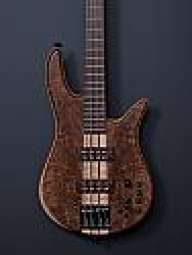
Wow, Janek's new fodera seems a little more aggressive than his older fodera to me. maybe that's just how he's playing in that video though. it sounds incredible!

Rich Treat said:I'd love to hear that wood combination.
Haha, that's a great description!
Angus, I think yours has the perfect body shape for six string basses... even better than the single-cuts!
That emperor and Janek`s new bass both look great! What is the advantage of having an XLR out? Is that what Anthony Jackson has?
Janek wanted an XLR output so he could plug straight into a board to record.
The difference between Janek's and Anthony's is that Janek's includes a real active balanced line driver so the XLR out is a true low impedance balanced (push-pull) version of whatever is at the output jack.
Anthony's is passive and is wired with the plus and minus of the pickup output to Pins 2 and 3 of the XLR respectively...a passive push-pull arrangement as long as it's plugged into a balanced load. The shield wire, the cavity sheild, bridge ground, etc., all goes to Pin 1 of the XLR. Theoretically this keeps the shield noise off of the audio ground and could be quieter. Ground and shield aren't the same thing just because they're both "zero" If it's plugged into a single ended load, it's effectively just the same as using a guitar cable with a different connector.
Janek wanted an XLR output so he could plug straight into a board to record.
The difference between Janek's and Anthony's is that Janek's includes a real active balanced line driver so the XLR out is a true low impedance balanced (push-pull) version of whatever is at the output jack.

Angus, I think yours has the perfect body shape for six string basses... even better than the single-cuts!
Jason, I was reading the description on Oteil's bass and it says that 60's spacing was used where usually with walnut you use 70's. Why is that and can you decribed the effect on walnut basses?