• TalkBass has been independent since 1998. Add your voice.
    Create a free account to reply to discussions, view embedded media, and browse with fewer display ads.
    Join freeLog in
    Want zero display ads or expanded classifieds tools? Compare plans.

Fodera Club Part XIV

Status
Not open for further replies.
Actually way more the latter. And that is part of the problem. I started working with Anthony at the beginning of the year to tear down my playing and start over. But I also have been averaging 2-3 gigs a week. So I had the situation where I'm doing specific practice every day but also then having to perform where I kinda have to fall on old habits to cover the tunes. Combine that with churning through a bunch of gear chasing and refining what I want - well, that ends up being a lot of energy. Now at least I feel like I've got tools that match my goals and won't get in the way of me achieving them. So I can focus on the process and the journey instead of the widgets.

In other words, no excuses are left :D

I've been there with the gigs taking over the practice time so much that I feel it hurts my playing in the long run, especially if the gig isn't particularly stimulating. Hard to find balance!
 
FunkyMcNasty said:
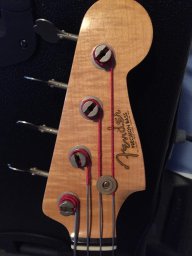
What does the b string being wound around a hight peg do? I am guessing it makes it tighter, but it does not change the scale of that string, so I don't see how it makes much difference. I am sure you know what your talking about, that's why I'm asking. I'm just curious about it, I've seen it on other Fodera basses and its interesting to me. Thanks.

You're seeing exactly what I'm getting at. I don't buy into the theory that extra length outside the string's speaking area makes a diff. So to me, it makes the headstock look doofy with no associated benefit.
 
roadkill2309 said:
You're seeing exactly what I'm getting at. I don't buy into the theory that extra length outside the string's speaking area makes a diff. So to me, it makes the headstock look doofy with no associated benefit.

+1, from an engineering perspective it doesn't make sense - the tension is the same. To get it tighter the only way I can see is to use greater tension strings or increase the scale length.

I always wondered if anyone could hear the difference - mayber there is something else going on other than tension?
 
+1, from an engineering perspective it doesn't make sense - the tension is the same. To get it tighter the only way I can see is to use greater tension strings or increase the scale length.

I always wondered if anyone could hear the difference - mayber there is something else going on other than tension?

I have one on order with and extended B. It doesn't change the tension, but something in the design is supposed to make it sound better. I suspect there is some small amount of vibration over the nut that is impacted by the extra length. It also puts the E and A in a more traditional position like a Fender.

Glenn at Austin Bass traders talked me into it for my 34" B, and I figure if him, Joey, and Mike Pope all agree, they must be onto something.
 
this is my dream bass!!!!!!

IMG_8144_small.jpg


Thanks man! It's still my dream bass after owning it for over 10+ years now. It's an absolutely staggering instrument.
 
Alright everybody else has their video playing foderas so here's mine. Sorry, this is in my basement in smelly workout clothes, half a cup of coffee in me, unshowered & unshaven during my early morning practice before going to work. When the MSG arrives I'll post a better video ( and delete this one).


Great stuff. Not to get too off topic BUT... how do you like the Apogee Jam? I want to pick something up to play along with iTunes and practice with.

I was also looking at the iRig. Would love to know what others are using...
 
Joelc73 said:
Great stuff. Not to get too off topic BUT... how do you like the Apogee Jam? I want to pick something up to play along with iTunes and practice with.

I was also looking at the iRig. Would love to know what others are using...

I have the iRig. I never use it; I bought a Scarlett to attach to my computer, and I don't have to deal with the iRig awkwardness anymore.
 
Hey Nostatic,

I absolutely love palm muting on my Fodera! It dampens the tone as expected, but for some reason, the notes retain a more usable volume and authority than with other basses I have had. It has become a regular technique of mine, and allows for a fun change in dynamics when switching between that and traditional plucking. I really think the Fodera dual coils/pope custom preamp is the best onboard electronics setup I have ever heard on an electric bass.

-Grady
 
A pic from a local jam last night. The Emperor 5 bolt on killed it, and sits in the mix so perfectly!

I really love how flexible the preamp is (cough-Thanks Mike!). I solo'd the neck pickup and boosted the bass while cutting the highs and passive tone for some monstrous dub/reggae bass for a few songs, and threw on single coil mode, pickups even with everythign flat(touch of bass boost) for some mean slap tones in a funk medley. So good!
 

Attachments

  • 524361_4353364193517_921158707_n.jpg
    524361_4353364193517_921158707_n.jpg
    16.8 KB · Views: 129
I have one on order with and extended B. It doesn't change the tension, but something in the design is supposed to make it sound better. I suspect there is some small amount of vibration over the nut that is impacted by the extra length. It also puts the E and A in a more traditional position like a Fender.

Glenn at Austin Bass traders talked me into it for my 34" B, and I figure if him, Joey, and Mike Pope all agree, they must be onto something.

The reason my last bass...the one I'm unloading...had an extended B was because I wanted the E and A strings non-speaking length to be the same as a 4 string bass in an effort to "slop" up the E. That left the last position as the only option. We were just using characteristics of 4 string basses as much as we could...whatever we could.

There is no difference, given the same size string, in static tension (tension while the string is sitting still) between the extended B and a standard B. There's no way there can be. Physics doesn't allow for it.

That doesn't speak to the dynamic effects of the straighter and longer non-speaking length, nor does it address the relationship between transverse mode of vibration (a function of string mass/stiffness, length, and tension) and longitudinal vibration (a function of only string mass/stiffness and length). The termination points of the string stop only the transverse vibration. They don't (particularly the nut) stop the longitudinal mode of vibration, and the relationship between those two modes is a part of "how the string sounds"...it lowers the pitch of the longitudinal mode because of more length). Tuning your E down to D is a good way to demonstrate this. The string "sounds different" in large part because the longitudinal mode has not changed due to lower tension, but the transverse mode (the one we hear as the fundamental) has gone down a whole step. I don't think anyone would argue with that example. What we hear as "overtones" is often the longitudinal mode, which is significantly higher (a few octaves, often) than the fundamental.

Another note is, traditionally, longer scales on string instruments were so that the string could have a lower mass per unit length, and still be the SAME tension as a shorter one. This produces a clearer fundamental and less "thud" or inharmonicity (components of the sound that are not related to the pitch of the fundamental through the overtone series)

So basically, it doesn't make the string tension higher. That's irrefutable. But it may, in fact, have a tonal effect, and may offer a "sense" of greater tension due to the extra length beyond the nut stretching as the string is pulled, released, and vibrated. There is NO evidence anywhere that I've ever been presented with that suggest that it does NOT do these things, and PLENTY that supports it.
 
I've been using an Apogee ONE for quite some time. Useful for "silent" practicing and tracking direct if need be. I generally use a Focusrite Saffire in my studio for proper recording. So far I find most of the iPo/ad interfaces lacking due to the inability of most of the apps to multitask.

Agree on the palm muting. I think it has to do with how articulate the instrument inherently is.
 
Joelc73 said:
Great stuff. Not to get too off topic BUT... how do you like the Apogee Jam? I want to pick something up to play along with iTunes and practice with.

I was also looking at the iRig. Would love to know what others are using...

I use a fire pod for recording in the studio, but the I just bought the apogee jam last weekend. Its great for the money, specs on it are quite good. I don't think you can do anything serious on an iPad, but you can use it with logic on the Mac too.
 
thepontif said:
The reason my last bass...the one I'm unloading...had an extended B was because I wanted the E and A strings non-speaking length to be the same as a 4 string bass in an effort to "slop" up the E. That left the last position as the only option. We were just using characteristics of 4 string basses as much as we could...whatever we could.

There is no difference, given the same size string, in static tension (tension while the string is sitting still) between the extended B and a standard B. There's no way there can be. Physics doesn't allow for it.

That doesn't speak to the dynamic effects of the straighter and longer non-speaking length, nor does it address the relationship between transverse mode of vibration (a function of string mass/stiffness, length, and tension) and longitudinal vibration (a function of only string mass/stiffness and length). The termination points of the string stop only the transverse vibration. They don't (particularly the nut) stop the longitudinal mode of vibration, and the relationship between those two modes is a part of "how the string sounds"...it lowers the pitch of the longitudinal mode because of more length). Tuning your E down to D is a good way to demonstrate this. The string "sounds different" in large part because the longitudinal mode has not changed due to lower tension, but the transverse mode (the one we hear as the fundamental) has gone down a whole step. I don't think anyone would argue with that example. What we hear as "overtones" is often the longitudinal mode, which is significantly higher (a few octaves, often) than the fundamental.

Another note is, traditionally, longer scales on string instruments were so that the string could have a lower mass per unit length, and still be the SAME tension as a shorter one. This produces a clearer fundamental and less "thud" or inharmonicity (components of the sound that are not related to the pitch of the fundamental through the overtone series)

So basically, it doesn't make the string tension higher. That's irrefutable. But it may, in fact, have a tonal effect, and may offer a "sense" of greater tension due to the extra length beyond the nut stretching as the string is pulled, released, and vibrated. There is NO evidence anywhere that I've ever been presented with that suggest that it does NOT do these things, and PLENTY that supports it.

Makes sense, good explanation.
 
That doesn't speak to the dynamic effects of the straighter and longer non-speaking length, nor does it address the relationship between transverse mode of vibration (a function of string mass/stiffness, length, and tension) and longitudinal vibration (a function of only string mass/stiffness and length). The termination points of the string stop only the transverse vibration. They don't (particularly the nut) stop the longitudinal mode of vibration, and the relationship between those two modes is a part of "how the string sounds"...it lowers the pitch of the longitudinal mode because of more length). Tuning your E down to D is a good way to demonstrate this. The string "sounds different" in large part because the longitudinal mode has not changed due to lower tension, but the transverse mode (the one we hear as the fundamental) has gone down a whole step. I don't think anyone would argue with that example. What we hear as "overtones" is often the longitudinal mode, which is significantly higher (a few octaves, often) than the fundamental.

I'm not sure I buy into the effects of longitudinal modes for a bass guitar. Typically longitudinal waves propagate at the speed of sound of the medium. The speed of sound of the steel core of a bass string is about 4500 m/s. With a string length of about 1 m, the fundamental would be a couple of kHz.. Not only that, I don't think a magnetic pickup would even be able to detect the pressure wave in the core of the string, especially with a wire wrapping. (The wrapping wouldn't produce a pressure wave.)

That's how I see it anyway, FWIW.

Jim
 
jsbarber said:
I'm not sure I buy into the effects of longitudinal modes for a bass guitar. Typically longitudinal waves propagate at the speed of sound of the medium. The speed of sound of the steel core of a bass string is about 4500 m/s. With a string length of about 1 m, the fundamental would be a couple of kHz.. Not only that, I don't think a magnetic pickup would even be able to detect the pressure wave in the core of the string, especially with a wire wrapping. (The wrapping wouldn't produce a pressure wave.)

That's how I see it anyway, FWIW.

Jim

I remember this subject debated on tb a few times years ago - it is interesting. I'd like to hear comparison recordings of the same bass with the string tried with two different lengths above the nut. Do a blind a/b test...see how it goes.
 
Status
Not open for further replies.