• TalkBass has been independent since 1998. Add your voice.
    Create a free account to reply to discussions, view embedded media, and browse with fewer display ads.
    Join freeLog in
    Want zero display ads or expanded classifieds tools? Compare plans.

Fodera Club Part XIV

Status
Not open for further replies.
thepontif said:
The reason my last bass...the one I'm unloading...had an extended B was because I wanted the E and A strings non-speaking length to be the same as a 4 string bass in an effort to "slop" up the E. That left the last position as the only option. We were just using characteristics of 4 string basses as much as we could...whatever we could.

...

So basically, it doesn't make the string tension higher. That's irrefutable. But it may, in fact, have a tonal effect, and may offer a "sense" of greater tension due to the extra length beyond the nut stretching as the string is pulled, released, and vibrated. There is NO evidence anywhere that I've ever been presented with that suggest that it does NOT do these things, and PLENTY that supports it.

Honestly, this seems a bit like the bass version of buying the titanium seat post clamp to lighten up your race bike by a few grams. I can think of no situation outside of a TB discussion where there would be a big enough effect to justify the optics of that headstock. I don't dispute the physics you're talking about; I dispute that an instrument small enough to be held in the hand will produce a pronounced enough example of what you're saying for it to really count in a live show or band recording. It just feels like we're hoving into theoretical territory. I might see things differently if I were a solo bassist or something, but even there I'm unconvinced.
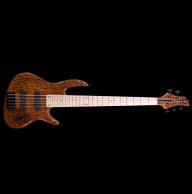
 
I remember this subject debated on tb a few times years ago - it is interesting. I'd like to hear comparison recordings of the same bass with the string tried with two different lengths above the nut. Do a blind a/b test...see how it goes.

Just to be clear, I didn't comment on whether there are audible after-length effects - just that I don't think that longitudinal modes are a factor.

Jim
 
I ditched math and science classes in high school and college to practice more, so I don't know what Mike's talking about, but I do know that he has one of my favorite Fodera tones, especially on the low end. (BTW, Mike, I'm really digging the Joe Locke/Geoff Keezer "Signing" album.)

I agree the extended B is less visually appealing, but outside of that, there's no other "cost" to it, and I trust Glenn's ears quite a bit as a dealer who's heard lots of Foderas and designed many with customers and the shop. He really just has had better luck with them, he told me. If my B is killing on this new bass, I won't really know if it was that or the wood specs we put together.

We need another A/B test, Jason, with the same block of wood like the bolt on/neckthrough thing. (I know probably not worth the time!)
 
The pros and cons of the Extended B String rumble on.
I personally wanted to try the extended B design because of the sonic properties it may impart on a 33" scale 6 string plus, I happen to like the larger headstock design. To my eyes it looks more in keeping with a 6, so it's a no brainer for me, I had nothing to lose by going for the option.

Easy..
 
Is that your new baby in the Newborns?

I ditched math and science classes in high school and college to practice more, so I don't know what Mike's talking about, but I do know that he has one of my favorite Fodera tones, especially on the low end. (BTW, Mike, I'm really digging the Joe Locke/Geoff Keezer "Signing" album.)

I agree the extended B is less visually appealing, but outside of that, there's no other "cost" to it, and I trust Glenn's ears quite a bit as a dealer who's heard lots of Foderas and designed many with customers and the shop. He really just has had better luck with them, he told me. If my B is killing on this new bass, I won't really know if it was that or the wood specs we put together.

We need another A/B test, Jason, with the same block of wood like the bolt on/neckthrough thing. (I know probably not worth the time!)
 
bassdoubler said:
I have to disagree, I think the extended B thing looks really unique and I love the look of the headstock tilted in that direction versus the standard headstock design. Wish my Imperial had it, but I can't really imagine it making it sound much better than it already does!

I think that, since there's no upcharge for it, all opinions are valid. And we're not talking about something that makes the bass sound *worse,* we're debating whether or not it makes a bass sound noticeably better, so there's kind of no way to lose, here.
 
Honestly, this seems a bit like the bass version of buying the titanium seat post clamp to lighten up your race bike by a few grams. I can think of no situation outside of a TB discussion where there would be a big enough effect to justify the optics of that headstock. I don't dispute the physics you're talking about; I dispute that an instrument small enough to be held in the hand will produce a pronounced enough example of what you're saying for it to really count in a live show or band recording. It just feels like we're hoving into theoretical territory. I might see things differently if I were a solo bassist or something, but even there I'm unconvinced.


My goal wasn't to convince you. It was to state some facts.
 
I have to disagree, I think the extended B thing looks really unique and I love the look of the headstock tilted in that direction versus the standard headstock design. Wish my Imperial had it, but I can't really imagine it making it sound much better than it already does!

If it sounds good, it sounds good. The extended B can't make that kind of huge difference.

I'm going to take the E string off of my bass, and string the B to the B tuner, then to the E tuner, and I'll make a good quality recording and see if there is actually any discernible difference. Even with the change in angle over the nut, if there is difference in the sound, it will tell us in no uncertain terms that the termination makes a difference. Or, maybe it will make NO discernible difference.

Whether it does or doesn't, I don't really care. But I'm not going to accept people telling me it won't based solely on how they feel about it.

Give me some information! :hyper:
 
thepontif said:
If it sounds good, it sounds good. The extended B can't make that kind of huge difference.

I'm going to take the E string off of my bass, and string the B to the B tuner, then to the E tuner, and I'll make a good quality recording and see if there is actually any discernible difference. Even with the change in angle over the nut, if there is difference in the sound, it will tell us in no uncertain terms that the termination makes a difference. Or, maybe it will make NO discernible difference.

Whether it does or doesn't, I don't really care. But I'm not going to accept people telling me it won't based solely on how they feel about it.

Give me some information! :hyper:


I couldn't agree more and thanks in advance for doing this. I've wondered about this for years.
 
thepontif said:
My goal wasn't to convince you. It was to state some facts.

Legit. But I wasn't outright disagreeing with you anyway. I think you're probably right about the physics of it; where we're not on the same page is whether or not the difference is too granular to count once you work in a band. Not to mention an amp or soundboard and the woods that went into making a given bass.

I'm not trying to convince you either. I'm of a differing opinion is all. And it's an interesting debate, no matter how you slice it.
 
Hey, Mike. Why don't you put a fresh B sting on the B tuner and one on the E string at the same time. That would be a good real-time comparison.

If it sounds good, it sounds good. The extended B can't make that kind of huge difference.

I'm going to take the E string off of my bass, and string the B to the B tuner, then to the E tuner, and I'll make a good quality recording and see if there is actually any discernible difference. Even with the change in angle over the nut, if there is difference in the sound, it will tell us in no uncertain terms that the termination makes a difference. Or, maybe it will make NO discernible difference.

Whether it does or doesn't, I don't really care. But I'm not going to accept people telling me it won't based solely on how they feel about it.

Give me some information! :hyper:
 
Status
Not open for further replies.