- Apr 24, 2004
- 1,359
- 53
- Disclosures
- Designer Fodera Guitars/Michael Pope Design, Inc., Trickfish Amplification
Mike,
The reason I said "if" is because the only time I'd ever heard of this (longitudinal mode in the context of a bass) was in a previous post of yours a couple of years ago, so I wasn't sure if it was your own theory or accepted science. I just read the article in the link from nuwavedc's post quoting your post, which I originally missed. It's a very interesting article. The fundamental of the longitudinal is comparatively high in pitch, as I had indicated would be the case in my post the other day. But what's puzzling me is whether the longitudinal wave is in the core or the winding. At first I figured must be the core, because we're calling it a longitudinal (pressure) wave, but it could be some kind of slinky-like effect in the winding/wrapping. (the article says it can be tuned by altering the speaking length, or the ratio of winding mass to core mass. I would not expect the latter to affect the tuning if was a pressure wave in the core...)
If it's in the core, then the pressure wave in the core wouldn't directly affect the magnetic field to the pickup (as I indicated above, and especially with the winding shielding it) - but what it could do is cause an oscillating force on the tuning peg and bridge saddle that cause the instrument itself to vibrate, hence the pickup to vibrate relative to the string, and then the string's magnetic field responding, and thus the pickup detecting the strings response. Anyway, enough hypothesizing. Are you aware of more literature on this? I'd be interested to read more.
Jim
After doing a quick experiment, in which I put the B string on the B tuner and played through an amp loudly (so I could be sure I wasn't hearing the acoustic sound) and plucking in precisely the same way and same location with both pickups is single coil mode, I found that the longitudinal mode is most definitely audible. You can hear it as the string is dying, as it seems the longitudinal mode sustains longer. Very much like a piano, with the string on the E tuner, it is roughly a minor 7th above the octave (plus a couple/few octaves). With the string on the B tuner, it is around a maj 6th above the octave (plus a couple/few octaves).
I'll make a recording tomorrow. It is definitely telling, though. I'll do one version with the relatively dead string that's on there now, and then again with a brand new string. That way we can hear the longi pitch pretty clear on it's own, and then hear how it interacts with the natural upper harmonics of the string.
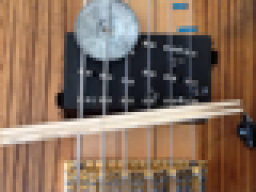

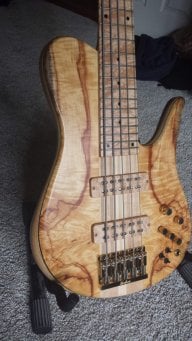


 I believe a have picture somewhere