• TalkBass has been independent since 1998. Add your voice.
    Create a free account to reply to discussions, view embedded media, and browse with fewer display ads.
    Join freeLog in
    Want zero display ads or expanded classifieds tools? Compare plans.

Folded Horn Configurations?

Oct 31, 2015
2,827
2,872
66
Greetings All,

Any reason nobody makes a folded horn in either a 2 x 10" or 2 x 12", or 4 x 10" or 4 x 12" configuration?

Just for clarification that either 1 on top and 1 on bottom, or 2 on top and 2 on bottom.

There must be a reason for it. Just amused how a standard 2 x10 or 2 x 12 work, never had a folded horn enclosure smaller than 2 x 15"?

 
Overall, folded horns don’t get much love. Probably because of weight.

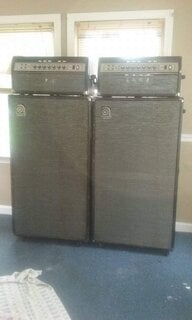
My favorite sounding cab that I ever played though (and I own one) is a 2x15 foldedhirn. It’s crazy heavy and large. It’s a 197x Ampeg V4B cabinet.

I would love a small version. Would it work with a 2x10?
 
There used to be a 212 folded horn, it was a variant of the EV Sentry IV. It was pretty big, heavy cabinet, and if the LF section was run full range, was unflatteringly voiced in the midrange (a really big issue with folded horn cabinets in general).

Re-edit... I thought I remembered an Emininator folded horn model which had a larger mid-high horn so I looked in my EV data binder and sure enough there was the Eliminator 1A. There was also a mention of a 212 version but no model number.
 
Last edited:
My favorite sounding cab that I ever played though (and I own one) is a 2x15 foldedhirn. It’s crazy heavy and large. It’s a 197x Ampeg V4B cabinet.

I would love a small version. Would it work with a 2x10?

Here's the problem: The wavelengths don't change, and horns are designed around the wavelengths they have to reproduce. If you want to achieve a particular low-end extension, the horn has to be long enough and the mouth has to be big enough. You really don't save much size by using smaller woofers. If you are okay with trading off low-end extension, then you could correspondingly shrink the horn.

In contrast, vented and sealed boxes can trade off some combination of efficiency and low-end extension in order to get a smaller box. So a small bass cab can theoretically go just as low as a big one (Acme Low B-1), but it will not be as loud. You can't do that sort of thing with horns.
 
Check out Bill Fitzmaurice folded horns.

Subs only. Not good above 150hz.

I’ve built a few BFM cabs, and I like them, but tomuse a Tuba or Titan you’d have to bi-amp and use a top cabinet for anything above 150hz or so.

If I ever get called on to do a festival gig, that’s exactly what I’m going to do. :cool:
 
Subs only. Not good above 150hz.

I’ve built a few BFM cabs, and I like them, but tomuse a Tuba or Titan you’d have to bi-amp and use a top cabinet for anything above 150hz or so.

If I ever get called on to do a festival gig, that’s exactly what I’m going to do. :cool:
The subs are obvious but some of the other ones are convoluted W folded horn arrangements for 100hz upwards.
 
The ultimate challenge with folded horn subs for bass guitar applications is the path length differences in the low mids and mids, along with multiple throat reflections. If you were to look at the broad band impulse response, or look at signal coherency, you would see that the signal is made up of a bunch of smaller signals all slightly time offset from each other, along with increased distortion components (in the midrange).

Combine this with the necessary size for low frequency extension, and the weight, and the added cost for materials, packaging and shipping and you can see why they quickly fell out of favor as amp power got bigger.

If it were such a great solution, one of the hundreds of commercial bass speaker manufacturers would offer this kind of cabinet, but they don't (as far as I am aware of).
 
Overall, folded horns don’t get much love. Probably because of weight.

My favorite sounding cab that I ever played though (and I own one) is a 2x15 foldedhirn. It’s crazy heavy and large. It’s a 197x Ampeg V4B cabinet.

I would love a small version. Would it work with a 2x10?

V4-B cab, also one of my all time favorite cabs. I've only played through them twice that I can remember but what a sound, solid solid.
 
  • Like
Reactions: SteveFromBerlin
There used to be a 212 folded horn, it was a variant of the EV Eliminator. It was pretty big, heavy cabinet, and if the LF section was run full range, was unflatteringly voiced in the midrange (a really big issue with folded horn cabinets in general).

The speaker you’re referring to is the Sentry IV, not an Eliminator. It was comprised of the dual 12 bass bin, a 90 x 40 horn with a phenolic MF driver and an ST-35 HF. Those were pretty good PA speakers back in the early 70s.
 
The speaker you’re referring to is the Sentry IV, not an Eliminator. It was comprised of the dual 12 bass bin, a 90 x 40 horn with a phenolic MF driver and an ST-35 HF. Those were pretty good PA speakers back in the early 70s.
That's right Sentry, not Eliminator. How time flies and the memories fade.

Update: there was in fact an Eliminator 1A which was another EV folded horn cabinet. My mind is like a steel trap... though arguably rusty!
 
Last edited:
I once had a bi-amp rig with a folded 18 for the low pass. Amazingly, I could stand in the right spot, hear the high half thru its' amp right NOW, and could actually hear a time delay from the folded horn. This was a) I decided that experiment had run its course, and b) decided 'Time Align' was probably a good idea after all.

Plus, moving that refrigerator-sized b*****d made a 215 cab seem tiny in comparison. LOTS of plywood in those innards. But then, I tried one of the late Acoustic rigs (and I don't remember model numbers here) with the two 15's in an internal manifold and two front mounted 15's firing directly, and the head to go with it. Just as hard to move (and not cheap . . . . . ), but geez it sounded amazing. Oh well . . . . . .

The 'W Bins' as we used to call them were an attempt with the amp heads of the day to try and buy some efficiency and projection in the low end. The mighty PS400 Fender would drive three of them (!). But these answers to those questions are no longer the answer in a day with much better acoustic engineering and far higher-powered amps and drivers with much better response and power handling.

For those of us 'of a certain age', these were contemporaries of Shure VocalMaster columns and heads, and Voice of the Theatre cabinets, so that's the level of tech back then. Ancient history.
 
Last edited:
But then, I tried one of the late Acoustic rigs (and I don't remember model numbers here) with the two 15's in an internal manifold and two front mounted 15's firing directly, and the head to go with it. Just as hard to move (and not cheap . . . . . ), but geez it sounded amazing. Oh well . . . . . .

That was the 408, and yes, it did. Sometimes I wish I still had mine, but I don't miss moving it.

Bassically, Michael
 
I’ve only played through one folded horn cab (an old original Acoustic 301) that I could actually say I liked. It had an 18” CV in it.

But despite its fridge size (I don’t think its all that heavy campared to some smaller 6x10s I’ve hefted) it’s not bassy sounding at all. There's a distict midrangy almost singing tone to it rather than the heavy low end you’d expect to hear.

So I guess you can’t always judge a cab by its size or whats in it.
 

Latest posts