• TalkBass has been independent since 1998. Add your voice.
    Create a free account to reply to discussions, view embedded media, and browse with fewer display ads.
    Join freeLog in
    Want zero display ads or expanded classifieds tools? Compare plans.

Formica, wallpaper, and other kitschy tops

Apr 7, 2010
4,421
3,833
37
DC05D69F-047C-430D-AA2C-DD049F17679B.jpeg


I came across this photo on Pinterest, and I’ve been daydreaming about it a lot, since daydreaming is easier than sitting down and doing a nice job of a conventional guitar finish..

Curious if anyone has any experience or insight with using unconventional materials to top a guitar... i’m particularly curious about wallpaper, and obviously Formica, per the picture.. but I’d love to hear anything relevant !
 
Check out SamanthaCay's projects. She's been doing some very creative things with fabric and paper overlays.

The hamster wheel of my brain.

And of course, JIO has been coating basses with metal foils and anything else he can find. Check out any of his build threads.

Diary of a bass
 
Last edited:
Someone will correct me if I’m wrong, but it’s my understanding that Fender’s original 1968 run of Pink Paisley and Blue Flower Power instruments were simply wallpaper applied to the bodies with a halo of paint masking the edges. Many of those original finishes failed, with the paper lifting from the bodies. The lesson is not to avoid wallpaper, but rather that surface prep and proper materials are key to success. I have to wonder if Fender just used regular wallpaper paste. :) Considering how many home-crafted decoupage projects survive from the ‘70s to this day and populate the knick-knack shelves in Goodwill stores nationwide, it’s clear that paper on wood can be quite durable when done properly.
 
I briefly owned a bizarre fever-dream 60’s era Japanese beatle bass clone that had what must have been red Naugahyde applied to the front. It looked original, but I never peeled it off to find out. One corner was coming up, and the unmistakeable scent of the ancient Minty chewing gum some previous owner had used to tack it back down would waft forth. It had fret sprout like 20 razor blades, so it was unplayable, but I should have kept it as pure wall art. +1 on @SamanthaCay builds, she brings a slightly demented genius to the art of bass building, I think she did a recent build with paisley wallpaper or fabric.
 
We’re out of town so I can’t post pictures but I have done one guitar with Formica on the top and back and a couple of others as fabric tops but the fabric still requires a decent amount of filling and clear coats. Rick Turner used to make a model with Formica also.

I remember reading an interview with Babe Simoni where he said the Fender paisley and blue flower were shelf contact paper and he claims he told Fender to use better glue then what was already on the paper and they didn’t... Certainly could be true.

Edit: here’s one of Rick’s Model T’s with a Formica top: Rick Turner Model T Rara Pink | Mark's Shop | Reverb
 
Last edited:
I used the backside of Wilsonart (a competitor of Formica brand...) for fretless bass and fretless banjo fingerboards. I sanded off the "photo surface" on the front side and glued that surface down to the neck's top surface. The surface was a dark gray and I hit it with a jumbo black magic marker to make it look more like jet-black ebony.

I would think that regular Formica and Wilsonart material would be quite easy to use as a top of body surface, especially if you used the same construction technique as what you see used for the new Fender Acoustisonic Telecasters.
 
View attachment 3946179

I came across this photo on Pinterest, and I’ve been daydreaming about it a lot, since daydreaming is easier than sitting down and doing a nice job of a conventional guitar finish..

Curious if anyone has any experience or insight with using unconventional materials to top a guitar... i’m particularly curious about wallpaper, and obviously Formica, per the picture.. but I’d love to hear anything relevant !

You can follow the entire build of that particular guitar, showing in detail how the Formica was used, on the TDPRI forum:

https://www.tdpri.com/threads/minimalist-lightweight-offset-bolt-on-with-formica.721448/
 
Check out SamanthaCay's projects. She's been doing some very creative things with fabric and paper overlays.

The hamster wheel of my brain.

And of course, JIO has been coating basses with metal foils and anything else he can find. Check out any of his build threads.

Diary of a bass
Bruce, while I have you peeking in, for something like wallpaper, would I be safe in assuming that you would advocate for the use of epoxy? Somehow wallpaper glue seems like something I don’t want in this application..

@SamanthaCay I had somehow never come across your work in here yet, what a refreshingly whacky but straightforward little corner of the LC
 
  • Like
Reactions: Beej
Someone will correct me if I’m wrong, but it’s my understanding that Fender’s original 1968 run of Pink Paisley and Blue Flower Power instruments were simply wallpaper applied to the bodies with a halo of paint masking the edges. Many of those original finishes failed, with the paper lifting from the bodies. The lesson is not to avoid wallpaper, but rather that surface prep and proper materials are key to success. I have to wonder if Fender just used regular wallpaper paste. :) Considering how many home-crafted decoupage projects survive from the ‘70s to this day and populate the knick-knack shelves in Goodwill stores nationwide, it’s clear that paper on wood can be quite durable when done properly.


Sort of doubt it. Leo likely had a legitimate adhesive that would not bleed through.

I own one from that era and one from a later 80's run.

Finish checking but no lifting on the original, nothing on the later. Both get used extensively.
 
View attachment 3946179

I came across this photo on Pinterest, and I’ve been daydreaming about it a lot, since daydreaming is easier than sitting down and doing a nice job of a conventional guitar finish..

Curious if anyone has any experience or insight with using unconventional materials to top a guitar... i’m particularly curious about wallpaper, and obviously Formica, per the picture.. but I’d love to hear anything relevant !
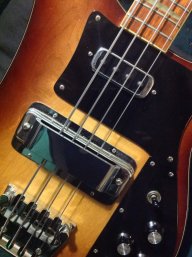
Lindert. Reverend US. Silvertone. Danelectro. Dipinto. There are some interesting tops through the years. I think Reverend offered anodized sheet aluminum at one time. And cool Formica choices. Back in the Rumblefish days. There was a guitar company in Salem, Oregon that made sheet aluminum guitars with aircraft style framework inside. Forgot their name.
 
  • Like
Reactions: SamanthaCay
I'm still very much experimenting with this.
Things I've learned using epoxy solely to lay down fabric it too tricky as it won't want to lay flat, perhaps a spray adhesive first and then epoxy after it dries?

Another thing I discovered is spray enamel will evaporate super 77 spray glue.

So the flower pickguard I did I used 77 to glue down the rather thick pattern paper and after spraying the first few heavy coats of clear enamel I found that it had almost entirely lost its tack, as the enamel evaporated said 77 through the paper.
I was able to re-glue it and get it to stay via coating it lighter and in giving everything more time to dry, but still I'm left wondering how I can better this process.
 
I'm still very much experimenting with this.
Things I've learned using epoxy solely to lay down fabric it too tricky as it won't want to lay flat, perhaps a spray adhesive first and then epoxy after it dries?

Another thing I discovered is spray enamel will evaporate super 77 spray glue.

So the flower pickguard I did I used 77 to glue down the rather thick pattern paper and after spraying the first few heavy coats of clear enamel I found that it had almost entirely lost its tack, as the enamel evaporated said 77 through the paper.
I was able to re-glue it and get it to stay via coating it lighter and in giving everything more time to dry, but still I'm left wondering how I can better this process.


For a fabric top or back on bare wood I’ve just used Titebond 1. Use a small paint roller to spread it out, lay the fabric down, use a J roller, ironically enough, for laminate countertops to smooth out the fabric, let dry and trim. Then fill, fill, fill to get the fabric smooth. Another option is to get the fabric positioned, then fold back 1/2 and spread out the glue, lay the fabric back down then do he other 1/2.

The first one I did I used ModPodge to fill. I think I read that on here somewhere. The last one I used the UV cure I Can’t Believe It’s Not Lacquer stuff and that worked pretty well because you can put on a lot pretty quickly. I’m sure epoxy would work as a filler once the fabric is glued down.
 
I've done a few fabric topped bodies, always using a good quality wood glue and have gotten good results. There's quite a lot of info on line from people who have created some outstanding finishes.

I've found all cotton fabrics works well, preferably a fine weave and ordinary wood glue that dries clear seems to do a good job. Just make sure you get a good even covering of the surface you're gluing to and make sure you don't get any wrinkles or air bubbles when laying down the material. A rubber roller can be helpful for this job. It can get a bit messy, glue will soak into the fabric, that's fine as the fabric needs to be soaked with glue or a filler anyway as part of the process.

I cut my material about half an inch oversize all round, once the glue has dried I saturate the fabric with more glue (or a clear sealer would work) and let that dry. You should now have a stiff material which can be trimmed without any fraying at the edges. Use an exacto knife or similar, with a new sharp blade and change to a new blade at any sign that the one you're using is getting blunt. Run the blade round carefully to trim as close to the body as you can. Any finishing of the edge can be done with sand paper as long as you got complete saturation with you glue/sealer.

A fabric finish does require quite a few coats of finish to get a smooth surface, but the end results can be stunning. There are plenty of pictures on line of fabric finishes, from Steve Vai's "gem" guitars, to amateur and professional efforts.
 
View attachment 3946179

I came across this photo on Pinterest, and I’ve been daydreaming about it a lot, since daydreaming is easier than sitting down and doing a nice job of a conventional guitar finish..

Curious if anyone has any experience or insight with using unconventional materials to top a guitar... i’m particularly curious about wallpaper, and obviously Formica, per the picture.. but I’d love to hear anything relevant !
Zemaitis too.
 
Last edited:
For a fabric top or back on bare wood I’ve just used Titebond 1. Use a small paint roller to spread it out, lay the fabric down, use a J roller, ironically enough, for laminate countertops to smooth out the fabric, let dry and trim. Then fill, fill, fill to get the fabric smooth. Another option is to get the fabric positioned, then fold back 1/2 and spread out the glue, lay the fabric back down then do he other 1/2.

The first one I did I used ModPodge to fill. I think I read that on here somewhere. The last one I used the UV cure I Can’t Believe It’s Not Lacquer stuff and that worked pretty well because you can put on a lot pretty quickly. I’m sure epoxy would work as a filler once the fabric is glued down.
Lol why is it sometimes the simplest things we think of last! Wood glue as a base glue is a great idea and I suppose would be good for paper as well.
 
  • Like
Reactions: wraub and eddododo

Latest posts