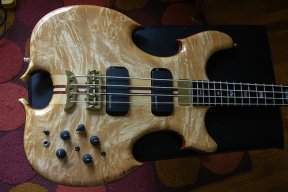
I love the Freddie King version, and that's Duck Dunn on the bass. This is how I play it:
The bass line is basically this pattern of notes (not chords):
1 3 5 b7 b7 6 5
The recording is in the key of Db, so when you are on the 1 chord, those notes would be:
Code:
1    3     5    b7     b7     6     5
Db   F     Ab   B      B      Bb    Ab
(I wrote B for the flat 7, but I believe technically it is Cb)
Or, on the fretboard, it is this pattern:
Code:
------------------------------------
|   6    |   b7    |        |      |
------------------------------------
|   3    |         |        |   5  |
------------------------------------
|        |   1     |        |      |
------------------------------------
So you use that pattern in this chord progression:
1 5 4 4
1 5
Then back to the 1 and play these notes
1 b7 walk down to 5 (i.e. b7 6 b6 5) 3 4 5
The 1 chord is Db, 5 is Ab, 4 is Gb. It goes down from 1 to 5, so when I play the 1 of the pattern and I'm on the Db, I play it on the 4th fret on the A string, then for the 5, I start on the 4th fret of the E string, and for the 4, on the 2nd fret of the E string.
The bridge is basically the same pattern, it just moves up a fourth. I just shift so I start the pattern on the 9th fret of the A string and play the same way, except that the turnaround is different. Because you have shifted up a fourth, the chord progression you are playing now is:
4 1 b7 b7
4 1
The only reason I am pointing this out is because I thought it would make my explanation of the last two measures clearer.
Instead of that 1 7b walkdown for the last two measures, you play 8th notes on the root of the 4 for one measure, and 8th notes on the root of the 5, or in simpler terms, play 8 8th notes on the 9th fret of the A string, then 8 8th notes on the 11th fret.
Then it goes back to the original pattern 1 5 4 4 1 5 + walkdown pattern.
I hope that wasn't too confusing. I tend to use numbers to describe both fingering patterns and chord progressions, and maybe it is difficult understanding when I am going from one to the other.