
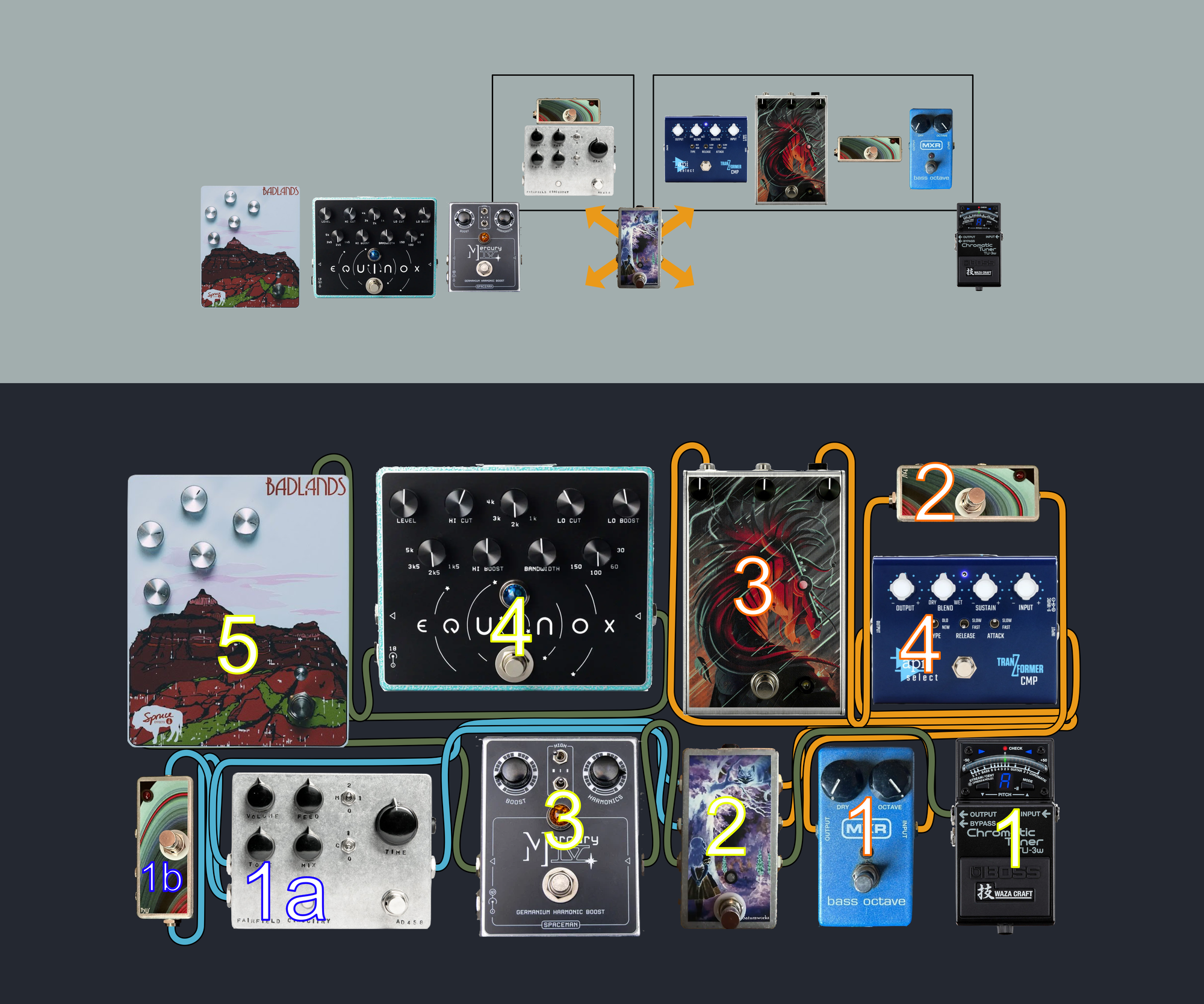
This is the completion of the first stage of pedalboard building for me. I typically utilize simple graphics like this to take "notes" and visualize. I design a visual representation of the chain, and then a mockup of the board's layout—using proper-ratio images of the pedals. Finally, I add depictions which represent the cable runs around a fixed path.
Signal:
[Primary signal path: Boss TU-3w>>Saturnworks Order Swapper*>>Spaceman Mercury IV>>Spaceman Equinox>>Spruce Badlands
Order Swapper
Loop A: MXR Bass Octave>>Saturnworks Truebypass Loop>>Lauren Audio Mustang>>API Tranzformer CMP
Loop B: Fairfield Circuitry Meet Maude>>Saturnworks True Bypass Loop in Meet Maude FX loop<<]
(More about individual pedals and then signal chain function at the end.)
Backstory:
I was band which split a while ago. From that point, my setup stayed frozen in time. I just stuck with it as it was—don't get me wrong, the whole rig was very capable and well designed. Albeit the frequency of playing was diminished, it never ceased. However, I could feel the stagnation.
Last year, I finally decided to strip apart my rig and take the time to redesign my tone. As memory is concerned, it was normally a joy to explore gear and equipment, but throughout this experience I was overwhelmed. It was tedious reacquainting myself with every individual piece. I was setting aside blocks of time to test pedals—which sounds as ridiculous as it is. I soon remembered the term "pedal-back" after an initial period of dwelling on my basement floor. Eventually, bearing ever closer to having more than just viable tone, I broke free of the attitude I had. The sagging, gray process began to tantalize me like it once did long ago.
I've made a number of pro-quality boards. I believe this concept is not just a proper culmination of what I've learned from building each board, but a tangible delineation of the whole experience. This chain has been derived by rigorously testing pedals (including not seen). I thoroughly experimented with their settings, order, and combinations. This was all done off-board, playing both solo and at rehearsals over the coarse of last year. I played mainly through a Dual Showman in an Acoustic 106 cab with EV speakers (very tight bass, with loads of shimmering top end, esp. for 15's).
My goals:
Eliminate the need for a junction box by placing the input and output designated pedals on the outsides while still maintaining a compact interface.
This would be a medium sized board with relatively simple switching (est. appx 12"x24"-28").
Use loops to leave access for modular versatility—such as making synth sounds, but without compromising the characteristics of a concise tone-focused pedalboard.
Have no unusable pedal combinations (also aided by limiting the number of pedals on the board).
Have precision control across all frequencies, and eliminate all chances of "drop-out" while playing. For example, when you engage some fuzzes and instantly disappear from the mix.
The pedals:
I am starting with the primary signal, as the chain is referenced above.
TU-3w...
This is my favorite tuner. I made 3 purchases for this board, and this was one of them. I had sold it prior to get the mini Peterson in the name of real estate. I've had the TU-3 and 2, Pitchblack, and a handful of others. I can unequivocally state this is my preferred tuner. The buffer is very good, and the strobe function makes tuning very ergonomic.
Order Swapper...
For starters, everyone should have one of these. You could make one if you need to. This pedal was essential for testing order. (There's even a way to do 6 combinations for testing the order of 3 pedals utilizing a rotary switch.)
While this doesn't come across as a pedal you would normally put on a board, I have taken to incorporating it in many of my signal chains. In this setup, it is being used to put the delay towards the end of the chain, or near the beginning.
When I want short or atmospheric delay sounds, I want the delay at the end of my chain in order to color my entire sound. However, when I am using the repeats as a central part of my playing, such as rhythmically like in One of These Days, I want the delay at the front of my chain so the repeats are more uniform, and evenly colored/shaped by the pedals that come after.
Mercury IV...
This pedal took a long time for me to figure out how to use, but when I did, I found it really shines on bass. This pedal can do a lot of things really well—clean boost, eq, perfectly tuned light drive— but what I found it really excels at, and they way I am using it here, is to emulate the front of an amp right on my board. It is a noted improvement upon plugging straight in for both guitar and bass, and the results are the same in all the amps I've tried it on. While I don't have it at the very end of my chain, it still serves as the sonic fulcrum of my entire rig. It is always on.
I have it in front of the eq to "fill it up". Which bring me to the.......
Equinox...
This is an incredibly high-headroom, Pultec-style equilizer. The bandwidths are insanely musical, and can saturate by design. This is kind of like using your thumb to smear charcoal lines of a drawing, creating shadow and 3rd dimension—which is exactly what this eq does. I have it set for an extremely clanky scooped sound, with the low-end set down to the 30 hz selection. Here is a good place to comment on the speakers in the Acoustic cab. This eq setting practically contours the audible response of the speakers. While I would never run a modern (or relatively high powered) bass head into this cabinet, it is perfectly suited for the Dual Showman.
Finally, the Badlands...
If you haven't used univibe on bass, you are missing out. First, I must compliment Spruce Effects. This is the best univibe I've ever played. It is incredible. I have to keep is simple because I don't have words to describe how good it is.
What I really want to talk about here is why it's at the very end of the chain. Amps have tremolo right? Usually hanging out somewhere between the preamp and poweramp sections. This is my tremolo—but better because it's univibe. And you'd better believe it makes the amp and speakers breathe when it moves.
Okay now for the LOOPS.
Starting with "Loop A", again, following the list above.
MXR Bass Octave...
This pedal was another purchase. I bought it to replace my old DOD octave (sans battery drawer and all). If you're wondering how they compare—don't. They are different. The DOD has a less compressed tone, while the MXR is more soft and fat. They both perform.
Octavers are interesting because conceptually, they are a simple effect, but when the individual musician comes into play, you start to see a wide range of variation and preference. first off, I think of these pedals as boosts, not just a low note pedal. However, on that note, it does track better at the front of my chain. Still, I don't see the wobble as a flaw. The wobble can be a rather cool effect if you work with it. At the front of the chain, the inherent glitchiness of an analog octaver gets tucked into the overall tone, evened out by the compressor, preamp, eq, etc. I don't go for a defined sub-octave sound, but rather a thickener that compliments big sections of a song by expanding the low end. I hate the overly distinct low octaves from digital units. I think they sound plastic.
True bypass loop...
This is a simple utility pedal—self explanatory. I'll explain how I intend to use it though, by telling you about a couple pedals that did not make it on the board. As I mentioned, part of this pedalboard's strategy is maintaining a focus on tone, so naturally many fancy effects were excluded from the final layout. However, I had a very hard time relinquishing having an envelope filter on the board. It is essential for synth sounds and I like to use it on some slap stuff, but in staying true to the concept, I could not justify hardwiring it in the chain. The true bypass loop keeps the spot open for an autowah or anything else, without compromising the signal for the octaver.
Mustang...
Neve 1073 preamp...need I say more? James at Lauren Audio is a paramount figure when it comes to creating equipment that shapes sound. He isn't a giant company, but his devices certainly stand tall. The 1073 has been used on countless albums, and is worth a deep dive if you have the inclination. This pedal is a moderately consolidated version of the preamp. It has an internal trim pot to expand how much the circuit breaks up. It 1000% enters fuzz territory. Like....really good fuzz. I however, have dialed it down to the perfect balance of being crystalline yet punchy. (You really can't get rid of the punch. It is the thing that make the 1073 what it is.) The tone control simultaneously stacks harmonic content and high-end, while the gain seemingly does the same with even harmonics, adding mass and bass to signal—along with the implied increase in output. The level control is very Fender-like, in that it adds low-end as it is increased, but comparably with less mud. The amount of bass it adds has a direct relationship with how much it articulates. I don't use overdrive. I am one of those musicians that subscribes to the concept of heavy sounds usually being cleaner. This pedal is the king of doing exactly that while giving me dynamic control over much of the character in any setting. I know I spent a long time talking about the low end character, but that is because it is so good. Overall, the tonal characteristics of this pedal are a tasteful push in mids (do not think tube screamer), with a good amount of compression on the output.
API Compressor...
This was my third and final purchase. It was one of those pedals I knew was going to be good before I tried it. It was.
I've needed a new compressor for a long time. Like since 2016 when I got rid of my Aguilar TLC. It one of those comps that you can feel the adjustment. I really like the feedforward setting. It is a touchy piece of gear admittedly, but I lay it on thick, so don't blame the comp.
It makes a great "happy fingers" compressor at the front of the chain too (dead silent here). However, I use it towards the end of the chain to glue everything together. I keep the attack fast, the release slow, about 2/3rds wet, sustain at 3:00, and the input gain around 3:00 as well. It's thick. I like it.
Loop B
The Meet Maude Delay...
Just to get it out of the way—You'll notice I have another true bypass loop attached to this pedal. It is in the FX loop so I can affect the repeats, or close the loop. Otherwise—with the FX loop engaged (done by utilizing the internal DIP switches), this pedal lacks the ability to maintain access the actual delay effect because the loop is just left open when it is unplugged. The CV jack is programmable with multiple modes, so I recommend checking that out.
So...I've already touched a bit on how I like to use delay. I'll stick to describing the pedal itself from here on out. The Meet Maude is a very dark delay. It is more "analog-er" than any other analog delay I've tried. Sonically, It's a very pretty effect. It is very well designed in that it widens the range of control you have when it is set on the brink of oscillation. It is unapologetically murky, and lush with white noise. That's right—noise is good. The slower the repeats are, the noisier it gets. I'm not mad at all. I dig it. In fact, it's a whole vibe of inspirational texture which I will take over BOP BOP BOP BOp BOp Bop bop bop any day.
Conclusion:
I'll post again when I get the board built. I think I am going to use an old Pedaltrain I have laying around; but I also have a bunch of Baltic birch which would work great for something more custom. Either way, I have recycled my Square Plugs way too many times to trust them anymore...I mean they're probably fine, but I'm getting new ones anyway. In the meantime, I'll have to make up some fun budget cash before I can proceed. Right now I'm working on my house, so funds an time are divided resources.
Thanks for reading. Hope you enjoyed.
Signal:
[Primary signal path: Boss TU-3w>>Saturnworks Order Swapper*>>Spaceman Mercury IV>>Spaceman Equinox>>Spruce Badlands
Order Swapper
Loop A: MXR Bass Octave>>Saturnworks Truebypass Loop>>Lauren Audio Mustang>>API Tranzformer CMP
Loop B: Fairfield Circuitry Meet Maude>>Saturnworks True Bypass Loop in Meet Maude FX loop<<]
(More about individual pedals and then signal chain function at the end.)
Backstory:
I was band which split a while ago. From that point, my setup stayed frozen in time. I just stuck with it as it was—don't get me wrong, the whole rig was very capable and well designed. Albeit the frequency of playing was diminished, it never ceased. However, I could feel the stagnation.
Last year, I finally decided to strip apart my rig and take the time to redesign my tone. As memory is concerned, it was normally a joy to explore gear and equipment, but throughout this experience I was overwhelmed. It was tedious reacquainting myself with every individual piece. I was setting aside blocks of time to test pedals—which sounds as ridiculous as it is. I soon remembered the term "pedal-back" after an initial period of dwelling on my basement floor. Eventually, bearing ever closer to having more than just viable tone, I broke free of the attitude I had. The sagging, gray process began to tantalize me like it once did long ago.
I've made a number of pro-quality boards. I believe this concept is not just a proper culmination of what I've learned from building each board, but a tangible delineation of the whole experience. This chain has been derived by rigorously testing pedals (including not seen). I thoroughly experimented with their settings, order, and combinations. This was all done off-board, playing both solo and at rehearsals over the coarse of last year. I played mainly through a Dual Showman in an Acoustic 106 cab with EV speakers (very tight bass, with loads of shimmering top end, esp. for 15's).
My goals:
Eliminate the need for a junction box by placing the input and output designated pedals on the outsides while still maintaining a compact interface.
This would be a medium sized board with relatively simple switching (est. appx 12"x24"-28").
Use loops to leave access for modular versatility—such as making synth sounds, but without compromising the characteristics of a concise tone-focused pedalboard.
Have no unusable pedal combinations (also aided by limiting the number of pedals on the board).
Have precision control across all frequencies, and eliminate all chances of "drop-out" while playing. For example, when you engage some fuzzes and instantly disappear from the mix.
The pedals:
I am starting with the primary signal, as the chain is referenced above.
TU-3w...
This is my favorite tuner. I made 3 purchases for this board, and this was one of them. I had sold it prior to get the mini Peterson in the name of real estate. I've had the TU-3 and 2, Pitchblack, and a handful of others. I can unequivocally state this is my preferred tuner. The buffer is very good, and the strobe function makes tuning very ergonomic.
Order Swapper...
For starters, everyone should have one of these. You could make one if you need to. This pedal was essential for testing order. (There's even a way to do 6 combinations for testing the order of 3 pedals utilizing a rotary switch.)
While this doesn't come across as a pedal you would normally put on a board, I have taken to incorporating it in many of my signal chains. In this setup, it is being used to put the delay towards the end of the chain, or near the beginning.
When I want short or atmospheric delay sounds, I want the delay at the end of my chain in order to color my entire sound. However, when I am using the repeats as a central part of my playing, such as rhythmically like in One of These Days, I want the delay at the front of my chain so the repeats are more uniform, and evenly colored/shaped by the pedals that come after.
Mercury IV...
This pedal took a long time for me to figure out how to use, but when I did, I found it really shines on bass. This pedal can do a lot of things really well—clean boost, eq, perfectly tuned light drive— but what I found it really excels at, and they way I am using it here, is to emulate the front of an amp right on my board. It is a noted improvement upon plugging straight in for both guitar and bass, and the results are the same in all the amps I've tried it on. While I don't have it at the very end of my chain, it still serves as the sonic fulcrum of my entire rig. It is always on.
I have it in front of the eq to "fill it up". Which bring me to the.......
Equinox...
This is an incredibly high-headroom, Pultec-style equilizer. The bandwidths are insanely musical, and can saturate by design. This is kind of like using your thumb to smear charcoal lines of a drawing, creating shadow and 3rd dimension—which is exactly what this eq does. I have it set for an extremely clanky scooped sound, with the low-end set down to the 30 hz selection. Here is a good place to comment on the speakers in the Acoustic cab. This eq setting practically contours the audible response of the speakers. While I would never run a modern (or relatively high powered) bass head into this cabinet, it is perfectly suited for the Dual Showman.
Finally, the Badlands...
If you haven't used univibe on bass, you are missing out. First, I must compliment Spruce Effects. This is the best univibe I've ever played. It is incredible. I have to keep is simple because I don't have words to describe how good it is.
What I really want to talk about here is why it's at the very end of the chain. Amps have tremolo right? Usually hanging out somewhere between the preamp and poweramp sections. This is my tremolo—but better because it's univibe. And you'd better believe it makes the amp and speakers breathe when it moves.
Okay now for the LOOPS.
Starting with "Loop A", again, following the list above.
MXR Bass Octave...
This pedal was another purchase. I bought it to replace my old DOD octave (sans battery drawer and all). If you're wondering how they compare—don't. They are different. The DOD has a less compressed tone, while the MXR is more soft and fat. They both perform.
Octavers are interesting because conceptually, they are a simple effect, but when the individual musician comes into play, you start to see a wide range of variation and preference. first off, I think of these pedals as boosts, not just a low note pedal. However, on that note, it does track better at the front of my chain. Still, I don't see the wobble as a flaw. The wobble can be a rather cool effect if you work with it. At the front of the chain, the inherent glitchiness of an analog octaver gets tucked into the overall tone, evened out by the compressor, preamp, eq, etc. I don't go for a defined sub-octave sound, but rather a thickener that compliments big sections of a song by expanding the low end. I hate the overly distinct low octaves from digital units. I think they sound plastic.
True bypass loop...
This is a simple utility pedal—self explanatory. I'll explain how I intend to use it though, by telling you about a couple pedals that did not make it on the board. As I mentioned, part of this pedalboard's strategy is maintaining a focus on tone, so naturally many fancy effects were excluded from the final layout. However, I had a very hard time relinquishing having an envelope filter on the board. It is essential for synth sounds and I like to use it on some slap stuff, but in staying true to the concept, I could not justify hardwiring it in the chain. The true bypass loop keeps the spot open for an autowah or anything else, without compromising the signal for the octaver.
Mustang...
Neve 1073 preamp...need I say more? James at Lauren Audio is a paramount figure when it comes to creating equipment that shapes sound. He isn't a giant company, but his devices certainly stand tall. The 1073 has been used on countless albums, and is worth a deep dive if you have the inclination. This pedal is a moderately consolidated version of the preamp. It has an internal trim pot to expand how much the circuit breaks up. It 1000% enters fuzz territory. Like....really good fuzz. I however, have dialed it down to the perfect balance of being crystalline yet punchy. (You really can't get rid of the punch. It is the thing that make the 1073 what it is.) The tone control simultaneously stacks harmonic content and high-end, while the gain seemingly does the same with even harmonics, adding mass and bass to signal—along with the implied increase in output. The level control is very Fender-like, in that it adds low-end as it is increased, but comparably with less mud. The amount of bass it adds has a direct relationship with how much it articulates. I don't use overdrive. I am one of those musicians that subscribes to the concept of heavy sounds usually being cleaner. This pedal is the king of doing exactly that while giving me dynamic control over much of the character in any setting. I know I spent a long time talking about the low end character, but that is because it is so good. Overall, the tonal characteristics of this pedal are a tasteful push in mids (do not think tube screamer), with a good amount of compression on the output.
API Compressor...
This was my third and final purchase. It was one of those pedals I knew was going to be good before I tried it. It was.
I've needed a new compressor for a long time. Like since 2016 when I got rid of my Aguilar TLC. It one of those comps that you can feel the adjustment. I really like the feedforward setting. It is a touchy piece of gear admittedly, but I lay it on thick, so don't blame the comp.
It makes a great "happy fingers" compressor at the front of the chain too (dead silent here). However, I use it towards the end of the chain to glue everything together. I keep the attack fast, the release slow, about 2/3rds wet, sustain at 3:00, and the input gain around 3:00 as well. It's thick. I like it.
Loop B
The Meet Maude Delay...
Just to get it out of the way—You'll notice I have another true bypass loop attached to this pedal. It is in the FX loop so I can affect the repeats, or close the loop. Otherwise—with the FX loop engaged (done by utilizing the internal DIP switches), this pedal lacks the ability to maintain access the actual delay effect because the loop is just left open when it is unplugged. The CV jack is programmable with multiple modes, so I recommend checking that out.
So...I've already touched a bit on how I like to use delay. I'll stick to describing the pedal itself from here on out. The Meet Maude is a very dark delay. It is more "analog-er" than any other analog delay I've tried. Sonically, It's a very pretty effect. It is very well designed in that it widens the range of control you have when it is set on the brink of oscillation. It is unapologetically murky, and lush with white noise. That's right—noise is good. The slower the repeats are, the noisier it gets. I'm not mad at all. I dig it. In fact, it's a whole vibe of inspirational texture which I will take over BOP BOP BOP BOp BOp Bop bop bop any day.
Conclusion:
I'll post again when I get the board built. I think I am going to use an old Pedaltrain I have laying around; but I also have a bunch of Baltic birch which would work great for something more custom. Either way, I have recycled my Square Plugs way too many times to trust them anymore...I mean they're probably fine, but I'm getting new ones anyway. In the meantime, I'll have to make up some fun budget cash before I can proceed. Right now I'm working on my house, so funds an time are divided resources.
Thanks for reading. Hope you enjoyed.


