
Apart from the fact that it looks and sounds like a turd, this is of course a laughable concept. You'd either have a fretted bass with a ridiculously low action or a fretless with a ridiculously high action, both of which aren't very nice. I would never buy it if I could afford it.

Enjoy the benefits of a premium membership!
Upgrade Account
-
TalkBass has been independent since 1998. Add your voice.
Create a free account to reply to discussions, view embedded media, and browse with fewer display ads.
Join free Log in
Want zero display ads or expanded classifieds tools? Compare plans.
You are using an out of date browser. It may not display this or other websites correctly.
You should upgrade or use an alternative browser.
You should upgrade or use an alternative browser.
Fret(less) bass - the heck is this?
- Thread starter Stealth
- Start date
More options
Who Replied?
no..
It was in old bass player magazines in an ad... like early / mid 90's...
there were these metal things that the string vibrated against and made a twangy sound...
Ill be in Miami where all my old stuff is tomorrow so ill see if I can find it...

Pretty cool idea yeah... Much cooler than that bridge that makes a fretless "Twang" remember that thing?
HERE it is (with sound clip of Dominique Di Piazza playing it): Invalid Link Removedno..
That's pretty sweet, but I doubt that it'd work as well as two separate basses. Actually, two separate basses would be cheaper anyway. At least at this point.

Vegier (a French Company) was the originator of this concept I believe. Don't think it is manufactured anymore.
http://www.vigierguitars.com/
DRW
http://www.vigierguitars.com/
DRW
HERE it is (with sound clip of Dominique Di Piazza playing it): Invalid Link Removed
yeah thats what its like... but the one i remember didnt look as slick... they must have improved the look of it...

Gotta admit that the bridge always sounded good when Dominique played it. Every once in a while I think it would be cool to get one on a bass. Hmmmmmmmmmmmm.
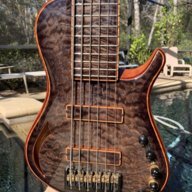
Steinberger made one years ago. The knob stuck out of the "headstock" at the end. It did not look as simple as that though. The Steinberger one was kind of ugly, even for a Steinberger (and I play a Steinberger).
http://steinbergerworld.com/
Click on photos and images, then under prototypes.
http://steinbergerworld.com/
Click on photos and images, then under prototypes.

Yeah, but Dominique could make a paper bag full of turds sound great- he is truly a master. Still.....Hmmmmmmmmmmmm.Gotta admit that the bridge always sounded good when Dominique played it. Every once in a while I think it would be cool to get one on a bass. Hmmmmmmmmmmmm.

I can't help wondering if this isn't illegal under the same laws as switchblades and concealed weapons. 
Seriously, cool idea, but not sure how well it would work in execution. Seems to me that the moving parts and joints are extra things to vibrate and make unwanted noise...
Seriously, cool idea, but not sure how well it would work in execution. Seems to me that the moving parts and joints are extra things to vibrate and make unwanted noise...

It's made by Mikey guitar - the neck has no radius and the frets roll over from a rounded side to a flat side. As stated before, how do have good action for both?
This bass hasn't been posted in a while. For a while it was a once a per week or more type of thing. Anyway, decent concept, although you're really left with a fretless with high action. It's also pretty darn expensive, to the point where you could easily get a nice fretless and nice fretted bass for about the same money.
Didn't someone figure that you could buy a really nice fretless and a really nice fretted bass guitar for the same price as that one instrument.
I've thought about this for many years. It's possible to have a radiused fingerboard w. matching frets. But as you say, how to have correct action for both modes? IMO you need to raise and lower the nut and bridge saddles as well as the frets, but then it goes out of tune, so that's no good.It's made by Mikey guitar - the neck has no radius and the frets roll over from a rounded side to a flat side. As stated before, how do have good action for both?
An alternate approach would be to raise and lower the fingerboard instead of the frets, but then to have a smooth surface in fretless mode the frets would have to be flat with no crown, also no good.
So really, to do it right, you have to both raise and lower the fingerboard, AND rotate the frets- a mechanical nightmare.
Still, my hat's off to the maker for having the determination to get as far as he did.
I've thought about this for many years. It's possible to have a radiused fingerboard w. matching frets. But as you say, how to have correct action for both modes? IMO you need to raise and lower the nut and bridge saddles as well as the frets, but then it goes out of tune, so that's no good.
An alternate approach would be to raise and lower the fingerboard instead of the frets, but then to have a smooth surface in fretless mode the frets would have to be flat with no crown, also no good.
So really, to do it right, you have to both raise and lower the fingerboard, AND rotate the frets- a mechanical nightmare.
Still, my hat's off to the maker for having the determination to get as far as he did.
Ot, you can also run the switch to the bridge somehow and lower the action...
Ot, you can also run the switch to the bridge somehow and lower the action...
If you've ever dropped a saddle, the first thing you'd notice is that it goes flat.


