• TalkBass has been independent since 1998. Add your voice.
    Create a free account to reply to discussions, view embedded media, and browse with fewer display ads.
    Join freeLog in
    Want zero display ads or expanded classifieds tools? Compare plans.

Fretless dilemma.

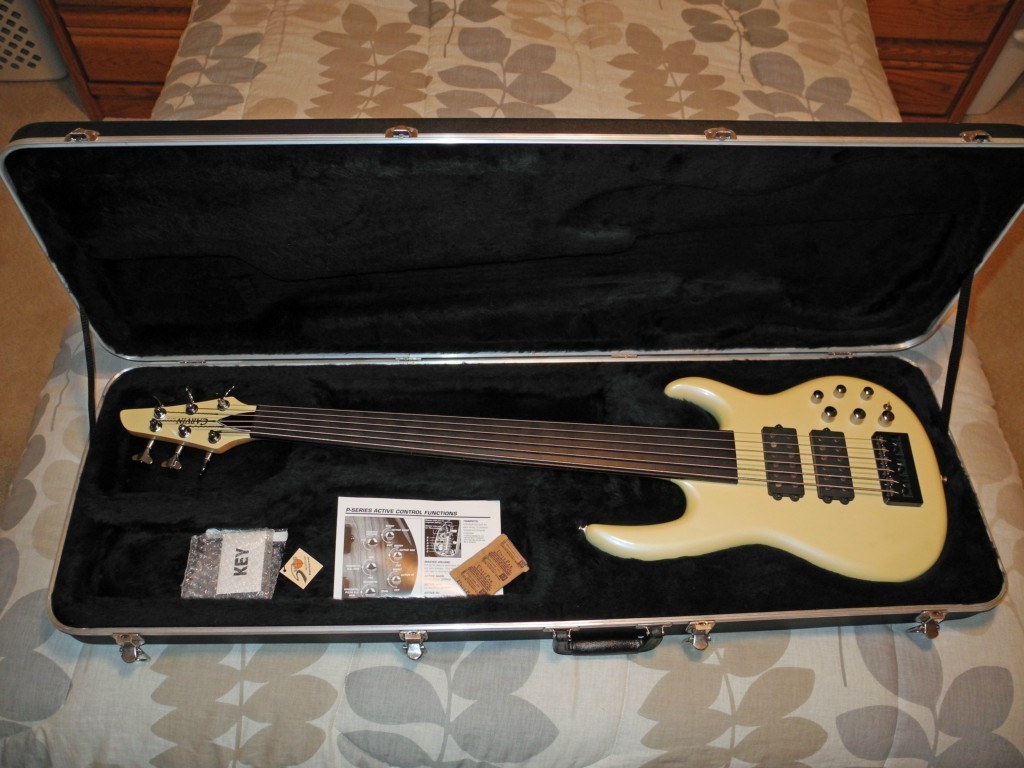
They're out there. I snagged this used Carvin LB76PF fretless with piezos for $600.
3.jpg


34" scale.

Nice! I just looked up @ their website - apparently Icon 6 can be fretless too. Haven't seen any of those though. Neck through sounds very tempting :-)
 
Speaking for the dean. I had been playing an Ibanez 6 string for a year and moved to a defretted dean edge 6 string. I love the sound of it it personally sounds great to me. Admittedly the move from 34' to 35' took some getting used to but it wasn't too difficult
 
As an eBay Associate, TalkBass may earn a commission from qualifying purchases.
I see fretless 6'ers in the TB classifieds regularly.
Question for the OP - in your post, it wasn't clear if you regularly play a 5 or a 6, and you ask "is there any reason the C would get in the way?"
Musically no, but the ergonomics of 5 and 6 are very different. 5's fit me right, and I feel uncomfortable on 6's. That's just me, but it's worth checking out if you haven't done so yet.
 
I see fretless 6'ers in the TB classifieds regularly.
Question for the OP - in your post, it wasn't clear if you regularly play a 5 or a 6, and you ask "is there any reason the C would get in the way?"
Musically no, but the ergonomics of 5 and 6 are very different. 5's fit me right, and I feel uncomfortable on 6's. That's just me, but it's worth checking out if you haven't done so yet.

I got a gvb36 a couple of weeks ago and in the process of adapting... Love it so far!!! Played only 4 before that. What in a 6 string makes it uncomfortable for you? The only issue I have so far is muting, but I'm getting there slowly :-)
 
Trying to figure out should I get a fretted 6er and defret it, get a fretless 5er or save money towards fretless 6er.
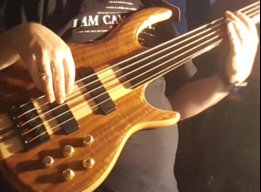
If you want a 5er get a 5er. Lots of fretless 5ers out the. (My G&L L2500 lined fretless is my main axe and blows anything away...little over $600 used)

If you want 6er (and note that this a MUSICAL choice depending on what kind of music you play and your tastes) and you should know that from playing fretted, then a 6 string fretless gets to be a problem. My only fretless 6er for years was my Alembic blank plank Epic and it was WAY too much bass for me for a LONG time! It was the only fretless 6er I had til recently.

As others have said, if you don't play 6ers or 5ers there are damping and neck width issue that immediately arise that you'll have to deal with. And that is in Addition to the fretless issues.

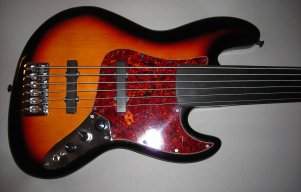
Anyway, given I've got lots of fretted 5ers, 6ers, and 7ers, that is no longer a problem. But the availablity of fretless 6ers was. I got taken with the Steve Bailey idea of a Fender jazz 6er. So I bought 3 SX six string jazz bass clones with the idea of making one fretless. The original thought was defretting. Decided that was a bad idea. You have to do the work of putting laminates in the slots to keep the neck strength, you don't have the cool blank plank look plus you are stuck with a maple or rosewood fingerboard which to me does not have the fretless tone of ebony.

The answer was clearly to steam iron the fingerboard off the SX and glue on a pre-radiused ebony fingerboard from luthier supply. This created a truly ASTOUNDING fretless Fender-like bass. The look. The tone. The feel. It's ALL there!

So great infact, that I'm still not satisfied! Next up is a fingerboard replacement and conversion on my Ibanez SR 506! I strongly suggest this over a simply defret. Another problem with defret is that it leaves side markers in the wrong place for fretless. IF you can't SEE the ends of the fretlines it makes playing the bass a chore.

Think about it.
 
Totally excellent points although, from experience and knowledge of physics, I can tell you that it's a myth that you have to fill fret holes with laminate. You'd have to have the exact width to fit perfectly in there UNDER PRESSURE for it to have any strength benefit... And that's impossible ... Sorry.... Very difficult... since there's no way to get laminate in under pressure that will get better strength than proper wood glue based filler.

Just fill with glue and wood pulp mix or even good quality wood filler... I've done both with good success that lasted years before I sold each bass (they were both not great basses in the first place)

But yea... Fingerboard replacement is a BRILLIANT idea.... I never thought of that! Clever boy...
 
If you want 6er (and note that this a MUSICAL choice depending on what kind of music you play and your tastes) and you should know that from playing fretted, then a 6 string fretless gets to be a problem. My only fretless 6er for years was my Alembic blank plank Epic and it was WAY too much bass for me for a LONG time! It was the only fretless 6er I had til recently.


Think about it.

Well, I have a fretless 4 and fretted 4s and just got a fretted 6 - love it so far! I just wish Ibanez had a fretless 6 - I love their necks: perfect fit for my small hands.

Replacing a fingerboard is something that I'm not sure I want to do myself. :-/
I'm ok with pickup/pre replacing (did that on 3 of my 4 basses), but woodwork on bass is outside of my comfort zone.
 
Totally excellent points although, from experience and knowledge of physics, I can tell you that it's a myth that you have to fill fret holes with laminate. You'd have to have the exact width to fit perfectly in there UNDER PRESSURE for it to have any strength benefit... And that's impossible since there's no way to get laminate in under pressure.

All points untrue:

- Yes you do have to fill the slots with something of equivalent strength. Once the frets are removed, the neck is suddenly thinner by the depth of the deepest fret slot. On some basses, that's practically all the way through the fingerboard on one or two slots. Try stringing the instrument up without the frets in the neck; try to get all the relief out of it with the truss rod and you'll see what I mean.
- Yes you can get a laminate like maple veneer or plastic binding in the slots under sufficient pressure. Most fret slots are about .020" which is nearly a perfect fit for veneer available from Rockler and elsewhere. Also, when you soak the veneer with adhesive during installation (eg. CA glue) it becomes much harder than the original wood once cured. Install and glue with a little backbow in the fingerboard to help it out a bit.
- If the slots have been wallowed out more than .020, just get slightly thicker material and sand down for a good fit.
- You can, with a lot of care, get a filler to do almost the same thing, but wood veneer or plastic binding is a much easier job and the results are usually a bit better in the end.

LS
 
And yet experience and the laws of physics back me up. I agree that you can get laminate in there... But it's not any stronger than wood glue, which is the primary ingredient in appropriate wood filler or glue plus sawdust.

Anyhow, there is endless discussion in this topic that will remain unsolved here... I'm not a luthier, just a musician and software engineer.

I've had different highly regarded luthiers use both techniques on my good instruments with great success that lasted decades.

Undeniably though --- replacing the fingerboard is the sexist solution :-)
 
And yet experience and the laws of physics back me up.
How do the laws of physics back you up?
I agree that you can get laminate in there... But it's not any stronger than wood glue, which is the primary ingredient in appropriate wood filler or glue plus sawdust.

That's not what you claimed. What you said is it's impossible to get laminate in the slots under pressure. That's just completely wrong. I've done it and so have many other defretters.

LS
 
How do they not?
No, you made the claim - it's your responsibility to back it up when it's challenged.
I don't have time to teach them but would like to know how wood glue based fillers aren't as strong or hard as hardwood.

Again, that's not what you claimed. Your claim was that laminate is "impossible" to get into the fret slots under pressure. And that somehow "the laws of physic back you up".

I simply want to know how the laws of physics back this claim up for you?

LS
 
I thought I said sorry already for the poorly worded first way I wrote it which is why I changed it.... And no. I don't have to prove that physics works thanks. I have better things to do with my life after doing that stuff at university 25 years ago.

I wasn't trying to start an argument... I think I've clearly stated that both methods work and there are luthiers who successfully use both techniques.

My original intention was to claim that both methods work and that it's a myth that laminate will end up being better in the real world in the end.
 
No, you made the claim - it's your responsibility to back it up when it's challenged.


Again, that's not what you claimed. Your claim was that laminate is "impossible" to get into the fret slots under pressure. And that somehow "the laws of physic back you up".

I simply want to know how the laws of physics back this claim up for you?

LS

It's not simple teaching someone all of the physics required and I get the feeling that you would ask me to reference my old text books with page numbers. What's the point? Its not a big deal.

I personally know that laminate is not required for great fret hole filling that lasts the life of the bass. Disagree if you like. I was trying to help the guy out so he doesn't try what is IMHO the more difficult solution (laminate) when wood filler is perfectly good and easy to use.

Relax and enjoy the ride :-)