
I have this cherry Status S3000 body and pickups. I need a fretless bass so I thought about using this body as a base.

TalkBass has been independent since 1998. Add your voice.
Create a free account to reply to discussions, view embedded media, and browse with fewer display ads.
Join free Log in
Want zero display ads or expanded classifieds tools? Compare plans.




@RichterScale nailed it. Awesome.
@MPU you must be a favoured teacher where you work.


Can you talk about bedding the truss rod in epoxy? I've not done that before, but considered it based on the improved tone of a compression/tension rod. I've presumed encasing everything is what makes a c/t rod sound better and wondered about how this could potentially be adapted to a regular double acting double rod.View attachment 4795266
I was bored laying on the sofa so I went to the garage and routed the truss rod slot. I waxed the rod and kind of bedded in the slot with epoxy. Fingerboard slotting next. I’m not sure if I slot it like fretted or only on the side. I haven’t played a fretless before and it might be easier if I had fret lines. But the looks is not as nice as unlined. What do you fretless players say?
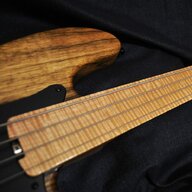
My defretted bass has sawdust & epoxy filling the slots, so they're noticeable to me while I play but not when I look at the bass in its stand. I'm happy with this arrangement, because I like lines (particularly when I play above 8th stop or so; I can keep intonation reasonably well without looking at the lower reaches), but they stay subtle enough to not break up the appearance of a clean fingerboard. So my answer is to have visible side dots and maybe a very slightly contrasting wood on the board. It might seem like a lot of work for not much result, but it's more useful than it seems, and possibly less work than short (<1cm) lines only at the top of the fretboard.Fingerboard slotting next. I’m not sure if I slot it like fretted or only on the side. I haven’t played a fretless before and it might be easier if I had fret lines. But the looks is not as nice as unlined. What do you fretless players say?
View attachment 4794916 View attachment 4794918
After some cutting of excess cf, planing and sanding I have one neck blank ready for routing truss rod slot plus one dull hand plane. One touch of cf laminate dulls the blade very efficiently.

View attachment 4795266
I was bored laying on the sofa so I went to the garage and routed the truss rod slot. I waxed the rod and kind of bedded in the slot with epoxy. Fingerboard slotting next. I’m not sure if I slot it like fretted or only on the side. I haven’t played a fretless before and it might be easier if I had fret lines. But the looks is not as nice as unlined. What do you fretless players say?
 I have looked at the fingerboard while playing for my whole life and it is a hard habit to break.
Well my thinking is that the less loose parts there is in the neck the better. Bedding makes a very tight fit and eliminates all possible rattles or resonating parts in the neck. I've done it before and I think it works. Just make sure that everything that needs to move is still moving after the epoxy is cured. Waxing the rod and greasing the threads to prevent epoxy sticking to threads is essential.Can you talk about bedding the truss rod in epoxy? I've not done that before, but considered it based on the improved tone of a compression/tension rod. I've presumed encasing everything is what makes a c/t rod sound better and wondered about how this could potentially be adapted to a regular double acting double rod.

Well my thinking is that the less loose parts there is in the neck the better. Bedding makes a very tight fit and eliminates all possible rattles or resonating parts in the neck. I've done it before and I think it works. Just make sure that everything that needs to move is still moving after the epoxy is cured. Waxing the rod and greasing the threads to prevent epoxy sticking to threads is essential.