

Enjoy the benefits of a premium membership!
Upgrade Account
-
TalkBass has been independent since 1998. Add your voice.
Create a free account to reply to discussions, view embedded media, and browse with fewer display ads.
Join free Log in
Want zero display ads or expanded classifieds tools? Compare plans.
You are using an out of date browser. It may not display this or other websites correctly.
You should upgrade or use an alternative browser.
You should upgrade or use an alternative browser.
Fretless newbie
- Thread starter bcoomes
- Start date
More options
Who Replied?
I know I need fret markers (training wheels) and I would prefer passive pups. I'm open to 5 strings (even though I've never owned a 5 string - hey, if I'm going to venture into new territory, why not go all the way?). I'm open to new or used (leaning toward used).
Don't go 5-string, AND fretless until you've done one or the other pretty well, imho. Eh strings? just use groundwounds - I've had them on my fretless Ampeg AMUB since they came out, and only had to plane the ebony fingerboard once, and only after about 20 years of hard use. With a $400 bass, you really needn't worry much anyway.
But that wasn't really your question, was it? First of all, you don't really need those "training wheels" like you might think. My Ampeg just has tiny dots on the side of the neck (between the theoretical fret locations), and nothing else. Fretless is more a concept thing.
With fretless, it's really about using your ear primarily, and a bit of muscle memory to find your notes. Think of it like singing - there's no fret markers there in your throat, right? Fretless bass is almost exactly like singing. To orient a beginner on fretless, I'd start with you finding the 7th-fret octave location on the neck, and ringing a D in tune on the G string, along with the open D string guiding your finger to that perfect in-tune sweet spot. Do it for the other 3 strings. Once that's a solid location for you, start playing some other notes along with the open D string to find other in-tune spots, always playing against an open string to keep you in tune. Do the same, playing notes with open A and E strings, and locate all your scale notes.
When you're comfortable with that, then find a fun, repetitive pattern you like to play and once you are playing it in tune most of the time, just close your eyes and keep playing it until your ear 'sees' where your hands need to go to play in tune, and your hands are responding. You really need to feel and hear it with your eyes closed, and get to that point asap. In no time, you'll be playing in tune all the time and rarely even notice whether you even have fret markings or not.
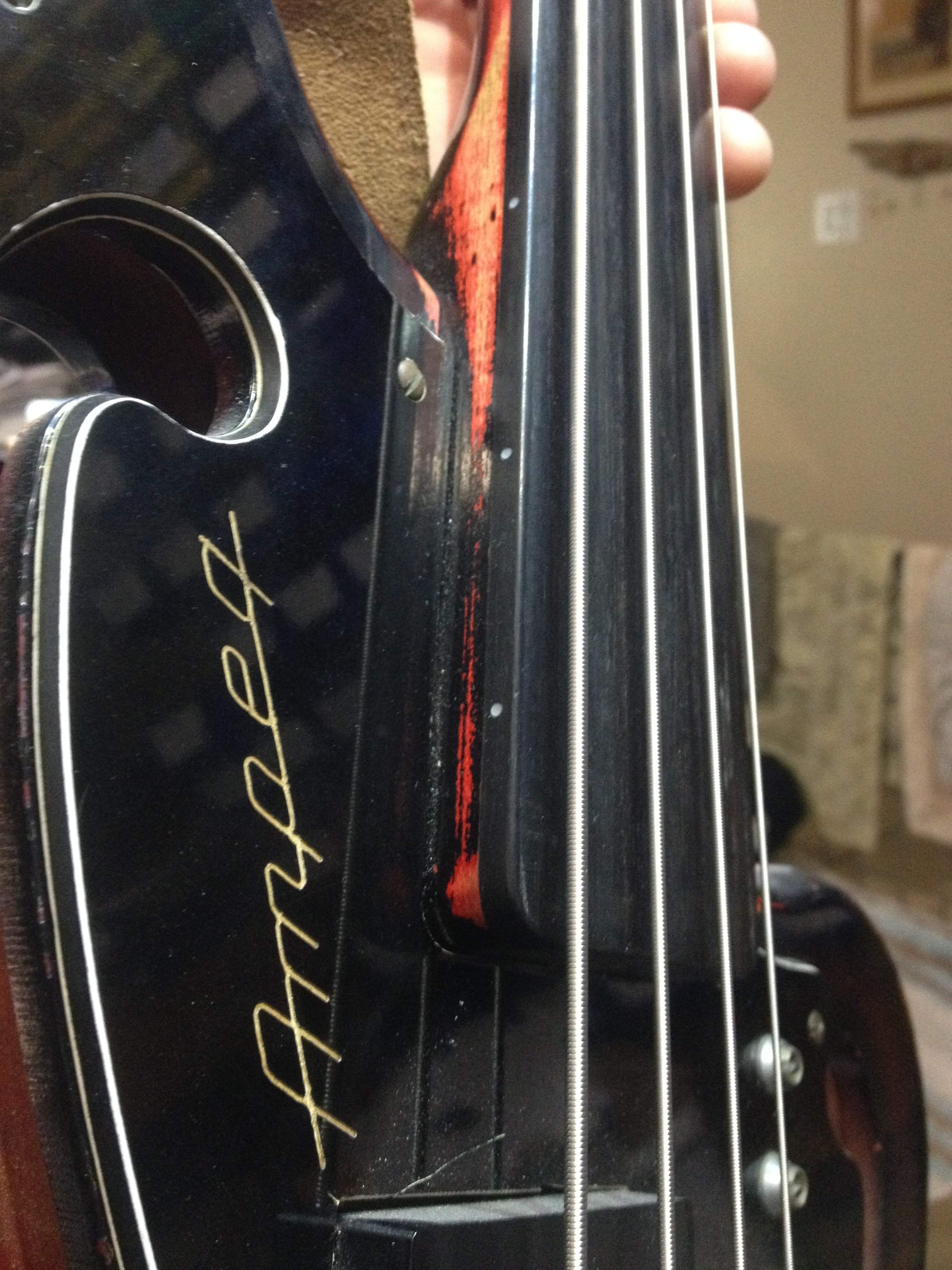
Don't go 5-string, AND fretless until you've done one or the other pretty well, imho. Eh strings? just use groundwounds - I've had them on my fretless Ampeg AMUB since they came out, and only had to plane the ebony fingerboard once, and only after about 20 years of hard use. With a $400 bass, you really needn't worry much anyway.
But that wasn't really your question, was it? First of all, you don't really need those "training wheels" like you might think. My Ampeg just has tiny dots on the side of the neck (between the theoretical fret locations), and nothing else. Fretless is more a concept thing.
With fretless, it's really about using your ear primarily, and a bit of muscle memory to find your notes. Think of it like singing - there's no fret markers there in your throat, right? Fretless bass is almost exactly like singing. To orient a beginner on fretless, I'd start with you finding the 7th-fret octave location on the neck, and ringing a D in tune on the G string, along with the open D string guiding your finger to that perfect in-tune sweet spot. Do it for the other 3 strings. Once that's a solid location for you, start playing some other notes along with the open D string to find other in-tune spots, always playing against an open string to keep you in tune. Do the same, playing notes with open A and E strings, and locate all your scale notes.
When you're comfortable with that, then find a fun, repetitive pattern you like to play and once you are playing it in tune most of the time, just close your eyes and keep playing it until your ear 'sees' where your hands need to go to play in tune, and your hands are responding. You really need to feel and hear it with your eyes closed, and get to that point asap. In no time, you'll be playing in tune all the time and rarely even notice whether you even have fret markings or not.


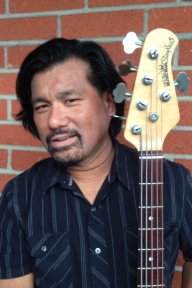
Fretless isn't as hard as you think it is...and I'm talking about unlined fretless. If you play unlined, just refer to the dots on the side of the fretboard. Also, if you're too worried about intonation, get used to playing with vibrato -- not by bending the string side to side like on fretted bass, but by slightly moving your finger back and forth parallel to the string. It requires some practice, but you can "mask" slightly off-tune notes by using vibrato.

...but you can "mask" slightly off-tune notes by using vibrato.
Vibrato should be used to express or emphasize something in a bass line, not to mask bad technique. Get in the shed and get it right!
I have to agree.Vibrato should be used to express or emphasize something in a bass line, not to mask bad technique.
Listen to some of the fretless masters - Jaco, Manring, Mark Egan - on their lightning-fast runs.
There is no time for vibrato or rolling to pitch.
Sure - if there -is- time, and you notice the note is off-pitch, by all means correct it. But try harder to hit it right the next time.
This, IMO, is where patience is required in the early learning stages.
If you are off-pitch (and you will be, some of the time) it's good to recognize it. If there's time to roll it to pitch without losing the groove, do it. But you have to teach your fingers to move to the right place the first time. The fact that the stops get closer together as you move down the neck means you have at least 12 positions on each string to ingrain into muscle memory. You never stop listening, but it should be a conditioned reflex. This conditioning takes time.

To the OP: Aside from the issue of how much roundwounds do or do not chew up fretless boards, I strongly recommend using TI Jazz Flats on your fretless. This is for considerations of sound, playability and durability. And don't be scared off by their price; in actuality they are among the cheapest strings you can buy.
Absolutely right. I am playing an unlined fretless these days (after having played lined fretlesses quite a bit in the past). This time around, I have adopted the habit of practicing in the dark, or at least without looking at the fingerboard. And I am concentrating on hitting the notes right the first time, without vibrato or rolling to pitch. It's all about muscle memory.I have to agree.
Listen to some of the fretless masters - Jaco, Manring, Mark Egan - on their lightning-fast runs.
There is no time for vibrato or rolling to pitch.
Sure - if there -is- time, and you notice the note is off-pitch, by all means correct it. But try harder to hit it right the next time.
This, IMO, is where patience is required in the early learning stages.
If you are off-pitch (and you will be, some of the time) it's good to recognize it. If there's time to roll it to pitch without losing the groove, do it. But you have to teach your fingers to move to the right place the first time. The fact that the stops get closer together as you move down the neck means you have at least 12 positions on each string to ingrain into muscle memory. You never stop listening, but it should be a conditioned reflex. This conditioning takes time.
I am reminded of what my upright bass teacher (who happened to be my son) told me when I would look at the fingerboard trying to find a note: "Why are you looking there, dad? There's no information there."
Well, perhaps my opinion on the lined vs unlined question may be useful precisely because I've JUST started playing fretless after quite a lot playing fretted: I don't know if it's just me, but I sometimes have the impression that the lines make me rely too much on them, kind of creating some sort of dependency (I hope this word makes sense, English isn't my primary language and I have never lived in any English-speaking country).
I don't look at the fingerboard even half of the time I'm playing fretted, so why do I feel the need to look at it *all the time* when playing fretless? Because I'm afraid of playing out of tune, of course. But will the sight of the fingerboard keep me in tune? Well, a bit, but from my short experience this bit really isn't enough. There's no info there, as the fellow TBer's son said. Well, at least not much info... I am looking at the fingerboard all the time and I have no problem at all spotting notes out of tune by ear, still I am getting a lot of them out of my bass. So I have to work on muscle memory. That's the only conclusion, I think.
To put it short, I feel the very beginning would be harder without fretlines, but I think it would be better for my technique in the long run. My solution now is forcing myself not to look, but it's very difficult not to look. Harder then it would be to play without the fretlines, I guess.
Good luck!
I don't look at the fingerboard even half of the time I'm playing fretted, so why do I feel the need to look at it *all the time* when playing fretless? Because I'm afraid of playing out of tune, of course. But will the sight of the fingerboard keep me in tune? Well, a bit, but from my short experience this bit really isn't enough. There's no info there, as the fellow TBer's son said. Well, at least not much info... I am looking at the fingerboard all the time and I have no problem at all spotting notes out of tune by ear, still I am getting a lot of them out of my bass. So I have to work on muscle memory. That's the only conclusion, I think.
To put it short, I feel the very beginning would be harder without fretlines, but I think it would be better for my technique in the long run. My solution now is forcing myself not to look, but it's very difficult not to look. Harder then it would be to play without the fretlines, I guess.
Good luck!
My first FL was lined and I found it to be more distracting than helpful. That's just me and the way my brain is wired. I don't think there's anything wrong with lined boards - I'm not about to tell Gary Willis, Mark Egan or Jimmy Haslip that they're wrong - but it's a good idea to try both and see which works out best.
Muscle memory is great and is certainly worth practicing (and practicing, and practicing) but electric FL is much different than upright. On an upright bass, the expanse of fingerboard that has no physical 'landmarks' is fairly short and the scale is much longer so there's a bit of room for intonation error (not a lot, but a bit). On a FL electric, however, most of the neck is extended past the heel, so there's nothing physical for your hand to feel for during big jumps. That means needing to look every now and again. It also means a whole lot of ear training.
I don't think there's anything wrong with looking at markers on FL if that's what keeps you in tune. I look at my edge dots often and make no apologies for it. I've also played entire sets on FL without the bandleader realizing I was playing FL, so I guess my intonation's okay....
Muscle memory is great and is certainly worth practicing (and practicing, and practicing) but electric FL is much different than upright. On an upright bass, the expanse of fingerboard that has no physical 'landmarks' is fairly short and the scale is much longer so there's a bit of room for intonation error (not a lot, but a bit). On a FL electric, however, most of the neck is extended past the heel, so there's nothing physical for your hand to feel for during big jumps. That means needing to look every now and again. It also means a whole lot of ear training.
I don't think there's anything wrong with looking at markers on FL if that's what keeps you in tune. I look at my edge dots often and make no apologies for it. I've also played entire sets on FL without the bandleader realizing I was playing FL, so I guess my intonation's okay....

I played a fretless Washburn at GC the other day with flats and I just didn't like the feel of them at all. I've only ever played rounds, so that's what I'll stick with for now. If I start to see any significant damage I'll consider switching to flats. I think it will be ok because my P will remain my main bass using the fretless for certain songs. I might even use the fretless for certain parts after looping a bass line with the P. I'm definitely going to be experimenting for a while. And I forget who said I should stick to 4 strings, but he's right. I played a 5 string that same day and it felt very foreign. Maybe I'll try 5 again some day (or maybe not).
The first time you use them flats may seem strange on the fingers, but you get used to them rather quickly. It's difficult to know for sure now, when you have just tried them for the first time and not in your own bass, if you'll like them after a while. My opinion is that you should think in terms of the sound you're after.
I remember that the first time I put flats on my bass it felt strange too. Now it's like 7 years since then and I don't even consider getting back to rounds, at least not in my fretted bass. Sometimes I have to do it because I have only one fretted bass and I feel the sound of rounds will fit better in this or that band, but everytime it happens I regret it and I curse those strings while I'm playing...
Edit: I don't mean to despise roundwound strings. It's just a personal thing.
I remember that the first time I put flats on my bass it felt strange too. Now it's like 7 years since then and I don't even consider getting back to rounds, at least not in my fretted bass. Sometimes I have to do it because I have only one fretted bass and I feel the sound of rounds will fit better in this or that band, but everytime it happens I regret it and I curse those strings while I'm playing...
Edit: I don't mean to despise roundwound strings. It's just a personal thing.

+1Although their selection is a little limited right now, check out Rondo Music and the SX line. Under $150 shipped, so there's no big investment if it doesn't work out, AND they are great modding platforms if you do like it. You can upgrade the pickups, neck, tuners, bridge, or whatever and stay in that $400 ballpark.
Picked up a SX short scale jazz fretless with the old head stock from a locale TBer. Swapped out the pick ups with Fender American from a TBer on line and spent a total of $160. It turned out to be a better sounding bass than my Squier VM jazz so that one hit the road. I use my SX when I go out for those all night beer guzzlers. No worries about it getting run over after midnight.


