• TalkBass has been independent since 1998. Add your voice.
    Create a free account to reply to discussions, view embedded media, and browse with fewer display ads.
    Join freeLog in
    Want zero display ads or expanded classifieds tools? Compare plans.

Fretless players; lined or unlined? and why?

Lined or unlined?

  • Lined

    Votes: 108 31.5%
  • unlined

    Votes: 182 53.1%
  • carrots

    Votes: 53 15.5%

  • Total voters
    343
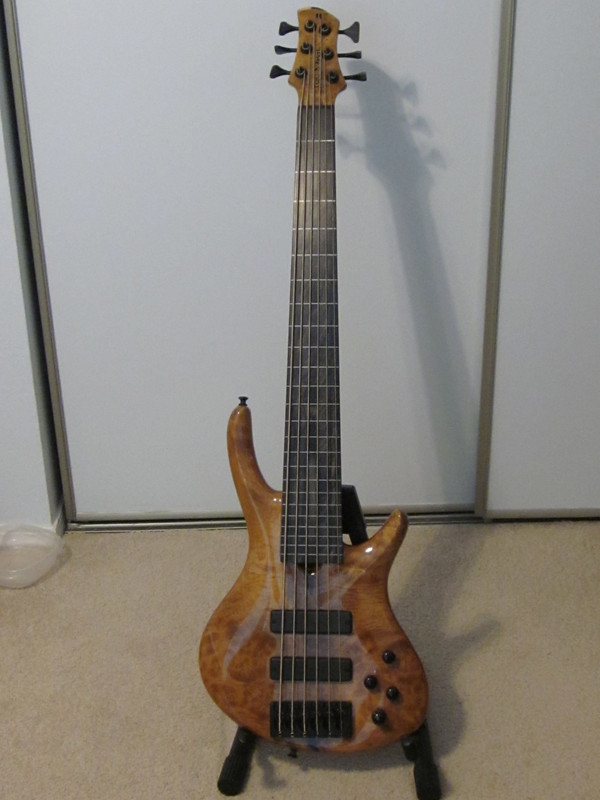
IMG-0140-1.jpg

IMG-3429.jpg


The first photo is my unlined 42" scale fretless. The second photo is my 35" scale lined fretless. Play the bass that inspires you. Lined or unlined? Your choice.
 
Now, the bass in this pic is just masochism for tuning LoL. :)

If you can do that at studio quality tuning repeatedly and reliably then I tip my hat to you!
Well, I'm not going to the studio any time soon, but in practice the differences in note positions from string to string and even skipping a string are so minorly different for typical reaches that it doesn't feel any more difficult to play relatively in tune compared to monoscale fretless. I don't play chords larger than double stops, maybe triads and that's rare, particularly on fretless, so that's a non-issue, too.

I haven't had a fretless around for a couple years, so it'll be a while before I'm confident enough to play this in front of anyone else who appreciates notes being played in tune.
 
  • Like
Reactions: dkelley
I have both, and generally prefer the unlined basses. I learned how to play bass on an unlined fretless, so that is where I am at home. Part of it is the look of a clean unlined fretboard, part of it is that I like the challenge of getting my intonation right without the aid of lines. That's just what I like though.
Just revisiting. I voted carrots a while ago.

I initially thought unlined was the way to go because I thought they just looked better. But after picking up a lightly lined fretless that even has dots on the FB, I was convinced that its fine either way. Definitely easier lined for a beginner.
 
  • Like
Reactions: MonetBass
Well, I'm not going to the studio any time soon, but in practice the differences in note positions from string to string and even skipping a string are so minorly different for typical reaches that it doesn't feel any more difficult to play relatively in tune compared to monoscale fretless. I don't play chords larger than double stops, maybe triads and that's rare, particularly on fretless, so that's a non-issue, too.

I haven't had a fretless around for a couple years, so it'll be a while before I'm confident enough to play this in front of anyone else who appreciates notes being played in tune.
fair enough ;-)
 
I remember my violin teacher putting little thin masking tape on my fiddle until I got the hang of Ist position.

:)
It's funny.. that's a very popular technique these days, and as a professional violin teacher myself, I personally dislike it and don't use it with my students. It isn't really nearly as helpful on violin as it is on something like a fretless bass, because you're looking down the neck at your fingers... the distances are super close together also. I'm not saying it doesn't work... but you will never see a violinist using that other than a raw beginner, and when I learned, I didn't use that, and my teacher just played the notes on piano at same time and ensured I was playing in tune, and taught me to listen for it and fix it right away.
IMG-0140-1.jpg

IMG-3429.jpg


The first photo is my unlined 42" scale fretless. The second photo is my 35" scale lined fretless. Play the bass that inspires you. Lined or unlined? Your choice.

For those not grasping the points he's making in this excellent post, (maybe haven't played upright, for example), full scale (or even 3/4) upright is totally different to play than fretless electric 34", since upright's huge scale requires different fingering (electric scale length is always (with ideal technique, at least) one semitone per finger, which is impossible with upright in the lower positions), and upright has a very short neck before you reach the body and thumb positions, so you can easily feel where you are and change hand shape dramatically in various positions to play correctly.

electric doesn't offer those feel changes or hand shape change requirements, and we have up to 1.5 octaves before we hit the neck join or body on some instruments.
 
I just want to use this post to point out that we are talking about fretless bass here, not fretted. Note that I added the bold underlined italics part, above, to the comment I'm quoting.

Regarding the criteria for what we are supposed to be focusing on.... this commenter said that we're "not supposed to be focusing on finger position but on making the note".... however, on fretless bass, finger position dictates if we are playing the note in tune or not. Therefore, we literally MUST focus on finger position on fretless... not so much on fretted if you don't want to. But on fretless? Finger position is critical.

I'm just using your post as a foundation for a summary of my earlier thoughts, which is this:

Playing in tune is just as important as playing on time. Being in tune is part of making music. Playing out of tune gets people fired from recording sessions (or black-listed to never get hired again from live gigs).... I watch it happen regularly.

Now, if we are not in a critical gig where tuning is super important - that's fine. Playing in tune has always been critical in the music I've made and for those who I have performed or recorded with. Some of them are exceptionally picky, where fretless is literally required because the tuning on a chord required the bass note to be a few cents sharp to mesh with the brass, or whatever.... because tuning is not mathematically perfect on fretted instruments. However the best way to REPEATEDLY and RELIABLY accomplish such minute tuning adjustments on fretless bass, from my own experience, is with a lined instrument where you can clearly place your finger on the exact spot over and over again, even if that spot is not directly stopped at the edge of the line.
I know I meandered over to fretted but my focus was fretless. I began on upright in the last century. I gig 50% on upright. I probably got too cerebral but not playing notes properly on a fretted is sloppy too. It sounds it. Proper placement before the fret is ideal. The note sounds pure.

I confirm what you wrote. I add that if you are playing music you at some point stop concentrating on where your fingers are and make the note. You want to hear the correct note. Any instrument. Any instrument. :)
 
Last edited:
Lined looks silly to me. Just put he time into learning without. It's more rewarding when you do so. Lined fingerboards are there to make it easier. That's true. Why else would they be there? Fretless instruments throughout history don't have lines. And if you like lines, awesome. Be happy with what you like. Without is harder to learn which makes it more satisfying. The saying goes.. the things you work hardest at are the things you appreciate the most.
 
It's funny.. that's a very popular technique these days, and as a professional violin teacher myself, I personally dislike it and don't use it with my students. It isn't really nearly as helpful on violin as it is on something like a fretless bass, because you're looking down the neck at your fingers... the distances are super close together also. I'm not saying it doesn't work... but you will never see a violinist using that other than a raw beginner, and when I learned, I didn't use that, and my teacher just played the notes on piano at same time and ensured I was playing in tune, and taught me to listen for it and fix it right away.
I was raw and this was like 55 years ago. All I remember about it was, it my my finger board sticky.

:)
 
  • Like
Reactions: dkelley
Given that I primarily play a (lined) fretless in the main band I play in, I’ve never understood the idea that you learn intonation by ear vs. familiarity and muscle memory because all hearing the intonation is going to do on an unfamiliar bass is hammer home how horribly out of tune you are. I hardly ever have to look at my fingers and the fretboard, but… I can.
 
Before my left hand got messed up, I played by way but mostly by reflex. I wasn’t that good but I wasn’t bad either. I bought a lined1997 Fnder J fretless and I couldn’t nail I. It wouldn’t ntonate correctly. On open, yes, but if you put your fingers right on the lines it could and most likely would be off.
i even took it to a top luthier who was an experienced fretless player himself, and he said the same thing. Evidently the MiM neck lines were off. He told me to ignore them and work solely on ears and feel. It was tough but it payed off.
I also have an unlined fretless that has a few side markers that are dead on. I like that better. I’m might take my Fender and get a blank plank neck for it.
We’ll see…
 
My mom was a music teacher. In my thirty's, she gifted me (a sort of Birthday/ Christmas present ) two custom basses, which I commissioned and had built by Doug Roomian, in San Francisco. Sadly the fretted Jazz one, was stolen in Sacramento. If anyone sees an odd colored, “Oxblood Red” Roomian Jazz bass it’s mine! lol . One of one. I also had a Fretless bolt on PJ made with a center of maple and both body wings are sold Koa. It’s aged with bumps and bruises but a beautiful nitro finish crackle. Heavy Ebony slab. It has an almost cello arc to the fretboard. I have no problem playing without lines. I started on Upright bass 60+yrs ago at age 10.
IMG_0187.jpeg
IMG_0186.jpeg
IMG_0185.jpeg
 
Unlined, because I bough it purely by accident/luck. :D
I always wanted a cheapo fretless just to get started on it, practicing etc. But saw a used vintage USA Spector on Guitar Center for $1400 and of course I couldn't resist, and those were built unlined.
And it turned out that only 39 fretless Kramer era Spector were ever made, and mine is the only solid red out of the 39.

It was well worth and I couldn't ever imagine that my first fretless will be a high end USA instrument.
received_1473360870172746~2.jpeg
 
I remember my violin teacher putting little thin masking tape on my fiddle until I got the hang of Ist position.

:)

It's funny.. that's a very popular technique these days, and as a professional violin teacher myself, I personally dislike it and don't use it with my students. It isn't really nearly as helpful on violin as it is on something like a fretless bass, because you're looking down the neck at your fingers... the distances are super close together also. I'm not saying it doesn't work... but you will never see a violinist using that other than a raw beginner...

I recently came into possession of a beginner cello (free) that had the tape lines on it.

I played it like that for a few weeks, and for a few lessons (my teacher disapproved of the lines) But I found it was holding back my progress on properly playing the instrument.

I couldn't see the lines when playing first position, but I could feel them. And I knew they were a crutch so I removed the tape. My intonation has gotten much better and more natural. I know where to position my hand relative to the cello and where it sits in relation to my body.

Disclaimer - I did leave side dots on the cello, similar to a fretless, as a check of my hand position. Can't use them while playing, obviously, but they are an indicator for when I sound out of tune.

I'm usually sharp, but it's frequently a technique issue that needs to get corrected.

Having played fretless bass has certainly been a help to my learning the cello, and the cello neck discipline has helped my bass playing.
 
...
I couldn't see the lines when playing first position, but I could feel them.
...

That is the point - it is the tactile aspect that helps you develop the posture/hand-shape that underpins secure intonation. The visible aspect is the main drawback - they tempt you into trying to watch which in turn messes up your posture. See this from one of my daughter's former 'cello tutors:
Link Removed
 
  • Like
Reactions: DJ Bebop and MVE
That is the point - it is the tactile aspect that helps you develop the posture/hand-shape that underpins secure intonation. The visible aspect is the main drawback - they tempt you into trying to watch which in turn messes up your posture. See this from one of my daughter's former 'cello tutors:
Link Removed

Thanks Steve, I am going to try adding braille dots to the back of my neck.
 
  • Like
Reactions: DJ Bebop
Learned from 3rd grade on cello where you have no lines and don't ever look at your hand. I prefer lined fretless basses. Could I practice on un-lined and get it down? Of course. I just don't want to spend my time doing that, and TBH I like the look of lined fretless electric. A DB or Cello with lines would look silly to me. Go figure.
 
  • Like
Reactions: DJ Bebop

Latest posts