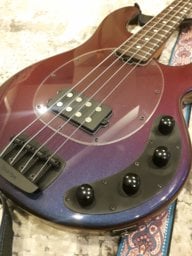
The defret looks like it turned out great. What's with the piece of wood attached to the body behind the bridge with the clip-on tuner? I've seen them attached the the headstock so that theyre out of sight but why the body?

TalkBass has been independent since 1998. Add your voice.
Create a free account to reply to discussions, view embedded media, and browse with fewer display ads.
Join free Log in
Want zero display ads or expanded classifieds tools? Compare plans.

I used to attach it to the bridge screws,but they would fall off.The defret looks like it turned out great. What's with the piece of wood attached to the body behind the bridge with the clip-on tuner? I've seen them attached the the headstock so that theyre out of sight but why the body?



I doubt it, without lines. Played fretless professionally for decades. I can't make the jump accurately if I can't feel or see where I'm jumping to without hearing the note first. And tapping the string to hear it is the only way, and everyone can hear it, not just me.
But... thanks for the vote of confidence... I AM trying to get so good that I can jump anywhere on the neck and nail a note without anything to feel and guide me... practice makes ... well, pretty good




Here are some words from Steve Bailey that I ripped off a Facebook group, which are quite pertinent here;
'Good pitch on any instrument is controlling the pitch, and doing it at speeds that the listener can't hear if that is the intention. Study a great violinists solo in post baroque music. Vibrato is simply controlling in and out of tune... Whether its Yo Yo Ma or Jaco, if you really analyze their expressivity, it is controlled intonation, not perfect intonation. Might as well play fretted if thats what you are looking for.'

I might have already stated this earlier in the thread, but this has been my experience on the FL also. It's not about making your flying, gyrating fingers land in exactly the in-tune place - intonation is something you actively and continuously do for the entire duration of the note. The better you get at it, the faster you can do it to achieve the effect you want, which is why really good FL players sound like they're always landing on exactly the right spot at the start. When in fact, they're not doing that at all. They very rarely are spot-on at the beginning of the note.
To me, that bears on the lined vs unlined thing too. The lines help you get in the neighborhood of where you want to be, but they don't relieve you of the task of controlling your intonation throughout the note. They can help you not have to correct as much at the beginning to achieve your goal for that note, tho, which is a good, useful thing.
Because of that, I've become a lines believer, and I have 2 lined basses now (Fender Jacos). I originally learned on unlined but when I'm not playing much and my skills deteroriate (like is the case these days), the lines help quite a bit. Eventually, I catch up on the unlined if I play and play a bunch, but I don't find the lines a hindrance in either case.
Only if I'm trying to land in the right spot, rather than truly control my intonation, that that lines can goof me up. They can help me do it the "wrong way", if I don't recognize I'm "slacking". But that's my fault, of course, not the fault of the bass having lines...
PS: insisting on not using vibrato of any type, especially when practicing, really helps me work on my intonation control. It doesn't give me the "leeway" of just adding a wiggle to kind of cover it up if I'm not where I want to be, and I have to put it spot-on as close as I can get. Else I get the dying-goat syndrome...
L

Exactly. Another way to state it is, always be suspicious of the guys who say that lines "mess them up" and they have problems with "training bars" etc. That typically means they're trying to master the flying fingers landing in the right place method, rather than learning active, deliberate intonation. The latter being the "right way" to really achieving good intonation control...Interesting thoughts. It's kind of like the fretted, lined, ghost lines, unlined thing is a continuum of practice and intention. If you practice enough and know the music well enough, sure go unlined. But if you've never played the music before and only have chord charts and 5 min till you're on, maybe grab the fretted. And everywhere in between.


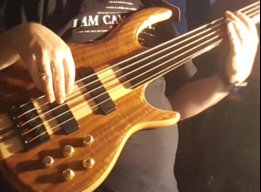
Being a former classical violinist who was getting into the concert violinist solo role before health worked against me, I disagree with that statement because of the laws of physics. a violin, viola, cello and classical bass are far easier to learn to predictively play in tune than electric bass guitar.Here are some words from Steve Bailey that I ripped off a Facebook group, which are quite pertinent here;
'Good pitch on any instrument is controlling the pitch, and doing it at speeds that the listener can't hear if that is the intention. Study a great violinists solo in post baroque music. Vibrato is simply controlling in and out of tune... Whether its Yo Yo Ma or Jaco, if you really analyze their expressivity, it is controlled intonation, not perfect intonation. Might as well play fretted if thats what you are looking for.'

Being a former classical violinist who was getting into the concert violinist solo role before health worked against me, I disagree with that statement because of the laws of physics. a violin, viola, cello and classical bass are far easier to learn to predictively play in tune than electric bass guitar.
scale length, the resulting fingering, and physical cues between positions that exist on all of the classical instruments but do not exist on the bass guitar all define the ability for muscle memory and touchable cues to allow this.
It's a great quote, however ALL violinists, ALL classical bassists (and upright players regardless of genre), all cellist and ALL violists play fretless, and it works just fine. Myself included. We all can do it without looking - with our eyes closed. This is not possible with the fretless bass... without side markers and visual cues. Yes those are part of the instrument, but they are there because of the lack of feelable and gross muscle memory distance cues.
But yea, with visual cues and you looking when needed, it is possible to play fretless bass flawlessly. And because you ONLY have visual cues for position changes until you're up into the second octave of frets, the better the visual cues, the more accurate you can be.
I made a living at this, I know what I'm talking about. Bailey watches his visual cues like a hawk when he is doing something challenging, and if he had no markings on the neck he too would miss notes... the fretless bass requires visual cues.
When I'm playing intense violin music, watching my left hand serves no purpose.
hahaha.It's pretty obvious from Steve Bailey's playing that he's cooked up some relativistic notion of intonation. He might as well be on payroll for the Big Line lobby.
More like insecure people who have to denigrate others in order to feel good about themselves. It's all over TB - I'm special because I don't use a music stand; I'm special because I don't use pedals; I'm special because I play a bass I got out of a dumpster and it's better than your Fodera; I'm special because I refuse to play covers; I'm special because I only play four strings; I'm special because I only play root/5th; etc., etc., etc.So, Jaco needed “training wheels?” Seriously? Dark comedy at best.


