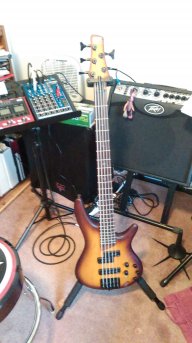
I think there is good reasons to use both depending on the sound you want. I have a short and a long, though the long scale is a 5 string. Typically I play at the fifth fret on the long scale and don't use the open notes. I like the short scale because I can play one finger per fret on the full neck. I also have a variety of trumpets, cornets, and a flugelhorn--sometimes you just need a different tool. Don't limit yourself by just using one type / scale of bass.

Enjoy the benefits of a premium membership!
Upgrade Account
-
TalkBass has been independent since 1998. Add your voice.
Create a free account to reply to discussions, view embedded media, and browse with fewer display ads.
Join free Log in
Want zero display ads or expanded classifieds tools? Compare plans.
You are using an out of date browser. It may not display this or other websites correctly.
You should upgrade or use an alternative browser.
You should upgrade or use an alternative browser.
Full Scale or Short Scale?
- Thread starter bmoney1990
- Start date
More options
Who Replied?
You'll have to be more specific. Prove that scale length alone determines the harmonic content of the vibrating string.
Whether he can prove it or not, some of us can clearly hear these differences!
Short-scales are the only basses that my small hands can successfully play. However, I have never been totally happy with their sound.

Whether he can prove it or not, some of us can clearly hear these differences!
All basses sound different so that argument is rendered moot, especially in light of his claim that it's "the laws of physics at work" that the short scale is responsible. For that reason he needs to back it up with a proof, not just a vague inference to Newtonian physics (which can be used to generate a wave equation for a vibrating string but he needs to show that it proves what he claims).
Last edited:
As a physicist and engineer, I find that his assessment may have merit. However, it is next to impossible to provide empirical proof of anything over the internet!
As a physicist and engineer, I find that his assessment may have merit. However, it is next to impossible to provide empirical proof of anything over the internet!
Same here, Electronic Engineer for over 24 years. I'm not asking for empirical proof. I want him to show me the math that demonstrates scale length alone determines the harmonic content of a vibrating string as he claimed.
Can you provide that? I'd really like to see it.
My experience tells me that in practical application, string mass, materials and construction is responsible for harmonic content and the tension of a given string (of particular mass, materials and construction) is responsible for pitch with scale length being responsible for how much tension is required to get that given string to a specific pitch.
Last edited:
Same here, Electronic Engineer for over 24 years. I'm not asking for empirical proof. I want him to show me the math that demonstrates scale length alone determines the harmonic content of a vibrating string as he claimed.
Can you provide that? I'd really like to see it.
This is the first time that someone has claimed proof of this particular theory. Lets see what he comes up with.
My experience tells me that string mass, materials and construction is responsible for harmonic content and the tension of a given string (of particular mass, materials and construction) is responsible for pitch with scale length being responsible for how much tension is required to get a given string to a specific pitch.
I agree with your assessment. However, I have always heard a notable difference between the scale lengths of basses regardless of these variables.
This is the first time that someone has claimed proof of this particular theory. Lets see what he comes up with.
Agreed.
I agree with your assessment. However, I have always heard a notable difference between the scale lengths of basses regardless of these variables.
The problem there is that, by the very nature of the cases, different basses had to be used and, since no two basses sound alike, it's not possible to determine any precise cause for any tonal differences. I'm thinking a test bed with a variable scale length would be required with a vibratory source to keep string excitation constant and a piezo transducer in the test bed bridge to eliminate any "window" effect or interference with string vibration from a magnetic pickup. Hook it up to a spectrum analyzer for data collection and analysis.
After all is said and done I think if any difference was noted it would be due to the delta in the tension of the string and it's effect on the modulus of elasticity of the string which could be easily mitigated by changing string gauge or in the real world maybe even by a change in technique/attack to manage string excursion.
Last edited:
I'd venture a guess that any discussion of tone and scale length would also need to figure in the effect of pickup placement, itself a really complex set of variables when you consider that, unless we play only open strings, our impressions of the overall tone comes from hearing multiple speaking lengths on the same set of strings. That's a bunch to account for.
I'd venture a guess that any discussion of tone and scale length would also need to figure in the effect of pickup placement, itself a really complex set of variables when you consider that, unless we play only open strings, our impressions of the overall tone comes from hearing multiple speaking lengths on the same set of strings. That's a bunch to account for.
Exactly.
When I was developing my short scale EUB "P bass" I had to be sure the pickup placement would be such that the pickup would transduce the same harmonic region of the strings as on the long scale version.
Last edited:
... I'm thinking a test bed with a variable scale length would be required ...
We all have one. They are called frets or finger position, depending. And your bass does sound with more fundamental and less overtones as you fret up the neck. But of course something else significant is going on at the same time. We, or at least I, tend not to move our plucking position as we move our fretting hand up the neck. Plucking closer to the center of the vibrating portion of the string definitely excites the fundamental preferentially compared to the overtones. You can get a very pure tone on the open strings by plucking at the 12th fret. No doubt this effect has some bearing on the common perception that short scales have a different tone.
Anyway my first bass was a short scale. Haven't played it in years and have no real reason to want a short scale, I would have said up until a few weeks ago. Then I got a Squier VI, thinking its higher voice and shorter scale length would be good for chording and right on both counts. But I have also been tuning in fifths for the last couple of years and so of course the Squier had to be tuned in fifths. What an amazing range! It gets the range of eight strings with only six. But it also puts the reach to thirds into long range territory and the shorter scale also helps with that. The cello tuning works very well with a scale length close to a cello's. In retrospect I suppose that should surprise no one but the magnitude of the effect is larger than I would have imagined. And with a heavy C string from LaBella I get a pretty nice, tight 32Hz C. Perhaps not tight enough to suit most or many on a traditional bass but on the VI the close spacing forces you to use a lighter touch anyway so the tension is plenty high enough. So I find myself actively liking the short scale rather than merely having to adapt to it as I expected. Not saying it would be worthwhile to convert to SS completely, although the thought has crossed my mind.
We all have one. They are called frets or finger position, depending. And your bass does sound with more fundamental and less overtones as you fret up the neck. But of course something else significant is going on at the same time. We, or at least I, tend not to move our plucking position as we move our fretting hand up the neck. Plucking closer to the center of the vibrating portion of the string definitely excites the fundamental preferentially compared to the overtones. You can get a very pure tone on the open strings by plucking at the 12th fret. No doubt this effect has some bearing on the common perception that short scales have a different tone.
Anyway my first bass was a short scale. Haven't played it in years and have no real reason to want a short scale, I would have said up until a few weeks ago. Then I got a Squier VI, thinking its higher voice and shorter scale length would be good for chording and right on both counts. But I have also been tuning in fifths for the last couple of years and so of course the Squier had to be tuned in fifths. What an amazing range! It gets the range of eight strings with only six. But it also puts the reach to thirds into long range territory and the shorter scale also helps with that. The cello tuning works very well with a scale length close to a cello's. In retrospect I suppose that should surprise no one but the magnitude of the effect is larger than I would have imagined. And with a heavy C string from LaBella I get a pretty nice, tight 32Hz C. Perhaps not tight enough to suit most or many on a traditional bass but on the VI the close spacing forces you to use a lighter touch anyway so the tension is plenty high enough. So I find myself actively liking the short scale rather than merely having to adapt to it as I expected. Not saying it would be worthwhile to convert to SS cmpletely, although the thought has crossed my mind.
Interesting points...Not quite the same but an analogous setup would be when I capo my long scale at the second fret and retune/setup to make it a shortscale. However the pickups no longer see the same harmonic region of the string which could easily change the tone. There's also the point you make that as you capo up the neck your plucking hand becomes relatively closer to the center of the string even if your hand doesn't move, and that which can also change the tone.
Last edited:

BassHappy
Supporting Member
Agreed. The problem there is that, by the very nature of the cases, different basses had to be used and, since no two basses sound alike, it's not possible to determine any precise cause for any tonal differences.
No problem - here is the solution - I have been wanting to do this 3-way comparison for YEARS:
Three perfect and identical Fender Jazz basses out of Fender Japan - A 34" full scale, a 32" medium scale and a 30" short scale - exact same electronics and hardware. All alder bodies and as far as I know, all two piece - with maple/rosewood necks - for all intents and purposes - all virtually identical and off the same assembly line in the same plant - scale length being the only variable.
Here is the short scale (called SMART scale in Japan) JB62SS: Invalid Link Removed
Invalid Link Removed
And the medium scale, JB62M: Invalid Link Removed
Invalid Link Removed
And the full scale, JB62US: Invalid Link Removed
Invalid Link Removed
(My apologies that the medium happens to look the coolest!
 ) Here is what we do - I have the medium scale and I will bring it - and I use NOTHING but standard long scale strings on all 15 of my mediums. I will bring it along - who has the smart scale and full scale from FJ, seems like a few of you do?
String em up with identical strings, put em though identical signal paths, make sure the tone controls are set identically and blast away - the same player on all three with different styles: pick - fingers - slap etc.
I bet in a blind listening test that no one could tell the difference - AT LEAST between my medium and your long for sure. I have already done it. I have NEVER seen anyone hear a track on a quality instrument and by an accomplished bass player - and be able to call out the scale length. Never.
Not sure about the smart scale, never owned one - never spent time or even seen one - but you might be surprised with all your "theories" on physics. I don't think anyone here speaks from direct experience, it has always been apples vs. oranges. Let's do apples vs. apples and see who is grinning.
Oh, and for those looking at the Fender Japan website, remember they measure scale length from the nut to the 12th fret - so you need to convert from mm to inches and then double it.
Let me know where and when and I would go out of my way (within reason) to be there - I will provide three brand new sets of strings and my medium scale.

Here are the three superimposed in case you are wondering:
The body is scaled down as well as the neck on the medium and smart scale - so that the ergonomics stay perfectly aligned.
Last edited:

Short-scales are the only basses that my small hands can successfully play. However, I have never been totally happy with their sound.
Perhaps you haven't played the right short-scale bass.


No problem - here is the solution...
Not really, due to the inherent variability of wood and since the basses are made from different pieces of wood, what you propose is essentially the old "wood doesn't matter" argument that's been done to death here.
Last edited:
BassHappy
Supporting Member
Not really, due to the inherent variability of wood and since the basses are made from different pieces of wood, what you propose is essentially the old "wood doesn't matter" argument that's been done to death here.
This test would be as close as you could get from a PRODUCTION bass point of view - to prove once and for all with a comprehensive ear test to quiet the physics and tension naysayers. Hey, quite frankly, you can stick your physics in your ear - as in the end it all comes down to your ear. It is all about sound and perception of sound. My contention is still that you won't hear the difference in scale length - AT LEAST between the medium and long scale.
An ever better test perhaps, would be to get the same luthier to build all three basses out of the same exact trees, using the exact same wood - but a bit impractical and could take a long time. Instant gratification could be yours for the taking on my challenge.
I just think this whole thing is amusing. A guy walks into a music store somewhere and picks up a Gibson SG or equivalent with humbuckers, which has the wrong strings from the factory and is pulling the wrong tension - or he picks up a Mustang with non-standard Fender Electronics - neither are set up properly and neither have strings pulling the proper tension - and he finds it "floppy" - or he just isn't enamored with the sound - and the rest is history as the myth becomes perpetuated. "All short scales now feel floppy and just don't sound as good as long scales".
When I owned my EB-O in the late 1960's, I had a special capacitor installed to add some brightness and used a wah-wah pedal locked in the on and down position in order to get a sound that would cut through the mix. It allowed me to get the proper "bark" and it sounded amazing using very little EQ. I also upgraded a size to heavier strings.
Very few of us have managed to compare apples to apples - Fender to Fender to see what a myth scale length truly is. How many Fender Jazz medium scales have you played?
Oh, I see.
BassHappy
PS: A perfect idea would be to do it at "Gearfest" next weekend at Sweetwater. I am sure I could talk Chuck into using their studio for the test, and we could even get him to record and probably video tape the test for posterity. Only problem is, we need a fairly new Fender Japan JB62US and a Smart Scale JBSS. I have the medium scale. Other problem is my schedule, which I might be able to rework.
Last edited:
This test would be as close as you could get from a PRODUCTION bass point of view - to prove once and for all with a comprehensive ear test to quiet the physics and tension naysayers. Hey, quite frankly, you can stick your physics in your ear - as in the end it all comes down to your ear. It is all about sound and perception of sound. My contention is still that you won't hear the difference in scale length - AT LEAST between the medium and long scale.
An ever better test perhaps, would be to get the same luthier to build all three basses out of the same exact trees, using the exact same wood - but a bit impractical and could take a long time. Instant gratification could be yours for the taking on my challenge.
I just think this whole thing is amusing. A guy walks into a music store somewhere and picks up a Gibson SG or equivalent with humbuckers, which has the wrong strings from the factory and is pulling the wrong tension - or he picks up a Mustang with non-standard Fender Electronics - neither are set up properly and neither have strings pulling the proper tension - and he finds it "floppy" - or he just isn't enamored with the sound - and the rest is history as the myth becomes perpetuated. "All short scales now feel floppy and just don't sound as good as long scales".
When I owned my EB-O in the late 1960's, I had a special capacitor installed to add some brightness and used a wah-wah pedal locked in the on and down position in order to get a sound that would cut through the mix. It allowed me to get the proper "bark" and it sounded amazing using very little EQ. I also upgraded a size to heavier strings.
Very few of us have managed to compare apples to apples - Fender to Fender to see what a myth scale length truly is. How many Fender Jazz medium scales have you played?
Oh, I see.
BassHappy
PS: A perfect idea would be to do it at "Gearfest" next weekend at Sweetwater. I am sure I could talk Chuck into using their studio for the test, and we could even get him to record and probably video tape the test for posterity. Only problem is, we need a fairly new Fender Japan JB62US and a Smart Scale JBSS. I have the medium scale. Other problem is my schedule, which I might be able to rework.
It's still the old "wood doesn't matter" argument.
As I mentioned in one of those "wood doesn't matter" threads, I've used wood from the same plank for two bodies, swapped everything between the two bodies and set them up identically. I was expecting them to sound pretty much the same and I was very surprised to find that they sounded quite different, one very rich in lows and the other not as much lows at all.
Last edited:
BassHappy
Supporting Member
It's still the old "wood doesn't matter" argument.
As I mentioned in one of those "wood doesn't matter" threads, I've used wood from the same plank for two bodies, swapped everything between the two bodies and set them up identically. I was expecting them to sound pretty much the same and I was very surprised to find that they sounded quite different, one very rich in lows and the other not as much lows at all.
Oh, geeeeeez, that's right.
Let's just forget the whole thing then.
My bad.
BassHappy
Perhaps you haven't played the right short-scale bass.
I am still waiting for the right one to come along!


I am still waiting for the right one to come along!
Because you haven't met a PiccoBass.


