• TalkBass has been independent since 1998. Add your voice.
    Create a free account to reply to discussions, view embedded media, and browse with fewer display ads.
    Join freeLog in
    Want zero display ads or expanded classifieds tools? Compare plans.

Full Scale or Short Scale?

Sorry Guys - I was on vacation and am now catching up.

The job is: "To prove that scale length alone determines the harmonic content of [a] vibrating string."

I spoke with the guy who told me that, and he said that it can be proven matter-of-factly with a spectrum analyzer.

I said that "we" here at Talk Bass are looking for an equation that proves it. No demos.

He said that he will look into how much time it will take him to crank out the proof. He is pretty sure it can be done in a half hour or so.

If any of you guys are Civil engineers or Structural type engineers - you may have heard of him: John R. Hall ("Jack") - he is a world leading vibrations expert and still actively publishing. He is also my Dad.

Hopefully he can help us all grasp the physics behind it - stay tuned.

Eric

(Edit - to be clear - the string is a constant diameter and mass per length. The nodes are ideal fixed in space nodes. We all understand that the guitar and its construction contribute to harmonic content. We are only looking a one string that is tuned to the same frequency at a Long and Short length. Nothing else is factored in.)

 
You can definitely get more attack and overtones with your right hand closer to the bridge. On any bass. You can play that way on a short scale to capture more of a long scale feel. with equivalent right hand position I've always gotten a tubbier plunkier time on a short scale than a long scale. You have to play them differently to get them to sound similar.
 
Full scale gives a more harmonically rich sound. Short scale gives more fundamental. (This isn't opinion - this is the laws of physics at work).
If I want a throbbing bassline I'll go short. If I'm putting the bass forward in the mix then it is the full scale.

The fatal flaw behind your "Law of physics" is that when you speak of harmonic richness, you have now changed the discussion from something empirical that can be measured, to something that either lacks definition, or is different for each listener IE: "more harmonically rich sound"

Case in Point: I have a 32, 33, and 34 inch scale basses. I can't empirically measure their harmonic content. I don't have the equipment. I do have my band mates and patrons, who all tell me they like the 33 inch the best, on a regular basis. They all have the same pickup config, they all have the same 3band eq, they all play out of the same amp on the same settings. So therefore my 33's have more harmonic richness! Period!
In this case, beauty is in the ears of the beholder, and they are my scientific measuring devices

The job is: "To prove that scale length alone determines the harmonic content of [a] vibrating string."

Hold on there partner. We all know the harmonic content will be different. You indicated in the post I pasted in above that the longer scale is richer harmonically. That's what you need to prove!

He is also my Dad.
Eric

Name dropper.

My dad could beat up your dad anyway, so who cares:woot:

-Scps
 
Sorry Guys - I was on vacation and am now catching up.

The job is: "To prove that scale length alone determines the harmonic content of [a] vibrating string."

I spoke with the guy who told me that, and he said that it can be proven matter-of-factly with a spectrum analyzer.

I said that "we" here at Talk Bass are looking for an equation that proves it. No demos.

He said that he will look into how much time it will take him to crank out the proof. He is pretty sure it can be done in a half hour or so.

If any of you guys are Civil engineers or Structural type engineers - you may have heard of him: John R. Hall ("Jack") - he is a world leading vibrations expert and still actively publishing. He is also my Dad.

Hopefully he can help us all grasp the physics behind it - stay tuned.

Eric

(Edit - to be clear - the string is a constant diameter and mass per length. The nodes are ideal fixed in space nodes. We all understand that the guitar and its construction contribute to harmonic content. We are only looking a one string that is tuned to the same frequency at a Long and Short length. Nothing else is factored in.)

So what we will be able to take away from this is the effect of scale length on the harmonic spectrum of a single open string. That's fine, but, every time you fret a note you are altering the effective scale length and when you place a pickup to transduce the vibration of the string at a fixed point it's going to catch different regions of the waves as you fret each string and change the location of the nodes.

Also, where and how strongly one plucks a string affects the harmonic content. That's self evident just from playing closer and farther away from the bridge. Try plucking an open string at the 12th fret and see how that sounds. Now fret a note farther up a ways and repeat...

The sound of a particular bass guitar is a composite impression of all the different notes produced at all the different speaking lengths.
 
Both!

4wUwoU9.png
Xq8SK2b.png
 
Haven't heard back from Jack yet on the equation(s).

I did speak with him again and said to try to include how plucking position affects harmonics. He started describing how plucking position can leave certain harmonics out completely.

Remember - this is a perfect string with perfect nodes. In the end I think that we will decide that a guitar is so much more complex that we will have only learned a generality. He said that the math for this perfect string equation is a bit advanced, and for a real live guitar would be off the hook.

Still - it is an interesting question - and I think that enough of us are truly interested.

He is a busy dude and as soon as I have the goods they will appear in this thread.

(And yes - he said that the longer scale will display more harmonics - shorter will display more fundamental).

Eric
 
Never thought I would say this, but my new MIM Pawn Shop Mustang is "better" than my MIA Standard Precision for rock and roll. It has minor manufacturing flaws and feels like a toy, but it just feels.... comfortable. I'm 6'1" with big hands so I can handle a 34" or 35" neck no problem. My wife doesn't understand, but I am beginning to realise that you have to buy lots of basses, try to love them and then ditch them if they don't love you back. My Mustang is a keeper!
 
  • Like
Reactions: BassHappy
IMO what one "likes" (per the original post) is not a matter of physics, string vibration qualities, etc.

It's based on what your ears and your fingers like. "Like" is a term that asks for an emotional reaction.

I like standard, medium and short scale. I play them all. The physics and other aspects are of no interest to me, as I like what I like.

 
Never thought I would say this, but my new MIM Pawn Shop Mustang is "better" than my MIA Standard Precision for rock and roll. It has minor manufacturing flaws and feels like a toy, but it just feels.... comfortable. I'm 6'1" with big hands so I can handle a 34" or 35" neck no problem. My wife doesn't understand, but I am beginning to realise that you have to buy lots of basses, try to love them and then ditch them if they don't love you back. My Mustang is a keeper!

Great to hear, play the bass that fits you and feels right. My guess is that you will be playing a lot longer with an instrument that fits and feels right. In the end it could make it easier to maximize your bass-playing potential.

IMO what one "likes" (per the original post) is not a matter of physics, string vibration qualities, etc. It's based on what your ears and your fingers like. "Like" is a term that asks for an emotional reaction. I like standard, medium and short scale. I play them all. The physics and other aspects are of no interest to me, as I like what I like.

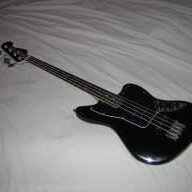
Instead of "one size fits all" we got us a "all sizes fit one". Seems rather rare to me - but good for you!

BassHappy
www.innertainment.net
 
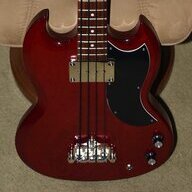
I'm selling off my last two 34s. I'll probably have around 500 after that, so I'm in the beginning stages of figuring out what the next one will be. I've got a 30" 5 string Brice, a modded out Bronco, and a fretless jazz from SX that could use some modding. Maybe an Ibanez semi-hollow, or an Eastwood hi flyer. Epiphone EB0 with a Dimarzo? It'd be nice to sell those off and have a used Waterstone Indra hit the market at the same time.
Unless I join a death metal band, I cant see myself going back to 34s.
 
I just sold my Am Std P-Bass yesterday. Hope I don't regret it... My intention is to go short scale. I'm looking at the Squier VM Jag SS. Price is right. I'm a guitar player who does home recordings. Been playing bass for about 20 years (the P-Bass). Now, age and tendonitis have me looking for a SS bass - but it has to sound good! Hopefully the VM Jag SS will fit the bill. ;)