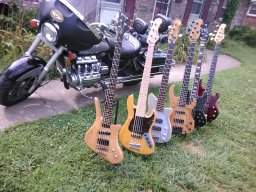
finally got my soooo desired JB special collection 2012 model...what a beauty, and the tone....
I am the only italian bassist that own a G&L JB...(I had to buy it unseen unplayed because it is not imported in Italy)
the bass is wonderfully crafted with three defects.
First the pluses:
- weight...lightest bass ever, the swamp ash is feather light
- tonewoods: grain resonance, it's all there
- balance...perfect
- tone, tone, tone etc etc.
- finish, this honey ale near naked finish is truly something special, even if it's maybe due to a new finishing process at G&L, and this is in my opinion the reason because this point shows up in the "minuses" too...
- pickups, very woody sounding, ancient, thanks God
- almost quarter sawn super stable neck. this is the first bass that does not need to be retuned every time I change environment, cold, warm, dry, wet, nothing seems to be able to induce the wood to adapt, almost non-real...
- nice working machine heads
- pots and caps: you can feel the quality, very smooth and even functioning
- neck pocket: unbelievably tight for a jazz bass...so different to the standard Fender production...but I have to admit that my Warwick Thumb is even more tight in this regard, the neck is fitted by "interference"...
Minuses:
- the bridge: good materials but mine was "defective". The saddle width was lower than optimal, so that when properly locked, the strings were forced to allign badly with pickup polepieces, and the G string did not sound, almost dead, it was off side too much. And the plastic pin that locks the saddles together was almost all visible and the screw almost at the extreme inner part the hole...bad, I had to build washers of the right width and place them between the saddles, you can see them if you look carefully...this way all things get solved, and the G string now rocks.
- the bone nut is too high on the E and A, playable, but it's a bit difficult to fret in the first position, one of these days I have to file it a bit
- the lower horn profile has a visible indent, like a fingerprint were the CNC machinery or the employee went too deep, the finish has concentrated around this point so the imperfection is evident, the finish is also uneven and some parts of the ash, usually when grain changes, is un-naturally "accented".
I am the only italian bassist that own a G&L JB...(I had to buy it unseen unplayed because it is not imported in Italy)
the bass is wonderfully crafted with three defects.
First the pluses:
- weight...lightest bass ever, the swamp ash is feather light
- tonewoods: grain resonance, it's all there
- balance...perfect
- tone, tone, tone etc etc.
- finish, this honey ale near naked finish is truly something special, even if it's maybe due to a new finishing process at G&L, and this is in my opinion the reason because this point shows up in the "minuses" too...
- pickups, very woody sounding, ancient, thanks God
- almost quarter sawn super stable neck. this is the first bass that does not need to be retuned every time I change environment, cold, warm, dry, wet, nothing seems to be able to induce the wood to adapt, almost non-real...
- nice working machine heads
- pots and caps: you can feel the quality, very smooth and even functioning
- neck pocket: unbelievably tight for a jazz bass...so different to the standard Fender production...but I have to admit that my Warwick Thumb is even more tight in this regard, the neck is fitted by "interference"...
Minuses:
- the bridge: good materials but mine was "defective". The saddle width was lower than optimal, so that when properly locked, the strings were forced to allign badly with pickup polepieces, and the G string did not sound, almost dead, it was off side too much. And the plastic pin that locks the saddles together was almost all visible and the screw almost at the extreme inner part the hole...bad, I had to build washers of the right width and place them between the saddles, you can see them if you look carefully...this way all things get solved, and the G string now rocks.
- the bone nut is too high on the E and A, playable, but it's a bit difficult to fret in the first position, one of these days I have to file it a bit
- the lower horn profile has a visible indent, like a fingerprint were the CNC machinery or the employee went too deep, the finish has concentrated around this point so the imperfection is evident, the finish is also uneven and some parts of the ash, usually when grain changes, is un-naturally "accented".