• TalkBass has been independent since 1998. Add your voice.
    Create a free account to reply to discussions, view embedded media, and browse with fewer display ads.
    Join freeLog in
    Want zero display ads or expanded classifieds tools? Compare plans.

G&L Club Part 7

Ha! Maybe you should put Locktite on your kidneys...:laugh: I've got a collection of colours of Locktite as well and I take your point. Personally I can't see how a screw like that is going to fall out, but then I'm a bit of a stiff on stage.

I am not stiff on stage. In the least! Heh heh. I was reading on G&L before I happened to luck into mine. So that was the first thing In checked. It was, is, there. Nylon liner an all. It was loose, but intact. However...

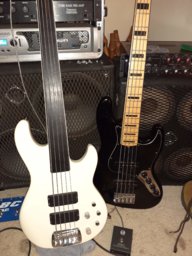
One small niggle. To truly intonate my G correctly, the saddle ends up just behind the interior hole, where the screw meets the saddle. The lock screw still catches the saddle. But I can see it. I compromised, covering the hole with the saddle. It isn't a big deal, as my bass is a fretless, but I thought it might be interesting info here. I've looked at a ton of G&Ls. A recent convert that totally ignored the company til mine showed up. Now I love em. And the bridges I see have the G saddle farther forward than mine. I assume they are intonated correctly. But my G saddle, if I'm nitpicking, is a bit far back for perfect intonation.

 
The weird play of light on the back of the neck might be due to the grain and not the finish. For example, on one of my basses the wood gives the appearance of some stain having gotten on it from the honey burst body. It is the same hue. However, when the angle changes it disappears, so it is just some kind of 'flaming' that might be happening. It is a rock solid quarter-sawn neck that feels great (came with no extra charge) so I don't even think about it now.

@Scott Loveless: Enjoy that handsome looking bass! Congrats!

I complete agree about the neck. All that neck is sprayed with is clear finish. I think that's nothing other than the wood underneath. Remember, it's a natural thing and they all have unique variations. Enjoy your bass!
 
  • Like
Reactions: David McIntire
So I completed my "k-wiring" mod on my L2000 and it was super, super easy. It's the one using the outer coils in single coil mode. All it required was a new switch and then following a diagram I got off the basses by leo site. Took me maybe 20 minutes to do.

This is the diagram I used: https://www.bassesbyleo.com/images/l2500/modded/l_2500_series_single_parallel_for_active.pdf

It definitely gives another sound. It's not as drastic as between parallel and series, but it sounds more mid heavy than parallel mode. Almost a bit dirtier too. Of course it's nothing like jazz bass, but it's another sound available out of what is already a super versatile instrument.

If you're capable and have an L2K or L2500, I'd recommend it.
 
Can anyone with an L2K or Tribute tell me how much their bass weighs?

Numbers will be all over the place on them. Varies quite a bit by body wood. I would say 9-10 lbs (4 to 4.5 kg) is average. If you are looking at buying at Tribute, I would say my estimated range is probably close. From what I have seen posted at dealers, the CLF L2000s seem to be coming in a hair lower than non-CLF. No idea if this is body wood related (meaning random chance from what I have seen) or due to the front routed controls.
 
  • Like
Reactions: sneha1965
Can anyone with an L2K or Tribute tell me how much their bass weighs?

I think you're going to find the answers all over the map depending on what type of wood the body is made of. I used to have a wunkay HOG that was north of 10 lbs but now have a 2K in Monkey Pod that is 7.6 lbs.

IMG_5162.jpg
 
Last edited:

Latest posts