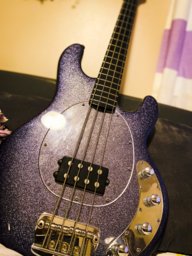
Maybe you've got a high fret (or frets) somewhere? I've played some Sire basses with very questionable fretwork. The frets MIGHT need to be leveled+crowned which is a job for a luthier if you don't know how to do it yourself.
Or it could simply be a setup issue. If that's the case, where exactly are you experiencing this buzz?
If it's on higher frets (say above 12th) your action might be too low but you say you've already raised the saddles so I'm guessing that's not the problem here.
If it's on lower frets (say between 1st to 6th) you may not have enough relief in your neck. Try loosening your trussrod (counter clockwise). Start with no more than a quarter turn. Repeat if necessary and check your relief as you go. Any more than half a turn shouldn't be necessary and would suggest that the problem is elsewhere. Also, if the buzz turns out to be in the lower frets you may want to lower the saddles back to where you started for a nicer, lower action at the upper frets (as long as you don't introduce buzzing in the upper frets of course).
If it's around the middle of the neck, like 7th-10th you might actually have too much relief in your neck (but buzzing in this area often turns out to be a high fret somewhere). You could try tightening the truss rod (clockwise) but be careful, no more than a quarter turn at first. If you go too far you will introduce buzz in the lower frets.
If you are only experiencing buzzing on the open string the nut is probably filed too low (although it COULD be related to not having enough relief as well, if the nut slot is filed very low). I don't think this is the case here though. All Sire basses I've played had the nut slots a bit HIGH for my taste.
If you're experiencing buzz in all of the above... it might be a faulty string of course but to be honest I don't think so. It's rare to get this type of problem from a hex core roundwound of decent quality. One or more high frets seems more likely, although a couple of high frets shouldn't affect ALL frets and certainly not the open string! If you're hearing the buzz on ALL frets and also on the open string, maybe it's a bad string after all.
But like you said, maybe you're just not used to roundwounds. If you're not sure what actual fretbuzz sounds like with roundwounds and want to find out, simply lower the action of the G-string until you get fretbuzz. If that's the kind of buzz you're hearing you probably either have a setup issue or a high fret somewhere. If the buzzing you're hearing is very different.. it might the string.
A good setup really is a balancing act. Any adjustments you make to deal with problem in one area of the neck could introduce problems in other areas of the neck. This is why some people pay luthiers to do setups. A decent setup is easy, a SUPERB setup is hard and in many cases, especially on cheaper instruments, it will require fret levelling/crowning and filing of the nut slots. The good news is that all of this (except filing the nut and fret levelling) is 100% reversible. As long as you don't go crazy with the truss rod you won't damage anything (except MAYBE break a string but that's rare with bass strings if you're careful).
There's one last thing you might want to try though. The source of the buzzing could come from the point of contact between the string and the saddle/nut. If it's the nut you will only hear it on the open string of course so I'm guessing the saddle is the most likely culprit. Try pushing down on the string (for example with with a flat screwdriver) at the point were the string rests on the saddle (or nut). If the buzz disappears (or gets less annoying) you've got a problem with the saddle. A tiny burr in the saddle slot can cause this (as can a poorly cut angle in the nut slot, but like I said, nut issues will only affect OPEN strings). The solution is to take a nut file, or a suitably sized small round needle file, and GENTLY file the slot. Be careful, you don't want to lower the slot. It should only take a couple of VERY light strokes to fix this type of problem. Also, make sure you've set your witness points at both the nut and saddle.
And finally, all basses are different. There is no "one size fits all" when it comes to setups. Even two identical Fender basses might need completely different setups to be at their best. That's why I never go by numbers/specs when doing setups, always by ear. Every bass player is different too. Different styles/techniques need different setups. Going by numbers/specs will rarely give the best setup for YOU. The only thing that matters is that the instrument feels right when YOU play it. If this means you are WAY off Fender specs for P or J, who cares? And if you REALLY care about your setup you will probably need to adjust your truss rod at least twice a year for optimal relief when the temperature/humidity changes. Especially on cheap to mid priced instruments.
If you decide to have a luthier look at it, make sure you explain how you want your setup. If not you may end up with a very nice setup that isn't the best setup for YOU. Explain what you like about the current setup, what your problems are, what kind of music you play and your technique (pick/fingerstyle/slap, playing softly or digging in hard, playing close to the bridge or close to the neck, etc). All of this matters A LOT for the perfect setup and any decent luthier should know this.
It MIGHT be a bad string too of course. If you don't want to mess around too much with your setup that's probably the place to start. But I have a very strong feeling your problem is elsewhere. It's impossible to say without an audio clip though.
Good luck!