• TalkBass has been independent since 1998. Add your voice.
    Create a free account to reply to discussions, view embedded media, and browse with fewer display ads.
    Join freeLog in
    Want zero display ads or expanded classifieds tools? Compare plans.

Getting improved note definition

I disagree with worrying about a tweeter. You should be able to discern the lower notes just fine with no tweeter at all
In this situation I agree that a tweeter/horn/high frequency driver is likely not a significant part of the root problem. I would also agree that a mid or high driver does help add air and definition to your notes by getting some of the upper harmonics out there more effectively. However, there are plenty of single driver cabs for bass that sound just fine on the low register notes and only tend to be a little darker (not muddy) in areas outside where the issue here seems to be.
 
  • Like
Reactions: Kams and Doufuss
I'd like to go back to the amp/cab setup. If I'm misunderstanding anything here, please correct me.

It sounds like you have a Rumble 500 2x10 combo, and you are adding the Markbass 121p as an extension. There's a chance that the cabs are not playing nice together here, albeit a small chance. Ideally, when you add a cab, you just want it to sound just like the combo, but "more". Maybe a Rumble 2x10 extension cab would be a better fit, although that combo gets plenty loud as is and has a baked in warm sound.

Here's one way to dial your tone in. If you can, play some music at a good volume through either your home audio setup or whatever PA you have available. Don't run the music through your combo. Turn off bright, contour and vintage controls. Turn off overdrive. Set all your tone controls to flat, then turn the bass knob all the way to the left (off) and play along. Turn your bass knob up incrementally as you play along, taking your time and listening critically to how it blends in. When it sounds nice and fits good, you're there. When you get with your band, you are at a good starting point but will probably have to make some small adjustments.

Also, there's a surprising amount of "bass" information through the tweeter that adds to the note definition down scale. IIRC that combo has an on/off switch, but no attenuator. Keep it on for now.

Edit - Looking at the tone controls from the manual - BASS: ±15dB @ 80Hz LOW-MID: ±12dB @ 280Hz HIGH-MID: ±12dB @ 1.2kHz TREBLE: ±15dB @ 10kHz. The bass control is likely shelving which means it increases/decreases all frequencies below 80 Hz. Conversely, the treble control is also likely shelving which increases/decreases all frequencies above 10k. The contour switch kills your mids outright and while it may sound great playing at home might make your tone ill defined in a band mix. BRIGHT: +13dB @ 10kHz CONTOUR: +1dB @ 80Hz, -13dB @ 670Hz, +2dB @ 8kHz VINTAGE: Dynamic compression (-9dB max) with low pass (-6dB/oct) @ 400Hz

There's also a built in compressor but they don't go into a lot of detail about what/how it does what it does. It's probably fine as is. I'm not clear on the vintage switch but it sounds like it reduces frequencies at 6db/octave above 400 Hz. Ya kinda need those.


Good luck!
 
Last edited:
  • Like
Reactions: Al Kraft
I would not underestimate the role of technique. Picking/plucking just a few centimeters closer (or further away from) the bridge can make a big difference in which partials dominate in the attack.
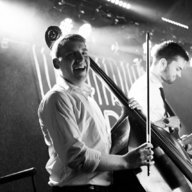
Not only that, but how much surface area of your finger contacts the string matters, too. It's possible to thin out or fatten tone, as well as change from a sharp attack to a slower attack just by adjusting how much "meat" you use on the strings.

This is where the "it's all in the fingers" idea really comes from. If you spend time experimenting with your right hand fingering you might be surprised how many tones you can create without ever touching a knob.
 
Others have already said similar but I think it's definitely worth repeating that it's probably not a gear problem (I know, boooooo). Although the pickups being too high could definitely be a factor.

Things that will make your tone more focused:
1) Playing closer to the bridge to allow for a quicker attack - small distances can make surprisingly big differences!
2) Having a lighter touch with your plucking hand on the lower strings in order to get a nicer tone out of them - to back up what brianrost says above, the fatter strings require more energy to move them but if you achieve this by just hitting them really fast and hard, you'll lose all the nice parts of your tone.
3) Having a lighter touch with your fretting hand on the first few frets, particularly if the nut isn't cut quite as low as it could be - this will let you get more volume and less fret buzz out of each note down there.

Also, practicing at a lower volume (sorry if this is making an assumption!) might help with ear fatigue and how you perceive the sound of the notes.
 
  • Like
Reactions: Kams
You have a PJ? You said you are using just the J and not the P? That right there seems like your problem. Turn the P pickup back on. Check your pickup heights, maybe lower the P if it's too boomy. Other than that, I think this is a about technique, nothing else. Look for a teacher, take a few lessons.
 
I suggest that trying a HPF set between 40 and 50 Hz should go a long way to improve this.

It can be a combination of things going on that contributes to the problem, including the speaker's inability to reproduce the lower fundamental notes. When this happens, the distortion increases greatly and these harmonics may work against the perception of fat and tight.
 
I’d love to see your eq settings. Perhaps set your eq flat and if your using the markbass head, turn off the vle and vpf filters (all the way to the left) as they are notorious tone suckers. Do not cut the mids. Do not boost the bass beyond flat (all eq knobs straight up in the 12 o’clock position)... also the set up of your bass as previous posters have suggested could be the issue.
 
Thank you for that! I have adjusted the bass tone control subtractively, but it seems that I have to do it to the point where I lose that low end grunt I so love. I’ll have to fiddle a little more with those mids and low mids. I don’t like what the high mids do to the tone, so I basically dial it down to about 10-11 o’clock.

I’ll also look into a high pass filter. Do you have a suggestion as to brand/model?

I use a Broughton Always On HPF. Tiny little box. But WOW doesn't help me with various cabs and rooms.
 
OP, when I first read your post I keyed in on the difficulty you are having distinguishing pitch in the lower registers. I too have problems with lower pitches as I suffer from noise-induced hearing loss. I can trace this to a four day diminished hearing period following a Grand Funk RR concert where we sat a dozen rows in front of the PA speakers. This was back in the mid 70s before noise laws. My drummer sat next to me. We never wore hearing protection in rehearsals or on stage. (Unfortunately, he later developed tinitus and debilitating Ménière's disease). Use this opportunity to have your most important piece of equipment checked out - YOUR EARS. Have the audiologist give you a copy of your test results, and then discuss your " personal eq settings" with your GP or ENT. Best wishes for a clean bill of aural health!
 
...impossible for my ear to hear whole and half steps. In other words, every note sounds the same
You have my empathy. I can't stand it!

[BEGIN my two cents]
Many good posts above (especially concerning room acoustics), but see if this is exactly what you're hearing: You pluck the low note and search in the sound for the exact pitch but there's a dense fog around it, but it's worse than fog; it's like a jello, but more viscous than rubbery, like molasses.

Some modern solid state bass amps are designed to emulate the immersed-in-something-viscous lows of most tube amps. I don't know if yours is one of them. If so it could frustrate your evaluation of the clarity of the lows of strings, cabinets and everything else mentioned above, because this molasses will be on everything. This probably invalidates my past evaluation of La Bella flats, for example.

I should have started with a pro audio type of solid state power amp (Crown, QSC, etc) to eliminate *this* variable. Then I could have heard the other factors better. But I didn't understand that I wanted such extreme clarity.

**
Suppose there's a clear bass tone on a studio recording that could serve as a model to you.
On the one hand, it might never have existed in the real world because it could have been DI into the console. But on the other hand, you *can* hear it clearly now in the real world because you're listening through a *high fidelity system*, not a bass amp.
Therefore, the only hope of producing it on stage would be with hi fi equipment, very expensive, and you'd immediately run in to the room acoustics problem anyway.

So, some adjustment of expectations is also necessary, as someone said above. But that exact flavor of molasses I can't live with.
[END my two cents]
 
I recently posted a question about how to eliminate excessive harmonics when playing at 5th and 7th fret positions. Got some good suggestions which I will work on.

The next problem I’d like some help with is that of getting nice fat lows with good definition — i.e. “tight” low end response. It seems like when I play down the neck — toward the nut — the notes turn to mud making it impossible for my ear to hear whole and half steps. In other words, every note sounds the same, or at the very least they sound like the intonation is way off. Yes, I check intonation with a Peterson tuner! I have tried rolling off the bass EQ settings, increasing the trebles while using the J pups and rolling off the P pups. As a result I end up with a tone that is, for my taste, too trebly. I want defined, tight low end punch as well as clean high end pop. I can get the high end definition, but the low end is mud and ill-defined note-wise.

I have tried playing with all the EQ frequencies on the amp as well as with the EQ’s on the bass. Just can’t get what my ear is craving. I’m wondering if an amp like the the Mesa Boogie WD-800 Subway + cab would do the trick since that amp is SO adjustable. I just don’t want to lay out the big bucks only to have the same problem rear its ugly head. I have a MarkBass 121P, the latest Fender Rumble 500 (2X10), and at one point I also ran the MarkBass thru a 410 extension cab. I also had an original SWR Super Red Head. I have just not been able to dial in “that sound.” Any help would be greatly appreciated!

P.S. I guess I should have added that I want to be able to play nice walking bass lines with great pitch definition as well as classic rock and funk slap and pop.
HPF + Compression + good technique + good strings - bad acoustics - overly EQ’d Bass/amp = even tone is one thing to try.

Instead of using your speaker cabs, First try using some decent ear buds verifying your pickups are adjusted correctly.

One other point, overtones and harmonics come with vibrating springs. To your point, the best you can do is mask them, but may I dare say, you are not about to eliminate them. Frankly, some of them you don’t want to mask. It’s very difficult to weed out the ones you don’t want without removing or covering up the ones you do want.

For instance, think of an upright bass. At the notes go lower, the bass (Lower frequencies) will bloom creating a sense of it being louder. By cutting off this ability to bloom to have an “even” dB level, I‘m afraid will sound very odd, especially on an electric bass.

I think one of the reasons PBs have be popular for so long is the fact that they record very well. The main reason is there is no midrange “hump”, it has a very natural ‘bloom more like an acoustic bass. JMO.

Best wishes on finding an agreeable sound.
 
I totally agree with WASNEX's post that room acoustics can play a large role in how your system sounds. Placement of your cabinet within a room (if placed equidistant from the walls) will likely result in muddier bass. This also applies to a subwoofer for a home audio/theatre system. EQ can help compensate and balance freq levels but EQ isn't going to cure other causes for undesirable sound performance.

But there is also a lot more potential causes beyond how a room responds to sound waves. And others on this thread have already mentioned those so I won't go into that. But I would like to mention that I consistently hear more note definition higher up than neck than low. In other words, a mistake higher up the neck is less forgiving than a misplaced note down low. That's been my observation (YMMV) and it seems unusual to me that you'd be experiencing the opposite.

I'm interested in finding out the root cause and it seems there can be many ranging from gear to technique to setup. Good thread. I might actually learn a thing or two.
 
Last edited:
  • Like
Reactions: Al Kraft and Wasnex
I recently posted a question about how to eliminate excessive harmonics when playing at 5th and 7th fret positions. Got some good suggestions which I will work on.

The next problem I’d like some help with is that of getting nice fat lows with good definition — i.e. “tight” low end response. It seems like when I play down the neck — toward the nut — the notes turn to mud making it impossible for my ear to hear whole and half steps. In other words, every note sounds the same, or at the very least they sound like the intonation is way off. Yes, I check intonation with a Peterson tuner! I have tried rolling off the bass EQ settings, increasing the trebles while using the J pups and rolling off the P pups. As a result I end up with a tone that is, for my taste, too trebly. I want defined, tight low end punch as well as clean high end pop. I can get the high end definition, but the low end is mud and ill-defined note-wise.

I have tried playing with all the EQ frequencies on the amp as well as with the EQ’s on the bass. Just can’t get what my ear is craving. I’m wondering if an amp like the the Mesa Boogie WD-800 Subway + cab would do the trick since that amp is SO adjustable. I just don’t want to lay out the big bucks only to have the same problem rear its ugly head. I have a MarkBass 121P, the latest Fender Rumble 500 (2X10), and at one point I also ran the MarkBass thru a 410 extension cab. I also had an original SWR Super Red Head. I have just not been able to dial in “that sound.” Any help would be greatly appreciated!

P.S. I guess I should have added that I want to be able to play nice walking bass lines with great pitch definition as well as classic rock and funk slap and pop.

So many variables on that question. I did not see this mentioned on the first page of the stream, but playing back toward the bridge and bridge pickup seems to bring out the nuggets/goodies that I sometimes perceive as note definition and cut, but can reduce punch and bottom end unless EQ'd back in. Just a different angle than has been previously mentioned. Lots of good suggestions already.
 
  • Like
Reactions: Watchootognbout
Thanks so much for all the info. A friend of mine has an Eden combo amp — I think it is a 210 — and she likes it a lot. I’ll have to ask her to let me try it.

I’ll have to take a look at the DNA. I’m not familiar with that brand at all, but from what you are saying, it seems it might just be worth a hard look/listen. I agree that the Cab has a huge impact on tone as do the speakers. The cabs I have, and have been trying, are all light weight jobs made of poplar loaded with neodymium speakers. They are appealing in terms of their light weight/portability, however, I am now wondering if those weight-saving measures have resulted in inferior low end response lacking definition.
No. Some might have more low end response than others, but the definition you're looking for where you can actually hear what note you're playing comes from the mids. I used to own that little Markbass combo and I never had a problem getting note definition on the lowest notes.

I am impressed by the Mesa Boogie WD-800 Subway amp, so perhaps marrying it with a DNA DNS-210 will give me what I’m looking for. Of course I’ll also look into the Mesa Boogie cabs too. I only play small venues, so I don’t need enough power to blow the house down, but I still want plenty of warm, tight, defined bottom end. I am also wondering about the speaker size and it’s effect on note definition. I have always thought 15” spkrs are too flubby. 1x12’s don’t give enough low end, 2x10’s give better definition, and 4x10’s are wonderful, but they weigh a ton, and I don’t have a roadie! I have to schlep my gear by own mine self!
Those are gross generalizations that may or may not apply. I have found cabs that I love and hate in all of those formats, and everything in between. If what you were saying were true, then every cab would sound the same regardless of the different speakers used, and they don't. Design of the speaker and design of the cab you put it in are way more important factors than just speaker size. And being a professional touring musician who has had to play through anything from some of the finest gear that money can buy to the cheapo 30 year old combo that some promoter uses in his little oldies band and tries to save money on rented backline at my expense, it's never the rig's fault if you can't find a usable sound out of it and somehow make it work. And you have some pretty good stuff already and there's no reason you shouldn't be able to make it happen. Throwing more money at it isn't going to solve a thing.

Now I don't know exactly what you're hearing, but you're definitely looking for note definition in the wrong place. I read you don't like mids and that's understandable...most of us don't because too much mid sounds like your cab's made of cardboard. But you do need some, especially when you're struggling to make out the difference in pitch between your lowest notes.

Here's what I would do if I were you...this is not only good for finding a sound that works for you, but it's also some good ear training.

---Plug into your little Markbass combo, and put all the knobs at noon except the VLE and VPF, which should be off at all times. Setting it this way gives you flat response from the head, and the cab is pretty strong in mids, too, so that's why I think you should use only the Markbass combo for now. Plus it's small, light, and easy to set pointed to your ears. Give yourself a nice comfy volume that's not real loud but you can hear it decently...that way your ears won't fatigue.

---Play your lowest note over and over as you cycle the low mid and hi mid knobs up and down separately. Listen very critically at the differences in tones as you do it. Then do the do them in the same positions at the same time. Get extreme with it...turn them all the way down for a few seconds then crank them all the way up. Sweep slowly through them or sweep quickly. Play some riffs all over the neck while you're at it, too, just to hear how the mids affect them. You will definitely hear some ugliness, but that's OK.

---Put the tone knobs back at noon and start playing your lowest notes. If you struggle to be able to tell the difference still, start boosting the mid knobs until you can. If you can hear the differences, back off the mid knobs till you can't. At that point, bring them slowly back up one at a time till you can. You might need to experiment around to find a sound that suits you, but it doesn't have to be the perfect sound yet. But only move the mid knobs, not the bass and treble knobs.

Once you figure out how much mid response you need to be able to hear the note definition, THEN you can start using the bass and treble knobs, but bearing in mind that you probably won't hear any note definition unless your mid knobs are at a certain level. But mids always sound more extreme by themselves than they do in a band, and even bass players who use a lot of mid scoop still see the need for them to get note definition in a mix. They may disagree about what range of mids they like to boost or cut, but they have at least some in there.

When I was using one, I'd have to give it a little (not much) bass boost and take down the mids slightly, and put the VLE knob at 10:00 because I don't like tweeters and that's the only way to cut the highs to my liking, but honestly it's not a bad sounding combo in a mix with knobs at noon, either, even if the cab's a little too middy for my tastes.
 
Without TB which takes a lot of discernment to separate all the great advice so you can see what fits you, you have to use your ears.

What will you do after you get the hpf set everything perfectly, get the ideal setup and you get to that jam and you didn’t know you’d need your bass plus rig and some one hands your their Pbass. Are you going to make music or bow out or stress about how good it could have been with your rig?

No snark here. Once in BP mag they said Don Was showed up to a session. The only bass there hadn’t been set up for eons. Half dead strings poor intonation.
He made it make music! Bending when he had to to make the date successful.
That’s the real bar.
Are we mice or are we men? Are we musicians first then bassists?
 
  • Like
Reactions: Sid Fang and JimmyM
...it's never the rig's fault if you can't find a usable sound out of it and somehow make it work. And you have some pretty good stuff already and there's no reason you shouldn't be able to make it happen. Throwing more money at it isn't going to solve a thing.....
+10. I personally refuse to fall into the money trap of thinking I can sound better only if I had this very expensive rig. It's the same with tennis players, everytime they miss a ball it's the racquets fault, then they smash their racquet and go buy a different one, never even considering for a moment that it's not the racquet's fault at all.

I think a good exercise is to set the bass to a neutral tone and set the amp to be perfectly flat, and then try to make that sound good just with your hands. A really talented bassist will immediately sound like a really talented bassist, and someone who is pretty much clueless will sound like fresh donkey poo. The stark reality is that in a band context we really don't need much more than a simple P bass and an amp set relatively flat to provide all the bottom end necessary to make the band sound good. We really don't need Fodera basses, boutique amps, thousands of dollars worth of pedals, and above all, a HPF to sound great. James Jamerson taught us that.
 
  • Like
Reactions: JimmyM