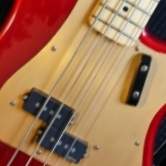
Use a booster like the tc Sparkbooster. I had the same problem with mine. Pressurewonds work really well with the pbass.

TalkBass has been independent since 1998. Add your voice.
Create a free account to reply to discussions, view embedded media, and browse with fewer display ads.
Join free Log in
Want zero display ads or expanded classifieds tools? Compare plans.
And, the problem with that is?


So you don't think a note played on a set of 10 year old flatwounds will have a much quicker decay and less sustain?
I know what you mean, but I think the issue is that if the initial attack is concentrated in the low frequencies, it'll get high-passed out, EQ-ed to make room for the kick drum, compressed, buried in guitars, etc. You don't just need that first volume spike...you need a volume spike in the right frequency range.Decay and sustain are not attack.
Look at the diagram some more.

A preamp will defintiely sort you out.An Aguilar tone hammer if you don't want to mess with your bass is not a bad idea. John East makes a great preamp for bass which is easy to install and you charge it with a battery kit through your input jack. I personally chose the Bartolini HR-2.2AP.(which I thought would be cheaper but not the case)I'm primarily a P-bass player, and I love the idea of keeping things simple - one bass, two knobs. But a few recent studio experiences have me wondering if I need to augment my situation in some way. I'm also not a studio guy, just showed up to record some tracks for a friend, so I'm not expert in how it all goes.
In the past year, I recorded two separate tracks with an American Standard P-bass. Both times, the producer (same one each time) remarked that I wasn't getting enough 'attack' from the bass to situate it properly in the mix. Even after opening up the tone fully, it still wasn't quite enough for one of the tracks - I ended up using a pick super close to the bridge just to get a little more bite. The track sounds ok, but not nearly as meaty as it should've been. (I should note that I was using GHS pressurewounds on this particular bass).
My question is, (without of course knowing if the pickups were faulty) should I look into adding some sort of overdrive, or a preamp to my setup? Right now I just go PBass into amp (or DI in the studio), no effects. I've always loved the P tone, but if it's going to be my workhorse, what could I do to maybe add a little more presence to it? FWIW, I typically play rock in the style of bands like Wilco, MMJ, Dr Dog, etc. But I also take on some Motown/Soul stuff from time to time.
Decay and sustain are not attack.
Look at the diagram some more.
"New strings" seems like dangerous advice unless everyone at the session is okay with hanging out for awhile while you get through the super-boingy break-in stage!
True, but the customer is always right. All that matters is what the producer or engineer thinks and he is saying not enough attack.But, this is how TB works.


Tone is in the fingers. You need harder fingers.
OK, a bit facetious, but there is some truth to it. I have hard callouses, and when I want a good attack, I don't pull on the strings, I strike them (my finger is moving pretty fast before it's touching the string). If I do it near or over the fretboard, I can get a bit of bounce off the frets (that's what the frets above the octave are there for), and I get all the attack I want.
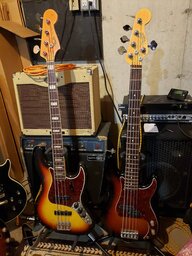

If he can do all that then he might be ready for an ash bodied one 2 months from now.
 Seriously, what producer or engineer can't get a P bass to sound right in the mix? Sounds like the problem is at the other side of the board, not you.
Attack is usually a word that describes your technique and not something that gets adjusted in the tone. More attack = digging in harder and getting more volume out of the strings, which also opens up other tonal characteristics. This might include a little more fret noise, but also the strings themselves will give you a different response. The increase in string travel will also react differently with the magnetism of the pickups which can further color the tone.
Were you maybe trying to play too clean, being in the studio, or is your playing style a little on the lighter/smoother side?
.

In my book, you use compression to decrease attack (make everything the same volume, "squeeze" the dynamics) not increase it. But it does depend on what is meant by 'attack'.