
I think they do neck throughs as well. Worth asking them about it.That’s surprising, I don’t think I’ve ever seen a neck through with classic ski jump, but I guess it’s the same principal. Do companies like Warpedneck.com even do neck through?
Edit doesn’t look like they do neck through, no mention of it on the website. Might be major surgery like removing the fingerboard and planing it flat. Are the body wings separating from the neck beam? That’s a whole other kettle of fish. Any cracks along those seams?

Enjoy the benefits of a premium membership!
Upgrade Account
-
TalkBass has been independent since 1998. Add your voice.
Create a free account to reply to discussions, view embedded media, and browse with fewer display ads.
Join free Log in
Want zero display ads or expanded classifieds tools? Compare plans.
You are using an out of date browser. It may not display this or other websites correctly.
You should upgrade or use an alternative browser.
You should upgrade or use an alternative browser.
Getting the Facts about Ski Jumps
- Thread starter Turnaround
- Start date
More options
Who Replied?
I've been asked a number of times if there is anything that can be done to prevent a ski jump. The answer is yes and no.
You can't really "prevent" a ski jump, but you can reduce the risk of developing one. The ski jump happens because of the tension of the strings acting at an angle to the plane of the neck. If the strings were at the same plane as the neck there would be no bending force on the neck, only tension along its length. But because the strings are elevated from the neck and at an incline to it there is an upward force at the nut end of the neck from the string tension. The greater the angle, the greater the up force. This upward force causes the neck to bend forming relief. But the largest stress point it just outside of the body joint - just where the 12th fret kink occurs. If we reduce the string to neck angle (lower action) we reduce the stress at the kink spot and reduce the chances of a kink developing. So a lower action will help to reduce the risk of developing a ski jump.
But just as important is the amount of relief in the neck. If you have a lot of relief, even if you have low action, there will be more leverage on the neck than if you had less relief.
Another approach to reducing the stress on the neck is to use strings with lower tension. Less tension = lower angular force. It's a compromise, especially if you hate a floppy B string, but so is low action for those that need higher action.
So, whatever your choice of string tension, string height and relief, it is best to keep your bass in proper adjustment. Keep an eye on relief, and string height and don't allow either to become excessive. The worst cases of ski jump I have encountered were on basses where the string height and relief had become excessive and the bass was left that way for an extended period.
But in the end, some necks are going to develop a ski jump no matter how much care you take. I have kept my beater bass properly adjusted with very low action, moderate tension strings and very little relief and it has developed a ski jump. It took 15 years to develop, but it's there. None of my other basses have a lift.
You can't really "prevent" a ski jump, but you can reduce the risk of developing one. The ski jump happens because of the tension of the strings acting at an angle to the plane of the neck. If the strings were at the same plane as the neck there would be no bending force on the neck, only tension along its length. But because the strings are elevated from the neck and at an incline to it there is an upward force at the nut end of the neck from the string tension. The greater the angle, the greater the up force. This upward force causes the neck to bend forming relief. But the largest stress point it just outside of the body joint - just where the 12th fret kink occurs. If we reduce the string to neck angle (lower action) we reduce the stress at the kink spot and reduce the chances of a kink developing. So a lower action will help to reduce the risk of developing a ski jump.
But just as important is the amount of relief in the neck. If you have a lot of relief, even if you have low action, there will be more leverage on the neck than if you had less relief.
Another approach to reducing the stress on the neck is to use strings with lower tension. Less tension = lower angular force. It's a compromise, especially if you hate a floppy B string, but so is low action for those that need higher action.
So, whatever your choice of string tension, string height and relief, it is best to keep your bass in proper adjustment. Keep an eye on relief, and string height and don't allow either to become excessive. The worst cases of ski jump I have encountered were on basses where the string height and relief had become excessive and the bass was left that way for an extended period.
But in the end, some necks are going to develop a ski jump no matter how much care you take. I have kept my beater bass properly adjusted with very low action, moderate tension strings and very little relief and it has developed a ski jump. It took 15 years to develop, but it's there. None of my other basses have a lift.

For those who have been following my test of whether a shim can cause a ski jump....
First a review. There has been speculation that a partial shim in the neck pocket can cause the neck heel to distort causing a "rise" in the heel of the neck. I have long maintained that you cannot cause such a bend with a partial shim. To prove it I took a neck I had in the shop, bolted it to a body with a partial shim in the neck pocket. I also installed strings and brought them up to tension. I set it aside and occasionally checked the screws to make sure they were good and tight - really tight. Once a year I look for signs of a ski jump both along the upper surface of the neck and by removing the neck and checking the heel for flatness.
It has now been 3 years under extreme tension and there is no sign of a ski jump and the butt end of the neck is still dead flat. No sign of any deformation. To this I should add that I have never seen a bass or guitar with a ski jump that had a distorted heel. The distortion has always been outboard of the neck pocket. Since the bolt and the shim are inside the neck pocket, they could not contribute to the distortion outside of the pocket.
If I remember, I will check again next year. If I don't remember, someone remind me!
First a review. There has been speculation that a partial shim in the neck pocket can cause the neck heel to distort causing a "rise" in the heel of the neck. I have long maintained that you cannot cause such a bend with a partial shim. To prove it I took a neck I had in the shop, bolted it to a body with a partial shim in the neck pocket. I also installed strings and brought them up to tension. I set it aside and occasionally checked the screws to make sure they were good and tight - really tight. Once a year I look for signs of a ski jump both along the upper surface of the neck and by removing the neck and checking the heel for flatness.
It has now been 3 years under extreme tension and there is no sign of a ski jump and the butt end of the neck is still dead flat. No sign of any deformation. To this I should add that I have never seen a bass or guitar with a ski jump that had a distorted heel. The distortion has always been outboard of the neck pocket. Since the bolt and the shim are inside the neck pocket, they could not contribute to the distortion outside of the pocket.
If I remember, I will check again next year. If I don't remember, someone remind me!

Somebody ought to be paying this guy! Great feedback on a long-time topic. You can sell that bass on TB in a couple of years as a collectable! :}
Thanks for the info. I guess I just don't like the idea of a shim. A well-designed bass should not need a shim.For those who have been following my test of whether a shim can cause a ski jump....
First a review. There has been speculation that a partial shim in the neck pocket can cause the neck heel to distort causing a "rise" in the heel of the neck. I have long maintained that you cannot cause such a bend with a partial shim. To prove it I took a neck I had in the shop, bolted it to a body with a partial shim in the neck pocket. I also installed strings and brought them up to tension. I set it aside and occasionally checked the screws to make sure they were good and tight - really tight. Once a year I look for signs of a ski jump both along the upper surface of the neck and by removing the neck and checking the heel for flatness.
It has now been 3 years under extreme tension and there is no sign of a ski jump and the butt end of the neck is still dead flat. No sign of any deformation. To this I should add that I have never seen a bass or guitar with a ski jump that had a distorted heel. The distortion has always been outboard of the neck pocket. Since the bolt and the shim are inside the neck pocket, they could not contribute to the distortion outside of the pocket.
If I remember, I will check again next year. If I don't remember, someone remind me!
Quite right. But it’s very effective harmless and reversible when needed.I guess I just don't like the idea of a shim. A well-designed bass should not need a shim.

Thanks for the info. I guess I just don't like the idea of a shim. A well-designed bass should not need a shim.
Which would mean that no instrument with a bolt-on neck is well designed, as many of them need shims.


I suggest that the adjustability of a bolt-on neck by way of a shim is well designed.
I have a few well designed basses with bolt-on necks. The only one I have with a shim is factory production-line produced. It's an easy way to deal with mass-produced items where it is cost-prohibitive to hand fit the joints. Easy, effective, cheap.Which would mean that no instrument with a bolt-on neck is well designed, as many of them need shims.
People make the assumption that cnc should banish shims forever, but there’s still a lot of manual sanding to the necks and bodies by semi skilled labour that can introduce small irregularities that can occasionally add up.I have a few well designed basses with bolt-on necks. The only one I have with a shim is factory production-line produced. It's an easy way to deal with mass-produced items where it is cost-prohibitive to hand fit the joints. Easy, effective, cheap.
I learned very early on in my woodworking education (when I was about 8 years old) that it is folly to apply metal-working precision to wood working. Wood is not stable. What you cut today as a precision fit will not be so precise tomorrow. You need to design to take wood movement into account.People make the assumption that cnc should banish shims forever, but there’s still a lot of manual sanding to the necks and bodies by semi skilled labour that can introduce small irregularities that can occasionally add up.
CNC machines can cut very precisely. But they cannot control how the wood behaves. So if you are mass producing items it makes sense to design in some means to handle wood variation. Shimming a neck makes sense from the manufacturers standpoint, economic sense mostly.
Yes, the potential moisture loss/gain just by cutting the neck pocket can destabilize the equilibrium the body already has. The factories in places like Indonesia and China may have 90+% humidity. The variable stiffness from one neck to another, even of the same species, throws another variable in the mix. I have made it my policy to only buy in person. I don’t trust buying a random instrument without evaluating it first.I learned very early on in my woodworking education (when I was about 8 years old) that it is folly to apply metal-working precision to wood working. Wood is not stable. What you cut today as a precision fit will not be so precise tomorrow. You need to design to take wood movement into account.
CNC machines can cut very precisely. But they cannot control how the wood behaves. So if you are mass producing items it makes sense to design in some means to handle wood variation. Shimming a neck makes sense from the manufacturers standpoint, economic sense mostly.
I have a few well designed basses with bolt-on necks. The only one I have with a shim is factory production-line produced. It's an easy way to deal with mass-produced items where it is cost-prohibitive to hand fit the joints. Easy, effective, cheap.
Right! And I consider that part of design too - one needs to make it possible to produce instruments that make economic sense.
Thanks for the update to this @Turnaround.
I read the whole thread quite some time ago and can't recall if you discussed the position of the shim.
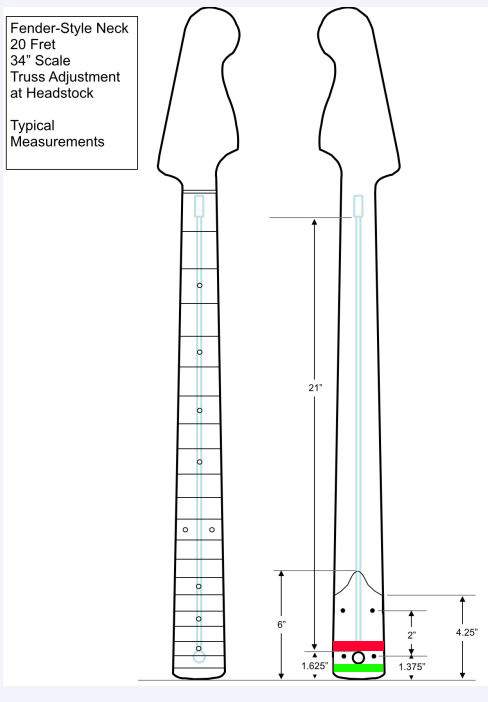
The luthier I used to use in Australia recommended putting any partial shim in between the mounting bolts (in the position shown in red below) rather than right at the end of the neck pocket (green). He theorised that if a shim could possibly cause a ski jump then putting it between the bolts as indicated would have much less chance of causing one.
I'm pretty sure that all my basses and guitars have a shim in them except for my Ibanez SR1200. For most of them it was not actually necessary as I could get a good low action without one, but that action meant the adjustment screws on the saddle height poked through and that's something I really don't like. A thin shim solved that and gave a better break angle over the saddles. Some of them have had that shim for well over 5 years and so far none have developed a ski jump.
I read the whole thread quite some time ago and can't recall if you discussed the position of the shim.
The luthier I used to use in Australia recommended putting any partial shim in between the mounting bolts (in the position shown in red below) rather than right at the end of the neck pocket (green). He theorised that if a shim could possibly cause a ski jump then putting it between the bolts as indicated would have much less chance of causing one.
I'm pretty sure that all my basses and guitars have a shim in them except for my Ibanez SR1200. For most of them it was not actually necessary as I could get a good low action without one, but that action meant the adjustment screws on the saddle height poked through and that's something I really don't like. A thin shim solved that and gave a better break angle over the saddles. Some of them have had that shim for well over 5 years and so far none have developed a ski jump.
I would put the shim at the inboard end of the pocket. That way the neck wouldn't tend to rock over the shim as you tighten the screws. But between the screws would be OK so long as you tightened the outboard screws before the inboard ones.
The heavier the gauge, the higher the tension, and the more stress on the neck. The additional stress adds to the likelihood of developing a ski jump.How much does the gauge of the strings have to do with developing a ski jump over time? Gauge vs thickness of the neck, etc.
Thanks for the update to this @Turnaround.
I read the whole thread quite some time ago and can't recall if you discussed the position of the shim.
The luthier I used to use in Australia recommended putting any partial shim in between the mounting bolts (in the position shown in red below) rather than right at the end of the neck pocket (green). He theorised that if a shim could possibly cause a ski jump then putting it between the bolts as indicated would have much less chance of causing one.
I'm pretty sure that all my basses and guitars have a shim in them except for my Ibanez SR1200. For most of them it was not actually necessary as I could get a good low action without one, but that action meant the adjustment screws on the saddle height poked through and that's something I really don't like. A thin shim solved that and gave a better break angle over the saddles. Some of them have had that shim for well over 5 years and so far none have developed a ski jump.
View attachment 4623741
You could get shorter saddle screws. What I found is that my right hand is sensitive to the height of the strings over the body. Since tilting the neck doesn't change the action you can achieve, only the saddle position needed to get that action, I tend to shim for minimum saddle height as that is more comfortable for my right hand. It's good to know that evidence shows partial shims won't cause neck deformation, but I tend to make full contact shims out of layered aluminum tape, so it isn't a concern for me anyway.
Latest posts
-

-

-
 Just picked up a used Bugera Veyron Mosfet BV1001M
- Latest: Gianni "Orlandez" Orlati
-

-
