• TalkBass has been independent since 1998. Add your voice.
    Create a free account to reply to discussions, view embedded media, and browse with fewer display ads.
    Join freeLog in
    Want zero display ads or expanded classifieds tools? Compare plans.

Getting the Facts about Ski Jumps

Just read this from start to finish and wanted to say thanks to the all pro's for the thorough explanation and their R&D efforts to learn more about this issue as well as design prevention & repairs.
Also thanks to all of the civilians who had useful contributions and experiences. Coming from a family of engineers, it's great to read about technical facts and not opinions or old wives tales.
Well done!
 
For those following my test where I attempt to induce a ski jump in a neck with a shim...

It's been four years now , and there has been no bending of the neck in the pocket. Because I brought the strings up over normal tension there is an indication of a kink forming between the 12th and 15th fret, but the neck in the pocket area remains dead flat.

Go back to post #134 to see about the test.
 

Attachments

  • upload_2023-3-13_11-12-18.png
    upload_2023-3-13_11-12-18.png
    233.4 KB · Views: 93
Is there any consensus among Pros as to best practice for "curing" Ski Jump? Warpedneck.com has developed a decent reputation for heat-treating necks to fix a bow, but I don't know if that's applicable, or preferable to a combination of planing the fingerboard/filing some "fallaway" into the frets above the 12th. I suspect (with no proof whatsoever) that a bent neck will eventually go back to bent regardless, but I think the jury is still out on that. My son has an old 90's era MIM P bass with a serious case of what I think is "ski Jump". The bass is nearly unplayable as-is, so I'm trying to decide if I want to give WarpedNeck a try.
 
My '81 L2K had a very thin neck, and was like a wet noodle. Setup was always a compromise. I eventually had the fingerboard planed a little and refretted. It was a lot better, but I had moved on to Spectors by then. The neck on my modern CLFR L2K is very stable, but feels nothing like the old glove that the '81 had going for it after I had completely stripped and tung oiled it. Those early Mohoghany/Ebony L2Ks were something else.
 
Is there any consensus among Pros as to best practice for "curing" Ski Jump? Warpedneck.com has developed a decent reputation for heat-treating necks to fix a bow, but I don't know if that's applicable, or preferable to a combination of planing the fingerboard/filing some "fallaway" into the frets above the 12th. I suspect (with no proof whatsoever) that a bent neck will eventually go back to bent regardless, but I think the jury is still out on that. My son has an old 90's era MIM P bass with a serious case of what I think is "ski Jump". The bass is nearly unplayable as-is, so I'm trying to decide if I want to give WarpedNeck a try.

I believe that warpedneck.com has had success straightening Fender-style necks with ski jumps. Although they caution that it may bend back once you put the string load on it for a while. Also, even after they straighten the kinked spot, the neck will still need to have the frets leveled.

If you've read through this thread, we've explained how 12th fret kinks (ski jumps) are very different from warpage. A 12th fret kink is caused by the wood on the back of the neck being overstressed by the string tension load. Sure, you can heat the wood and bend it back. But if you put the same strings back on and pull them up to tension, it will be overstressed again, just like before. You can expect that it will slowly start bending into the kink again. Maybe in a month, maybe a decade. Just straightening the neck doesn't solve the underlying problem.

If you want to make sure it doesn't kink again, you have to reinforce the neck in some way. We've talked about the different ways to do this in this thread.
 
Is there any consensus among Pros as to best practice for "curing" Ski Jump? Warpedneck.com has developed a decent reputation for heat-treating necks to fix a bow, but I don't know if that's applicable, or preferable to a combination of planing the fingerboard/filing some "fallaway" into the frets above the 12th. I suspect (with no proof whatsoever) that a bent neck will eventually go back to bent regardless, but I think the jury is still out on that. My son has an old 90's era MIM P bass with a serious case of what I think is "ski Jump". The bass is nearly unplayable as-is, so I'm trying to decide if I want to give WarpedNeck a try.
As Bruce has suggested, I think your best course of action would be the services of warpedneck.com. But we both caution that it is probably a long term solution.
If you don't want to go that route and spare yourself some expense, try this. Get the neck as straight as you can from the 12th fret to the first - NO RELIEF - zero. Then raise the saddles a bit at a time until you have an acceptable level of fret buzz. That's as good as it's going to get without neck work and it's not ideal, but it may make the instrument playable.
 
So is there recommended string tension one not exceed to mitigate the potential development of a 12th fret kink?
No. It will depend on the strength and stiffness of the wood in the neck - it varies. The best practice to avoid 12th fret kink is to keep the neck properly adjusted. Excessive bow exerts more bending stress on the neck than minimal bow. Keep your relief in ckeck.
 
Thanks to you all for the great discussion and insight.
The number one thing I’m taking away is “The best practice to avoid 12th fret kink is to keep the neck properly adjusted.”
I will be checking the seldom used basses and adjusting as needed!
 
As Bruce has suggested, I think your best course of action would be the services of warpedneck.com. But we both caution that it is probably a long term solution.
If you don't want to go that route and spare yourself some expense, try this. Get the neck as straight as you can from the 12th fret to the first - NO RELIEF - zero. Then raise the saddles a bit at a time until you have an acceptable level of fret buzz. That's as good as it's going to get without neck work and it's not ideal, but it may make the instrument playable.
Forgive me if this has been covered already, but is there any utility to filing in some "fallaway" in the frets over the neck joint, in other words, filing down only the "ski-jumped" frets? I realize once a neck is kinked, it may continuing bending forever, but would that buy you a little time? Am I misunderstanding the geometry?
 
  • Like
Reactions: zuma
Forgive me if this has been covered already, but is there any utility to filing in some "fallaway" in the frets over the neck joint, in other words, filing down only the "ski-jumped" frets? I realize once a neck is kinked, it may continuing bending forever, but would that buy you a little time? Am I misunderstanding the geometry?
Sort of. In the case of a ski jump it isn't really fall-away, it's just levelling. And since a ski jump originates near the 12th fret, even a minor kink can totally wipe out the 20th fret to get the fret tops in the same plane. But in mild ski jump cases it is an effective, if short term, treatment.

To determine how much will need to be removed from the upper frets, lay a straightedge from the 12th to the last fret. Look for the largest gap between the straightedge and the fret tops - that is the minimum that will need to be removed from the last fret to level the fret plane. If that amount is anywhere close to the height of the last fret's crown, the levelling will be too excessive.
 
  • Like
Reactions: Zooberwerx
Thanks to you all for the great discussion and insight.
The number one thing I’m taking away is “The best practice to avoid 12th fret kink is to keep the neck properly adjusted.”
I will be checking the seldom used basses and adjusting as needed!
Good plan. But remember, this will avoid not prevent a 12th fret kink. It sure improves your odds though.
 
Thanks @Turnaround. I assume that gets done with the neck off the bass, not under string tension? This one is weird, it buzzes, frets out, really, around the 17th-19th fret, mostly on the A and D strings, but a fret rocker does not reveal any high frets. Is that consistent with classic Ski Jump? It’s a Fender MIM P. Is the “kink” gradual enough that a fret rocker doesn’t register it? It doesn’t buzz at the last two frets on any string. Is that more indicative of twist than kink?
 
Still sounds like a kink, not a twist. And a fret rocker may not reveal such a ski jump. Like a curved line, a straight line between any two points on the inside of the curve won't touch any other point of the curve

upload_2023-5-10_16-1-22.png


So a fret rocker won't rock on a ski jump, unless there's also a high fret in the ski jump that is higher than the curve.
 
I wish I still had my '83 Aria Pro II SB Elite I, to take a picture of the fretboard.
It was a neck-thru, and had a very noticeable ski-jump.
And that was before I'd ever heard of the term.
IIRC, the lift occurred from about the 17th fret, to the 24th.
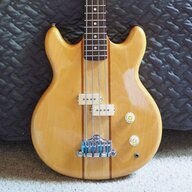
Following up on this post- I have a early 80’s Vantage that to the best of my knowledge does not have a ski ramp (I’ll confirm when I can). This is after decades in many different environments, including long term storage in an attic by the previous owner my understanding. Even though it was a very cheap instrument, the bolt-on neck was made with the Matsumoku approach of five pieces of wood bonded together at alternating grain directions (vertical/horizontal/vertical etc). The above post suggests these necks can end up with a ski jump, but in the estimation of the luthiers here does that construction reduce the risk by increasing the stability & stiffness of the neck?
 
There are a number of schemes aimed at increasing neck stability and stiffness. Alternating the grain directions will not add to the stiffness but may help with stability. But alternating between flat sawn and quarter sawn adds some stress to the wood that may cause problems over time. Flat sawn wood changes dimensionally principally across its width, while quarter sawn mostly changes in thickness. There will be a lot of stress introduced on the glue lines in such a configuration.

But if a neck blank is sawn into strips and every other strip is flipped over, the direction of dimensional change will be consistent and the glue lines will not be unduly stressed. When you flip the strips, more stability can be achieved since as one strip cups the one next to it up-bows and the result is that one cancels the other.

Though alternating flat and quarter sawn would seem to offer stability benefits as well, studies done in the 1930's showed structural failures in this configuration.
 
There are a number of schemes aimed at increasing neck stability and stiffness. Alternating the grain directions will not add to the stiffness but may help with stability. But alternating between flat sawn and quarter sawn adds some stress to the wood that may cause problems over time. Flat sawn wood changes dimensionally principally across its width, while quarter sawn mostly changes in thickness. There will be a lot of stress introduced on the glue lines in such a configuration.

But if a neck blank is sawn into strips and every other strip is flipped over, the direction of dimensional change will be consistent and the glue lines will not be unduly stressed. When you flip the strips, more stability can be achieved since as one strip cups the one next to it up-bows and the result is that one cancels the other.

Though alternating flat and quarter sawn would seem to offer stability benefits as well, studies done in the 1930's showed structural failures in this configuration.
Serek Basses (Jake Serek) published a YT video showing the “flipped strip” method of achieving neck stability (using mahogany) available on their web site. It is very clear and very interesting.
 
  • Like
Reactions: Andyman001