• TalkBass has been independent since 1998. Add your voice.
    Create a free account to reply to discussions, view embedded media, and browse with fewer display ads.
    Join freeLog in
    Want zero display ads or expanded classifieds tools? Compare plans.

GHS BRITE FLATS through-body or topload?

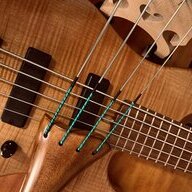
Would it be possible/advisable to string a set of GHS BRITE FLATS (ML3075 - .052 .065 .084 .103) through the body of a 2009 Am. St. P-bass?

If so, what would be the difference, in comparison to topload, in terms of:

a) tone

b) sustain

c) tension?

The aforementioned bass is standard equipped with a "high mass vintage bridge".

Thanks!
 
My experience:
I used brite flats strung through a Peavey T-40 (back in the day) and the only trouble I had was with the outer winding separating at the contact point on the E string- it happened twice, so I went back to rounds. Others string them through without issue, but I thought I would share.
My opinion:
tone- no issue
sustain- not noticeable, but you will have better coupling with the increased downward force on the saddle.

tension- no. People still claim "increased tension", when it is only increased downward force on the saddle. It may be only an issue of semantics here- as some people notice a difference in feel (compliance). The variables for tension (frequency, vibrating string length, mass per unit length) do not change.
 
Back in the day was 1985 on the T-40 and I tried them again in 1990 on a Westone super headless. They were decent, but a little too much "thud" and not enough clarity for my tastes on the E & A strings. Now, my favorite flat would be D'Addario Chromes after a few weeks of breaking-in.
 
Interesting...

According to GHS, Brite Flats, being rounds underneath the flat groundwound surface, are supposedly brighter and should have more definition than typical full blown flats...

Which set should I therefore choose for clarity and crunchiness (that is, no Jamerson style tone), Brite Flats or Chromes?
 
My Music Man StingRay came from the factory in '79 with Brite-Flats. That was when they were string through only. I used Brite-Flats for years with no troubles. However, doing a side-by-side comparison on THE SAME bass (Lakland 44-94) at the same time by stringing two strings top-load and two through the body, there us utterly no discernible difference in sound, feel, sustain, or anything.

John
 
My Music Man StingRay came from the factory in '79 with Brite-Flats. That was when they were string through only. I used Brite-Flats for years with no troubles. However, doing a side-by-side comparison on THE SAME bass (Lakland 44-94) at the same time by stringing two strings top-load and two through the body, there us utterly no discernible difference in sound, feel, sustain, or anything.

John

Thanks! It should then definitely make even less of a difference given the high mass bridge of the 2009 p-bass.

By the way, I have to admit that I just ordered (in addition to the GHS brite flats) a set of D'Addario EXL170BT (a nickel wound balanced set of roundwounds)... I used to hate rounds but somehow at the moment I want to squeeze the most modern tone possible out of the p-bass... By modern I mean anything from, say, Marcus Miller stuff to dance/house synth basslines. Quite certainly an impossible quest with the p-bass, but you never know... the neutrality of the Markbass amp should hopefully help to this end.