• TalkBass has been independent since 1998. Add your voice.
    Create a free account to reply to discussions, view embedded media, and browse with fewer display ads.
    Join freeLog in
    Want zero display ads or expanded classifieds tools? Compare plans.

Gigging Professionals Question

I don’t need one very often, nor do I enjoy using one, but I do have a couple. I’m probably going to sell one though. There are some very high-level pro bass players who don’t even own one and would never buy one, but I think it’s good to keep one around if you do a variety of gigs like I do.
 
Hey y’all. This one is for those who gig for a living:

Do you find that you NEED a 5-string bass in your arsenal? I’ve been doing this a long time and there’s been only three occasions that an act or producer has demanded that I bring a 5 string with me. One of those was just this week and it’s got me thinking that maybe I should buy one just so I have it. But then again, the investment might not generate enough return to make it worth it, given that this has only happened three times so far in almost 20 years.

That said, who’s to say that if I had a 5 banger for those three occasions that it wouldn’t have turned into more paying opportunities? So I ask you again, in your working life, do you find that a 5-string has been an absolute necessity, or have you been able to make do and get your bills paid without one?

(In case you’re curious, I’m considering buying one of the newish Charvel San Dimas JJ V basses)
I bought one because it became the standard for orchestra pit gigs after about 2005.
Kind of expected now for modern church music and the occasional jingle session.
 
My main income isn't music but I'm playing 3 nights a week with different acts and genres.

People haven't ever really told me what bass to play, but they have asked not to play certain things.

I do everything on a 4 string. If I need lower than an E, I detune. I have a Pbass tuned to C standard. I never really needed the open low B specifically when I had a 5 string but an open C is pretty nice.

My only complaint with a detuned 4 string is that I've run out of room on the fretboard at times when transposing. But most of the gigs that pay, aren't paying to hear bass notes that high on the neck.

If you want a 5 string get one but for me it wasn't worth the mental energy of the extra string, and it wasn't worth my time to become an dedicated 5 string player.
 
Nobody ever asked me to play a 5 instead of a 4 string--I just picked up on fivers on my own and liked having those low notes available.

I don't just play every line as low as I can, but I do pick the places where going down there adds something musically. I have had people say they really like that--especially in keys like B minor, C, D, and Eb.
 
I bought one because it became the standard for orchestra pit gigs after about 2005.
Kind of expected now for modern church music and the occasional jingle session.
This is true. I’ve noticed the same.

I don't just play every line as low as I can, but I do pick the places where going down there adds something musically. I have had people say they really like that--especially in keys like B minor, C, D, and Eb.

Eb is a big one, followed closely by D and B minor. Having access to those notes without down tuning would be very useful.
 
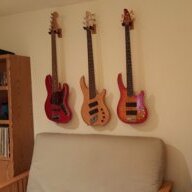
I mean... if you have the cash, and could see where you might want/need a 5 for some things.... just get a cheap 5 and play around. My collection is split, four 4s and four 5s.

I ALWAYS play the 5s at church, except for a few Sundays where I decided to bring a 4 and then regretted not having a 5. I got wise and started bring one of each in a dual bass bag. Then I got wise to the fact that I kept starting with the 4 and then switching to the 5 a couple songs into rehearsal. Now I ALWAYS plays 5s at church again.

I started playing at a regular blues-rock open jam, and was doing fine with just a 4 string the first couple times. This past Wednesday I really wished I had brought a 5. Some knucklehead had us playing a tune in E flat and I hated not having that extra noodle on the fretboard.

I started on a 4 string in 1997, then moved to a 5 string in 2003 and ONLY had a 5 string from 2003 to about 2016. When I decided to buy a 4 again, it was alien to me and I couldn't adapt easily. I sold the 4 quickly. About a year later I tried again. Same thing and I got rid of it. Finally a couple years ago I forced myself to play a 4 string ONLY for a few months, and then reintroduced the 5. Now I can jump back and forth with no issues.

I may be the only chucklehead who had an issue going from 4 to 5 or 5 to 4, but I doubt it. I'd recommend getting one now to fool with so you can be assured you know what you're doing with a 5 when you need to press it in to service.

Heck. You may actually LIKE it.
 
It completely depends on the kind of music you're playing. New country? It's a must. Metal or metal-influenced rock? Also a must. Other genres? It depends.

I bought a 5 string when I agreed to back a recording artist and discovered that the lower notes were used throughout her recorded material. I don't back her anymore, but I also used that 5 string when I worked briefly with a New Country band. Nowadays it mostly sits unplayed because the bands I'm in now don't demand those low notes.

I don't do a lot of recording, but if were called upon to do those genres in the studio, I'd be prepared for it. It doesn't sound like you're getting tons of requests for it, so it might not be worth the expense in your case. I'm glad I have mine in case they're needed, but I haven't really needed them that much.
 
  • Like
Reactions: superheavyfunk
You need a 5 when one of the following is true:
1. You want a 5.
2. Someone who is paying you to play wants you to use a 5.

Best if you are comfortable on the 5 before #2 happens. Depending upon the type of music you play and who you want to pay with, it may never happen.

I started on 4, transitioned to 5 in the early 90s, and then transitioned to 6 in the mid 90s. My #1 since then has been a 6.

I own about 9 basses and only one is a 6. I can play any of my 4s or 5s, but I am most comfortable on the 6. Also, I feel that if I play a 4 or 5 too much it degrades my ability to play the 6. The idea is if you play an extended range instrument long enough, you will eventually adopt new ways of navigating the fret board. On a 6 you can cover a lot of range by playing across the strings, rather than shifting up and down the neck. When I play a 4 or 5, I miss the extra strings and sometimes have to stop and think about how I will play a line, rather than just doing it automatically and without conscious effort. Essentially, if I play a 4 or 5 too long, it changes my thought process and my automated mental map of the fretboard.

I am by no means advocating for you to play a 5 or a 6. Play whatever instrument will serve your needs the best. For all I care, you could play a 3, a 2, or even a 1.


Good luck!
 
Bad approach of the question. 5 strings is not a material investment like a tool for a plumber or car mechanical, but a personal taste for playing.
When I was a kid and beginner, I had only 4 string basses, and always dreamed for a 5er, despite I loved the 70ies, 80ies music which doesn't really need the low B. But the new styles demanded tuning down occasionally to D or even C, hated that...
It gives much more option and choice of sounds... for me the real bass is the 5er since I could got one...
I had some works which MUCH more sounds better with 5er than 4strings.
 
I've been gigging professionally for 22 years, the last 15 of which are almost exclusively on a 4-string. I found a drop tuner to D very helpful in some situations, but I've never found a situation that absolutely needed a low B or C. There isn't much studio work here, but in the work I have done if they really needed a bass/tone they'd provide it. Otherwise I play my 4-string and they're perfectly happy.

Live I do bring various octave and "synth" effects so I can get those really low keyboard sounds and emulate parts that go to low C. Nobody asks for it, of course, but on some gigs it's nice to have the option.
 
When I was actively gigging - active bar bands, corporate wedding bands, sometimes multiple bands at the same time - I generally preferred to use a four string, mostly because I liked playing four string over five. I found that a five string was very handy in new bands and fill in gigs. It's easier to transpose on a fiver than a four.
 
  • Like
Reactions: superheavyfunk
Though retired, I spent 20+ years gigging, mostly as semi-professional, and several years as it with my only job.

When it comes to this evergreen '4-strings vs. (_____________ fill in how many string bass here)' question, I'll cut to the chase:

The only real question is not do I need one, but would a five (or whatever) help me make my best music. That's the only important question. Here's how, in the late 80's, I answered that question.

I started playing bass in the mid 70's. For about the first 10 years, I was never completely comfortable with a four string bass (and bear in mind, fives weren't available then). I came to electric bass from a classically trained keyboard background, and was never entirely comfortable with four strings in that I'd start a figure HERE and then have to shift up THERE to finish it. On keys, all the notes are in a straight line and don't repeat / overlap as on a stringed instrument.

So when fives began to be available from regular (not boutique) sources, I jumped in as now I could play across the strings in a more linear fashion that was more familiar. I found I could cover a lot of ground inside the space of a few frets. Also, there were a lot of keyboard bass parts in 80's music I could now easily duplicate on the bass.

And as others have pointed out, transposing, especially if you play with horns or singers who insist on 'other' keys for their songs, is a breeze. You just shift up or down a few frets, it's like shooting fish in a barrel.

I'd also advise that buying a completely different and foreign feeling bass (a five for occasional use for a long-time four string player) to pick up E-flat, D, D-flat, C, and open low B is a total aggravation and waste of money if you're not going to spend any real time with it. I'd also advise that a four-string bass and a five-string bass, to me, are two different instruments.

So for me, it simply suited my mind and outlook better, was far easier for me to play than a four, and I've played them exclusively since the late 80s (though on a whim I did buy a four-string Squier Jazz a few years ago). It gives me the best chance to do my best. Others can certainly have a different answer, but it simply suits me best in any way I can consider.
 
Hey y’all. This one is for those who gig for a living:

Do you find that you NEED a 5-string bass in your arsenal? I’ve been doing this a long time and there’s been only three occasions that an act or producer has demanded that I bring a 5 string with me. One of those was just this week and it’s got me thinking that maybe I should buy one just so I have it. But then again, the investment might not generate enough return to make it worth it, given that this has only happened three times so far in almost 20 years.

That said, who’s to say that if I had a 5 banger for those three occasions that it wouldn’t have turned into more paying opportunities? So I ask you again, in your working life, do you find that a 5-string has been an absolute necessity, or have you been able to make do and get your bills paid without one?

(In case you’re curious, I’m considering buying one of the newish Charvel San Dimas JJ V basses)
I don't like 5 strings. But, I've been forcing myself to use one. Just because. It's not comfortable. But, I play it just fine. Well, I have a hard time consistently muting the B string if I'm playing on the g string. Like 50/50 clean or mud. But, I don't use the g string all that much anyway, and it will get better with time.
 
  • Like
Reactions: superheavyfunk
In my career I’ve never needed one. The word need makes it a necessity, and it’s never been a case of ‘if you don’t have a 5th string don’t turn up’.

Sure, a lot of theatre parts for more modern shows the 5 string is becoming more useful due to the writing of low notes. Or having to transpose a part which basically sounds awful when it’s moved up the bass instead of down.

Personally I’m comfortable with playing using the E tuned down when I need it, so I’ve always been fine. However, I am starting to toy with idea of one. Then again, do I need 3 basses? No.
 
Though retired, I spent 20+ years gigging, mostly as semi-professional, and several years as it with my only job.

When it comes to this evergreen '4-strings vs. (_____________ fill in how many string bass here)' question, I'll cut to the chase:

The only real question is not do I need one, but would a five (or whatever) help me make my best music. That's the only important question. Here's how, in the late 80's, I answered that question.

I started playing bass in the mid 70's. For about the first 10 years, I was never completely comfortable with a four string bass (and bear in mind, fives weren't available then). I came to electric bass from a classically trained keyboard background, and was never entirely comfortable with four strings in that I'd start a figure HERE and then have to shift up THERE to finish it. On keys, all the notes are in a straight line and don't repeat / overlap as on a stringed instrument.

So when fives began to be available from regular (not boutique) sources, I jumped in as now I could play across the strings in a more linear fashion that was more familiar. I found I could cover a lot of ground inside the space of a few frets. Also, there were a lot of keyboard bass parts in 80's music I could now easily duplicate on the bass.

And as others have pointed out, transposing, especially if you play with horns or singers who insist on 'other' keys for their songs, is a breeze. You just shift up or down a few frets, it's like shooting fish in a barrel.

I'd also advise that buying a completely different and foreign feeling bass (a five for occasional use for a long-time four string player) to pick up E-flat, D, D-flat, C, and open low B is a total aggravation and waste of money if you're not going to spend any real time with it. I'd also advise that a four-string bass and a five-string bass, to me, are two different instruments.

So for me, it simply suited my mind and outlook better, was far easier for me to play than a four, and I've played them exclusively since the late 80s (though on a whim I did buy a four-string Squier Jazz a few years ago). It gives me the best chance to do my best. Others can certainly have a different answer, but it simply suits me best in any way I can consider.


I completely agree. When I made the transition to 5 strings, it took some practice to improve my muting skills and a bit of time to not see a 5 as a 4 string with a flexible thumb rest and a few new low notes. I committed to looking at the instrument as something entirely of itself and not as a modified "familiar" thing.
Hey y’all. This one is for those who gig for a living:

Do you find that you NEED a 5-string bass in your arsenal? I’ve been doing this a long time and there’s been only three occasions that an act or producer has demanded that I bring a 5 string with me. One of those was just this week and it’s got me thinking that maybe I should buy one just so I have it. But then again, the investment might not generate enough return to make it worth it, given that this has only happened three times so far in almost 20 years.

That said, who’s to say that if I had a 5 banger for those three occasions that it wouldn’t have turned into more paying opportunities? So I ask you again, in your working life, do you find that a 5-string has been an absolute necessity, or have you been able to make do and get your bills paid without one?

(In case you’re curious, I’m considering buying one of the newish Charvel San Dimas JJ V basses)

If you see the bass through 4-string glasses alone, there are two 4-string basses in every 5-string (BEAD and EADG). I see the 5 as an instrument in of itself and look at a 4 as missing a string. For my initial transition to playing 5 strings exclusively, I had to up my muting game. Acquiring better muting technique did not hinder my performance. With a 5, I don't need any 4 string basses.