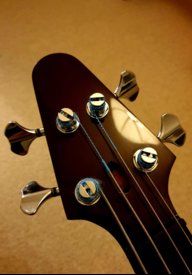
Gilding is mostly seen as a craft, and most gilded things you see are only that. Gold tchachke's, figurines, vases, picture frames, furniture... start looking and you'll see gold-leafing everywhere. Depending on the desired look one is after, you could stop after gilding and sealing and it can look pretty cool. The high-artisan version of 'gilding' is what can happen next - and it's where the gilding itself is a platform/foundation for an artistic effect.
First step was wet sanding the varnish until smooth. It's delicate work as you want to get it smooth w/o breaking through the seal. The closest to smooth guarantees the final clear-coat to be glass-smooth - "factory finish".
I used a well-used sheet of 220 wet-sanding and feeling the finish unit smooth. Dulling the varnish is also important for the following steps.
Once the whole bass is smooth/dulled, I start removing the varnish & gilding with targeted wet-sanding. It's sort of a 'negative effect' - removing rather than adding. "Wear" other than nicks/clips is worn/created by rubbing against it over and over. So for a bass guitar, I focused wear where one interfaces with their instrument while playing over time. The closer mimicking 'real' wear - the more convincing the look. That 'look' is not an attempt to 'fool' anyone - it's an artistic interpretation of natural relic-ing after studying real/natural wear. I started this thread -
SHOW YOUR DISTRESSED FINISHES! 10 years ago to act as a reference library for distressed/relic'd bass guitars and have used it for my own projects - including this one.
Selectively broke through the red oxide to the black factory finish - I guess I'd consider this a moderate relic-job. (mild/moderate/heavy)
Remembered I had a black "Goth" pg to use as an in-progress mock-up. The black pg will visually link with the black hs-face and provide a counter-point/accent to the gold.
Wear mostly at the 'cash register' section of the neck.
After relic-ing, the next steps come into play. This is the artist-oils glaze mix I mentioned. It's thinned with thinner and brushed over the finish.
Once thinly brushed on, I use a rag to pad it which removes glaze and starts to even it out over the surface.
...then, I use a very soft/dry make-up brush to pad the glaze creating a fine stipple texture.
Neck/hs and one wing done - the glaze is translucent so the gold-leaf is still present underneath. Gives the finish an "antique gold" hue.
More breaking through the red oxide at key areas allowing the factory black (halo) to peek through - which are like visual punctuation points.
The wet-sanding allowed the glaze to stick/stain in a random manor which looks very natural/organic. Key to the look is avoiding effecting wear that looks deliberate/designed.
Now, before you say "but, but Geo - it's not shiny gold anymore" - the next step will address that concern.

(tomorrow)