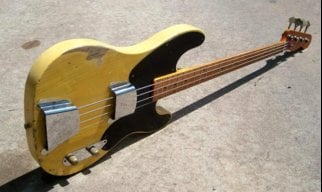
My first 5-stringer (after playing fretted 4 exclusively for number of years) was fretless, to add insult to injury

A mental transition had to be made, of course - remembering that my lowest string is not E, but B.
Advantages of 5, in my mind:
- you have extra range of really deep, low notes;
- you can play in keys like Eb, D, C#, C using your old familiar shapes, but one octave lower;
- when you play in keys between E and A (roughly) you can start them on B-string, instead of E-string, and this gives you lots of range higher up, without having to shift that much;
- you can play some really wicked, earth-shattering octaves using B-string;
- and it is indeed a very good thumb rest
Then, after a couple of years, a 6-stringer followed.
This one has its own merits (talking about BEADGC):
- extended upper range for soloing;
- chordal playing! Chords sound much cleaner;
- even less shifting: practically any shape, any key can be played with a sound that's not too thin, neither too muddy;
- overall range expansion is so f...ing dramatic! Think of that stupendous 4-octave arpeggio run in key of C that you can do on a 6-stringer
And then I brought back a 4-stringer
To learn proper slapping. Because with my fat fingers I need lots of space between strings, and 5-ers and 6-ers are spaced too close, true.




 ) and I don't want to make an investment in one. Plus, I'd like to keep some consistency with my upright and electric basses, and I can imagine that the 5-string upright would take a lot longer to get used to, or to even buy, than a 5-string electric.