I am getting ready to finish a body with teak top and back. Teak is porous and I am planning on doing a gloss finish on this one. You can see the pores in this picture, but based on what I have done so far I did not expect there to be any(!)
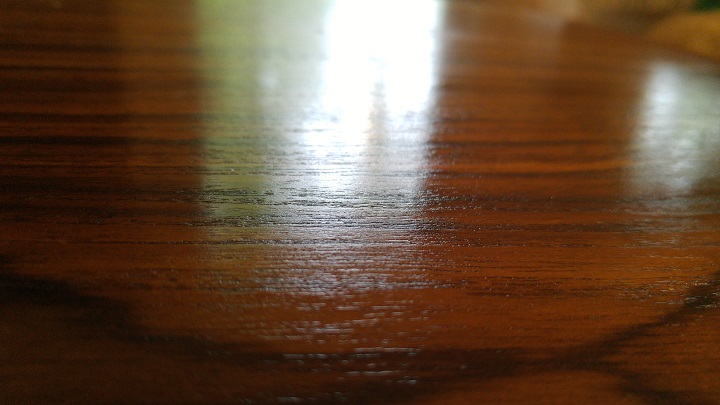
- I sanded the (bare) body to 600.
- Applied a coat of Zinsser Seal-Cote, applied with a foam brush, also lightly fine sanded.
- Tinted some Timbermate with Transtint dark mission brown and applied it with a putty knife
- Gave it a week to dry
- Sanded the Timbermate with 220, 320, 400
- Applied a second Seat-Cote
That's how I got to this point. On my scrap piece it seemed to come out perfectly flat and filled. Maybe I over-sanded the body after that...it looks like I never used any pore filler at all after applying the shellac.
This is the tinted Timbermate applied very heavily onto the test piece
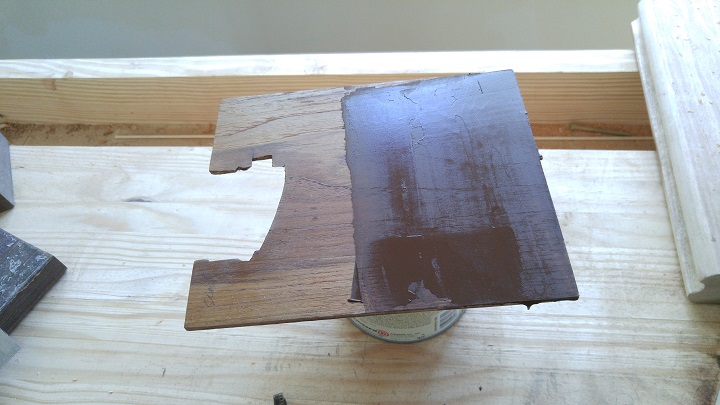
This is the paste going onto the body. Putty knife, lots of pressure, diagonal strokes. Seemed like I was behaving properly(?!)
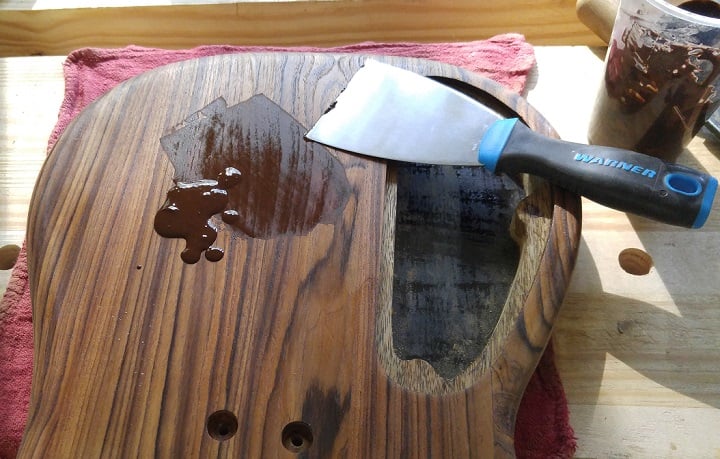
Here's the question; which plan should I go for?
Plan A1 - get some Z-poxy, tint it dark, and apply it over the shellac (which I'll have to sand just a little). Maybe need 2 coats with light sanding.
Plan A2 - do the Z-poxy but first sand it all back to bare wood first.
Plan B - start spraying a light and a heavy coat of Profinishers water based floor finish. Sand that back somewhat. Rinse and repeat until I can level it with no more evidence of pores, then spray a few more coats and level and buff it out.
Plan C - keep applying Seal-Cote and sanding back until the pores are gone, then go to the acrylic gloss.
Plan D - something you suggest I haven't thought of yet.
----------------
Many luthiers here have reported that their grain filler sank after a year, so they switched to epoxy. But my grain filler seems to have disappeared completely after a week or so. Maybe I sanded back too far after applying the Timbermate, and maybe when I applied it I didn't shove it in deep enough, so effectively I removed it. But it sure looked good when I reached for the Seal-Cote.
- I sanded the (bare) body to 600.
- Applied a coat of Zinsser Seal-Cote, applied with a foam brush, also lightly fine sanded.
- Tinted some Timbermate with Transtint dark mission brown and applied it with a putty knife
- Gave it a week to dry
- Sanded the Timbermate with 220, 320, 400
- Applied a second Seat-Cote
That's how I got to this point. On my scrap piece it seemed to come out perfectly flat and filled. Maybe I over-sanded the body after that...it looks like I never used any pore filler at all after applying the shellac.
This is the tinted Timbermate applied very heavily onto the test piece
This is the paste going onto the body. Putty knife, lots of pressure, diagonal strokes. Seemed like I was behaving properly(?!)
Here's the question; which plan should I go for?
Plan A1 - get some Z-poxy, tint it dark, and apply it over the shellac (which I'll have to sand just a little). Maybe need 2 coats with light sanding.
Plan A2 - do the Z-poxy but first sand it all back to bare wood first.
Plan B - start spraying a light and a heavy coat of Profinishers water based floor finish. Sand that back somewhat. Rinse and repeat until I can level it with no more evidence of pores, then spray a few more coats and level and buff it out.
Plan C - keep applying Seal-Cote and sanding back until the pores are gone, then go to the acrylic gloss.
Plan D - something you suggest I haven't thought of yet.
----------------
Many luthiers here have reported that their grain filler sank after a year, so they switched to epoxy. But my grain filler seems to have disappeared completely after a week or so. Maybe I sanded back too far after applying the Timbermate, and maybe when I applied it I didn't shove it in deep enough, so effectively I removed it. But it sure looked good when I reached for the Seal-Cote.