
Part 2
5) re-winding:
you'll need something to hold onto the ball end. i drilled and tapped a #4-40 hole into a block of Delrin close to the edge of one of it's sides and ran a capscrew through the ball end hole and attached it to the block and mounted it into a vise. from the end of wrap Sharpie mark you made earlier, make another one 1/2" to 5/8" away from that mark. this is where you will start your loop. taking a pair of chain pliers (these have tapered round ends) and your string, start making a loop. begin slowly curving the core wire around the groove in the ferrule. you kinda want to do this once if possible, if you have a sharp bend in the wire trying to straighten it out can cause problems or "exploding strings". once you have your loop, start wrapping the core wire over itself like a noose -a nice even coil all the way to your end of wrap. study a couple strings from different manufacturers and see how those look. some will twist the whole thing with their machinery while others seem to have a variable spaced coil.
either way try not to nick the wire as this will make a stress riser at that spot and could lead to breakage. leave a little bit of un-coiled core wire left over. you'll be wrapping cover wire over this later.
6) the outer wrap:
now with your string still attached to your fixture, begin re-winding the cover wire (outer wrap). work slowly and evenly in the same direction that the rest of the string is wrapped remembering to move the wrap around the core like you would if you were wrapping up a handlebar or a tennis racket with grip tape. use the sides of your needle nose pliers every now and then to pack the coils snugly together. work you way back to the ball end. leaving a little bit of a gap at the end near the ferrule like you would with a tie and wrap once around the ball end groove. this probably isn't necessary and i haven't seen any strings that have this feature, but it seems to make sense to me. poke the end through the "vee" one more time, draw it snug and nip it off. on the bass strings i suggest only looping the outer wrap wire not the inner around the ball end as you won't have room for both.
now you're done. take the string off of your fixture, do any minor straightening by hand, string up, stretch and play. if you want threaded wrap go to step 7
7) thread:
with your string still in your fixture, get some thread. i'm using some polyester sewing thread from a pack of Singer spools that i found in the house somewhere. traditionally i think silk is used. you can customize with colors if you like. get your thread and starting from the ball end, lay the thread over the outer wrap wire with a little bit of excess (1/2" or so) hanging out the other side start wrapping in the reverse direction that you did your outer wrap wire and fold the "tail" of thread under your first few wraps catching it there so things stay snug. take the string off your fixture and twirl the thread over the wrap wire with your fingers back and forth over the wrap area that you'd like to cover. you don't have to be super neat here just go for even coverage of about 1/2" to 5/8" in length from the ball end. make sure all of the gaps are covered and bring the last wrap back up to the ball end. get some super glue and apply a small drop on the thread. use a finger to spread it around coating all of the thread. cut the spool loose and you're done.
tool wise i suggest beading or jewelry grade tools, clean with no sharp dings or burrs:
-one pair of needle nose pliers.
-one pair of chain nose pliers.
-one pair of wire cutters.
-good light and/or optics. a magnifying lamp is an excellent choice.
-a ball end holding fixture (make) or a bench vise and a correctly sized nail.
-super glue (optional)
-suitable thread (optional)
hope this was helpful
5) re-winding:
you'll need something to hold onto the ball end. i drilled and tapped a #4-40 hole into a block of Delrin close to the edge of one of it's sides and ran a capscrew through the ball end hole and attached it to the block and mounted it into a vise. from the end of wrap Sharpie mark you made earlier, make another one 1/2" to 5/8" away from that mark. this is where you will start your loop. taking a pair of chain pliers (these have tapered round ends) and your string, start making a loop. begin slowly curving the core wire around the groove in the ferrule. you kinda want to do this once if possible, if you have a sharp bend in the wire trying to straighten it out can cause problems or "exploding strings". once you have your loop, start wrapping the core wire over itself like a noose -a nice even coil all the way to your end of wrap. study a couple strings from different manufacturers and see how those look. some will twist the whole thing with their machinery while others seem to have a variable spaced coil.
either way try not to nick the wire as this will make a stress riser at that spot and could lead to breakage. leave a little bit of un-coiled core wire left over. you'll be wrapping cover wire over this later.
6) the outer wrap:
now with your string still attached to your fixture, begin re-winding the cover wire (outer wrap). work slowly and evenly in the same direction that the rest of the string is wrapped remembering to move the wrap around the core like you would if you were wrapping up a handlebar or a tennis racket with grip tape. use the sides of your needle nose pliers every now and then to pack the coils snugly together. work you way back to the ball end. leaving a little bit of a gap at the end near the ferrule like you would with a tie and wrap once around the ball end groove. this probably isn't necessary and i haven't seen any strings that have this feature, but it seems to make sense to me. poke the end through the "vee" one more time, draw it snug and nip it off. on the bass strings i suggest only looping the outer wrap wire not the inner around the ball end as you won't have room for both.
now you're done. take the string off of your fixture, do any minor straightening by hand, string up, stretch and play. if you want threaded wrap go to step 7
7) thread:
with your string still in your fixture, get some thread. i'm using some polyester sewing thread from a pack of Singer spools that i found in the house somewhere. traditionally i think silk is used. you can customize with colors if you like. get your thread and starting from the ball end, lay the thread over the outer wrap wire with a little bit of excess (1/2" or so) hanging out the other side start wrapping in the reverse direction that you did your outer wrap wire and fold the "tail" of thread under your first few wraps catching it there so things stay snug. take the string off your fixture and twirl the thread over the wrap wire with your fingers back and forth over the wrap area that you'd like to cover. you don't have to be super neat here just go for even coverage of about 1/2" to 5/8" in length from the ball end. make sure all of the gaps are covered and bring the last wrap back up to the ball end. get some super glue and apply a small drop on the thread. use a finger to spread it around coating all of the thread. cut the spool loose and you're done.
tool wise i suggest beading or jewelry grade tools, clean with no sharp dings or burrs:
-one pair of needle nose pliers.
-one pair of chain nose pliers.
-one pair of wire cutters.
-good light and/or optics. a magnifying lamp is an excellent choice.
-a ball end holding fixture (make) or a bench vise and a correctly sized nail.
-super glue (optional)
-suitable thread (optional)
hope this was helpful
Last edited:

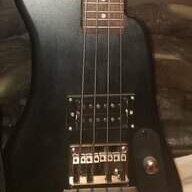


 Will report back here on the string length and where the taper begins.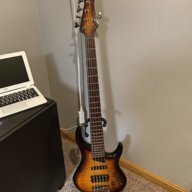


 After finding a case at Goodwill, my out of pocket cost was $35. After finishing, that may go up a little. Scale is 25.25.