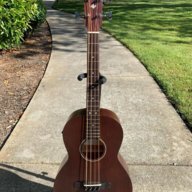
It think a better question would be why Guild would build the Jumbo Junior to suit steel-core strings.So who thinks Guild (Cordoba?) would build the Jumbo Juniors to only handle the synthetic core D'addarios?
I grew up in a family music business. I was got my first acoustic guitar in 1962. I spent countless hours in the repair departments of the music stores that my dad managed, and I've seen every destructive customer error known to man.
In addition, one of my friends is a highly-skilled luthier who has built custom instruments for the likes of Bruce Cockburn, Stephen Bennett and Tommy Emmanuel. He also gets to restore and modify a lot of valuable vintage instruments. I'm not a skilled luthier (solid-bodies are more my speed), but I've known Tony for over 25 years, watched him build dozens of instruments in his shop, travelled with him to guitar shows, had the opportunity to shoot the breeze with a ton of other top-ranked luthiers, and seen the insides of a wide range of acoustic instruments in the process.
This is the sum of my experience in this area:
Building a lively, resonant guitar is a balancing act. It must be built just strong enough to last, but not so heavy that it chokes off the tone and acoustic output.
An over-built instrument can withstand a lot of extra string tension, but the downside is a noticeable loss of acoustic output and tone.
This is why a serious nylon string conversion on a steel-strung guitar involves shaving the braces. Even then, they never measure up to a good, purpose-built classical guitar.
Which brings us to the subject at hand:
- The Taylor GS mini has a warranty warning against using other strings.
- The obvious implication is that the Taylor is lightly braced, in order to give good response with the stock strings.
- The average tension on the stock D'Addarios is around 12.5 lb per string.
- The EXPPB170S hex-core bronze wounds that came on the MK Sojourn 4K average about 23.75 lb per string, about a 55% increase.
- The Guild is built on a slightly longer scale than the Taylor, so string tension with equivalent sets is higher.
- If the Guild came from the factory over-braced and ready for heavier strings, the bass response and overall output would not be as loud as the Taylor out of the box. Also, the intonation with the stock nylon-cores would be off a noticeable amount at the 12th fret.
The Guild handles the La Bella CB40 nylon-cores quite nicely, but I would estimate that they are maybe 10% stiffer than stock.
I would only use heavy flats on the Guild, if I intended to downtune it. Otherwise, I would expect to be into major repairs within two to three years at best.
If I was going to do a steel string conversion on one a nylon-strung GSAB, I would probably start with an Ibanez PNB because of the heavier, laminated top. Plus, the low price makes it more disposable.