• TalkBass has been independent since 1998. Add your voice.
    Create a free account to reply to discussions, view embedded media, and browse with fewer display ads.
    Join freeLog in
    Want zero display ads or expanded classifieds tools? Compare plans.

Has anyone "downgraded" from a boutique bass?

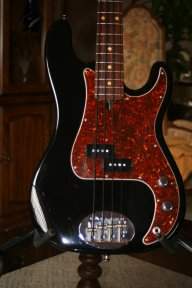
I'm finding I seem to like my passive P better than my active 5 lately. I wonder if my tastes are changing. But them I pick up my 5 and think, damn, this is an awesome bass. It plays so much better than any of my other basses, past or present, it's hard not to make it my #1. But theres something about the passive P with flats. Finger style is great for older stuff, country, even some pop/rock. Played with a pic is also a great tone, especially for harder "rock" stuff. I just can't decide.
That's me :)
Only 5 or 4 string passive P or PJ for me during the last 12 years!
 
My Roscoe has a toe in both realms. The quilted maple top (with a lighter stripe layer bent over the forearm bevel) is a little on the boutique side.
But the hardware & electronics are utilitarian - in the best possible way. This has become my bread 'n butter 5-string, the one I grab when technical reliability & a Fender-like sonic presence are a priority.
What doesn't come through in any picture is the way this instrument responds so evenly in every register. Whatever I play gets heard as intended.
I've tried then ultimately sold a bunch of classic passive bolt-ons and exotic neck-thru active basses that lacked this attribute.
View attachment 5252045
Hard to beat a Roscoe Century Standard Plus 5. That's been my #1 for years...until I got a Roscoe Classic Precision. Flats. a pick. Great rock tone. Finger style kills as well. I can't decide which one to play. I may have to just start playing both at gigs.
 
  • Like
Reactions: Jefenator
While vacillating between fancy and basic over the years has been my pattern (first bass was a parts P, second bass was a Warwick), I'll say that the overall take when it comes to any of them is, the quality and consistency are what kept me playing them... not the price tag.

I've played some very well built and reliable "cheap" basses and I've been let down by the overly-spendy "expensive" basses and vice versa.

The one boutique brand I will always desire again is STATUS though. It's my personal favorite of any uber-expensive boutique bass, but at the height of their success, was still coming in vastly cheaper than various other well-known boutique names.
Any time I had to sell one, I was pretty sad to see it go. The same couldn't be said for a number of others which cost me more.

That does bring to mind though, I had a Status Empathy and it was great, but my band sitch called for something more traditional. I ended up with a Fender American Deluxe with an East preamp, which was awesome and I loved it dearly as well (2003 build, probably the best era I've felt in Fenders myself). I wasn't sad to use that versus the Status and ended up moving the Status for a tidy profit.
It wasn't until I later realized that replacing said Status was gonna be very hard in general, let alone for a similar price, whereas I could get that kind of Fender much more frequently.
 
I recently had to put my boutique bass for sale due to an unforeseen financial situation. It's my sole bass, so my intention is to grab a cheaper bass in the US$1,500 range when it sells.

I went to the store today to try some basses and came away disappointed... Basses I happily owned years ago seemed unplayable. 7.25-inch and 9.5-inch radiuses felt odd and uncomfortable. Action and string height felt miles apart from my bass's neck relief of 0.010" and string height of 2/32. Strings were stiff. The Fender Jazz Ultra's preamp sounded metallic and sterile.

I guess a lot of these issues could be fixed with a proper setup, but I don't know. I guess I've been spoiled.

Has anyone "downgraded" from a boutique bass? How was your experience?
Me personally I don't think it's all about how much money you spend, it's the player and how the instrument feels to the individual, electronics and such can be changed, I've picked up high end/vintage high end stuff and they played like poopie! also...some played fantastic! I've also played some super cheap basses that played awesome as well, measurements and price tags don't make the bass for me, pick it up, play it, and don't look at the headstock, that's me anyway, everyone marches to their own bass line lol...a Peavey Cirrus might be something to consider if your looking to spend over $1000 or two.
 
My main bass is a US Spector; I love Spector basses and don't see that changing anytime soon, but I'd have absolutely no problem playing a $500 bass if it did what I required.

I do know that I no longer care for Fender's traditional basses - I still love their sound and look, but I greatly prefer smaller, rounded/curved bodies and active EQ. I think Ibanez Soundgears are great for bang-for-the-buck, and if I had to downgrade, I'd be more than happy with one of their SRs (and probably slap EMGs on them). Though I also like Yamaha's BB series.

(I do have a couple of Spector Euros which I suppose are also downgrades, and I'd definitely have no problem just playing those).
 
When it comes down to it? How does it feel in your hands, how does it sound?

There is a reason the HB and Glarry axes are so popular. More ppl can afford them and they perform adequately.

I've never laid my hands on one, so I can not verify my statement.
 
My main bass is a US Spector; I love Spector basses and don't see that changing anytime soon, but I'd have absolutely no problem playing a $500 bass if it did what I required.

I do know that I no longer care for Fender's traditional basses - I still love their sound and look, but I greatly prefer smaller, rounded/curved bodies and active EQ. I think Ibanez Soundgears are great for bang-for-the-buck, and if I had to downgrade, I'd be more than happy with one of their SRs (and probably slap EMGs on them). Though I also like Yamaha's BB series.

(I do have a couple of Spector Euros which I suppose are also downgrades, and I'd definitely have no problem just playing those).
Keep your US Spector and be an happy man ! I would invest myself ($$$) in such and good bass if it would suit my needs and fit the songs I play but, eh, I 'm "vintage" guy so Fender-like design is the way to go for me.
 
  • Like
Reactions: Bass Ape
since you don't have this pressing need to optimise for low power (even with advanced electronics, low power will mean more noise or distortion, usually noise).
Not really if you know what you're doing.
If you use an opamp for the buffer, you have the same issue WRT noise as you don't actually need any gain for the onboard pre outside of the EQ boost (if activated in use). If you use a JFET buffer, and build it as a simple follower, then the variability in the individual JFETs will mean you need to spend a lot of time matching them to get consistent performance unit to unit, accept they will all perform differently over quite a wide range, or build a more complex circuit with more gain and NFB to even out the performance. JFETs also aren't cheap any more as they're a niche product.

Using BJTs will have similar, but different, issues.

Not sure why I never went that route.
Because it doesn't sound the same as an individually buffered input preamp and you still have the passive loading of the pots and the capacitance of the cable.
 
Not really if you know what you're doing.
If you use an opamp for the buffer, you have the same issue WRT noise as you don't actually need any gain for the onboard pre outside of the EQ boost (if activated in use). If you use a JFET buffer, and build it as a simple follower, then the variability in the individual JFETs will mean you need to spend a lot of time matching them to get consistent performance unit to unit, accept they will all perform differently over quite a wide range, or build a more complex circuit with more gain and NFB to even out the performance. JFETs also aren't cheap any more as they're a niche product.

Using BJTs will have similar, but different, issues.
On the other hand, having just a simple buffer means that you can use an opamp with higher current/lower noise because you only have the one opamp (or maybe two, in two pickup basses, one per pickup, if you want them individually buffered) instead of, dunno, four?, in a more complex preamp. Also, distortion and noise concerns in general are lower since there is no gain.

Because it doesn't sound the same as an individually buffered input preamp and you still have the passive loading of the pots and the capacitance of the cable.
I think he didn't do it just because he didn't do it, not because of any technical concerns.
 
On the other hand, having just a simple buffer means that you can use an opamp with higher current/lower noise because you only have the one opamp (or maybe two, in two pickup basses, one per pickup, if you want them individually buffered) instead of, dunno, four?, in a more complex preamp. Also, distortion and noise concerns in general are lower since there is no gain.
It's not difficult to get opamps with SNR that the noise is not a significant issue, especially when reference to the self noise of the pickups themselves.

Using a single opamp, irrespective of the model and having 2 PUs with a blend, still brings the loading of the pots, same as using a pedal, but without the C issue. But simply putting the pre in an external case like a pedal doesn't mean it's going to have much better THD/N because manufacturers tend to use the cheapest components they can source that will just do the job well enough. This is not true for all, but it is at the bottom end of the market where most buyers are.

The reason onboard pres are noisy is because they're poorly designed and/or specified as there has been a considerable amount of development in recent years for hi quality analogue opamps for the actual money making applications like mobile devices.

I think he didn't do it just because he didn't do it, not because of any technical concerns.
I simply explained what the technical limitations might be.
 
That's ok, but the thing is, battery power (and expectations of battery longevity) are a big bottleneck. Whatever you can do with an onboard preamp can be done much better even with just a pedal, since you don't have this pressing need to optimise for low power (even with advanced electronics, low power will mean more noise or distortion, usually noise). On the other hand, there is an argument for an onboard *buffer*, since that helps the instrument's signal travel along the cables with much lower degradation. You need very few parts for a very good buffer. It also means that you can plug your bass into any DI without any concerns whatsoever.
I've only had batteries die on me due to my own negligence, and that was back in the 80s.....I change batteries as regularly scheduled maintenance and i havent had one die on me onstage in nearly 30 years. I change my strings very often ( i prefer them new) and treat batteries in a similar manner......Having the EQ on my bass gives me hands-on control of tweak on-the-fly adjustments faster and more efficiently than walking back to an amp ( which i dont send to FOH anyway) or stooping down to mess with pedals or my processor ( a Zoom B6 - which I use mainly for compressor, i also have a "fake fretless" patch for those songs, custom generalized shaping patches for specific basses, and I use the B6 as my DI.....yeah, I know: a B6 is overkill for my needs lol)
 
Last edited:
  • Like
Reactions: Snert
I've owned MTD's, Roscoes, a Dingwall, a Ken Smith 6 and an F Bass BN6, all of which would be considered boutique or boutique-adjacent. The only one of those I still have is an MTD 535-24. It is an undeniably great axe, but it only gets about 10% of the play time these days vs. my less expensive instruments. The top 2 of those as far as amount of use are a Bluesman Vintage El Dorado V and a Fender Road Worn P-bass.
 
Last edited:
  • Like
Reactions: LadyLoveStingRay5
The pendulum does seem to be swinging away from "boutique" and back to "basic" basses. I'll never sell my Roscoe 5. But I do tend to reach for it less these days.

Sean Hurley for example, used to play a Lakland 55-94. Now plays a precision (his signature even) for many gigs.
Pino has mostly played a P for years.
Yet, Jimmy Johnson pretty much exclusively plays his Alembic, even with James Taylor.

Not sure what that means other than play what you like and what works.
 
The more I try out basses in music stores, the more I realize my issue isn't so much "boutique" vs. "production" basses, but that I've grown accustomed to large 6-string necks with the flatter radiuses (20") and shorter string spacings (17.5 mm).

Wonder if I should just get a 4-string Jazz or Precision and get used to that again or a 5-string Stingray (17.5 mm string spacing).
 
  • Like
Reactions: LadyLoveStingRay5