
Enjoy the benefits of a premium membership!
Upgrade Account
-
TalkBass has been independent since 1998. Add your voice.
Create a free account to reply to discussions, view embedded media, and browse with fewer display ads.
Join free Log in
Want zero display ads or expanded classifieds tools? Compare plans.
You are using an out of date browser. It may not display this or other websites correctly.
You should upgrade or use an alternative browser.
You should upgrade or use an alternative browser.
Has anyone "downgraded" from a boutique bass?
- Thread starter Just Wrong
- Start date
More options
Who Replied?

songwriter21
I have an obsession for wood. The musical kind.
I recently had to put my boutique bass for sale due to an unforeseen financial situation. It's my sole bass, so my intention is to grab a cheaper bass in the US$1,500 range when it sells.
I went to the store today to try some basses and came away disappointed... Basses I happily owned years ago seemed unplayable. 7.25-inch and 9.5-inch radiuses felt odd and uncomfortable. Action and string height felt miles apart from my bass's neck relief of 0.010" and string height of 2/32. Strings were stiff. The Fender Jazz Ultra's preamp sounded metallic and sterile.
I guess a lot of these issues could be fixed with a proper setup, but I don't know. I guess I've been spoiled.
Has anyone "downgraded" from a boutique bass? How was your experience?
I recently bought the priciest bass of my life...basically a car's down payment. Thought it'd be amazing. Nnnnnnoope. Granted, it was used, but still in nice shape, and crazily didn't set up as well as my $560 Schecter (modified bridge, mind you). That's just me, if course, but holy cow, what a revelation. I won't say the builder/name, just that a LOT of money in their instruments is due to a small US staff, pricey materials, and laborious man-hours. Again, this was my experience.
You really can find an amazing bass for cheap...as long as the neck is stable!

Last edited:


Loading of the pots may be desirable, because presenting a very high impedance to the pickups will increase their resonant peak. That said, today you can certainly source opamps with performance unthinkable fifteen years ago, but I still maintain that whatever job they can do can be done better with a proper +/-15V power supply. Or even a 9V supply but with no current constraints. I mean, it's objective. What R&D has given us is fantastic optimization, but you can only go so far. By the way, I see onboard EQs promising +/-18dB boosts. That is... extravagant.It's not difficult to get opamps with SNR that the noise is not a significant issue, especially when reference to the self noise of the pickups themselves.
Using a single opamp, irrespective of the model and having 2 PUs with a blend, still brings the loading of the pots, same as using a pedal, but without the C issue. But simply putting the pre in an external case like a pedal doesn't mean it's going to have much better THD/N because manufacturers tend to use the cheapest components they can source that will just do the job well enough. This is not true for all, but it is at the bottom end of the market where most buyers are.
The reason onboard pres are noisy is because they're poorly designed and/or specified as there has been a considerable amount of development in recent years for hi quality analogue opamps for the actual money making applications like mobile devices.

Which can be replaced by a single resistor at the input of individually buffered pickups selected to give the specific load desired by the designer and therefore the desired FR. The same resistor that's at the input of pretty much every stage, opamp or discrete.Loading of the pots may be desirable, because presenting a very high impedance to the pickups will increase their resonant peak.
It's not needed on the input of an ADC with THD+N getting towards the asymptote of what's actually possible. Implementation and good design rule here.but I still maintain that whatever job they can do can be done better with a proper +/-15V power supply.
I'm an EE and have been designing linear electronics for a long time.
Agreed, stupid and unnecessary.By the way, I see onboard EQs promising +/-18dB boosts. That is... extravagant.
Of course, I was just saying that pot loading might not be a problem at all.Which can be replaced by a single resistor at the input of individually buffered pickups selected to give the specific load desired by the designer and therefore the desired FR. The same resistor that's at the input of pretty much every stage, opamp or discrete.
If we're talking about digitalising a signal, of course going digital (these days) is going to be much "cleaner" and any digital EQ is going to be far more flexible than an analog EQ, at the price of a very small latency. Which again tells me that you can leave tone shaping to separate stuff and leave on-board electronics to do what is most needed (if it is at all), which is buffer the signal. (Or embrace non-linearities and go with a deliberately "coloured" preamp). Of course, there is no "right" solution, I do get @Rib 13 's desire for convenience and that's why on-board EQs even exist. All I'm saying is that if I were a small-scale bass manufacturer (staying on topic) I would probably go with fully discrete electronics (since the small-scale actually allows you to do so) or even with opamps, but I wouldn't bother with active EQ apart from some very light-handed tone shaping, and/or I would take advantage of the buffers to actually use tone controls for each pickup independently, for instance.It's not needed on the input of an ADC with THD+N getting towards the asymptote of what's actually possible. Implementation and good design rule here.
I'm an EE and have been designing linear electronics for a long time.

By the way, I see onboard EQs promising +/-18dB boosts. That is... extravagant.
+1.......totally agree......and my Sire goes +/- 24db


Passinwind
I know nothing.
- Dec 3, 2003
- 23,093
- 46,077
- Disclosures
- Designer/Toaster Tech @ Passinwind Electronics
Agreed, stupid and unnecessary.
I butted heads over that with one luthier client for years. I finally discerned that his cutomers who were demading that were Jazz Bass users who heavily favor their bridge pickup.

It has nothing to do with EQ in the digital domain, nor latency, but with the design of the linear electronics before the ADC IC.If we're talking about digitalising a signal, of course going digital (these days) is going to be much "cleaner" and any digital EQ is going to be far more flexible than an analog EQ, at the price of a very small latency. Which again tells me that you can leave tone shaping to separate stuff and leave on-board electronics to do what is most needed (if it is at all), which is buffer the signal.
Here is a snip from the datasheet of one of the ADCs I've designed with; tell me why I need +/15V rails to get excellent performance when these complete circuits have vanishingly low THD+N, near the asymptote as I said in my previous post where I was responding to your claim. Even compromising with a single B+ which will lower the final noise floor some to provide the Vcom, and a 9V rail, it will still be significantly better than RBCD standard.

I had one boutique bass downgrade to me once. Played it a lot for two years at rehearsals etc but was always worried something might happen to it. Then the band started gigging dodgy places & my car broke down. Those things combined made me sell it (so the bass upgraded to a real player) & go back to the instruments my skills deserve
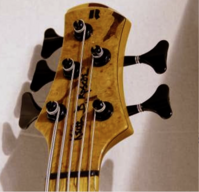
I had one boutique bass downgrade to me once. Played it a lot for two years at rehearsals etc but was always worried something might happen to it. Then the band started gigging dodgy places & my car broke down. Those things combined made me sell it (so the bass upgraded to a real player) & go back to the instruments my skills deserve
Boutique basses are fine and good, but considering 'The Nightfly' which used 4 different world-class bass players all of whom played sub-$1000 Fenders at the time, 'real players' don't need them. Bottom line - skills be damned, get what you want. It doesn't have to be boutique, but no apologies or permission needed if it is.
Last edited:
Of course, of course... But the point stands. If you can have this performance on low power, you can get even better on higher power. You might say, but it doesn't really matter. Yes, it doesn't... Or it might not anyway. But then again, if you are using stompboxes of any sort, you might not want to EQ your signal beforehand. Distortion like little bass in the input signal, compressors may react too strongly on lower notes. From a merely technical standpoint, you can certainly design an excellent onboard EQ, but I still maintain that such stuff is better done further down the chain (by the way, with none of the constraints).It has nothing to do with EQ in the digital domain, nor latency, but with the design of the linear electronics before the ADC IC.
Here is a snip from the datasheet of one of the ADCs I've designed with; tell me why I need +/15V rails to get excellent performance when these complete circuits have vanishingly low THD+N, near the asymptote as I said in my previous post where I was responding to your claim. Even compromising with a single B+ which will lower the final noise floor some to provide the Vcom, and a 9V rail, it will still be significantly better than RBCD standard.
View attachment 5254606
My name is Ben and I'm a GAS-aholic. I've owned a number of amazing basses and have really found the sweet spot to be in the $1500-$2000 range give or take. I've owned Zon, Benavente, Sadowsky, Warwick, MTD Elrick and some other Customs as well as an array of MusicMan, Fender, Ibanez blah blah blah.
I'm no longer a gigging bassist and can't justify $3-5K sitting on a rack plus I never… EVER took my expensive basses to a gig unless it was a low key sit-down affair. At a gig I just wanted something light that sounded reasonably good and had a good neck. My Fenders/G&L always fit that bill. I found that once my tone reached front of house it was rarely the sound I had in my head anyway.
I tend toward a more aggressive tone, less than 19mm spacing and a fatter/rounder neck with more radiused fingerboard. That eliminates a lot of instruments right there. I had a Lull P/J that was 35" that sounded great but the extra scale length on a Fender style bass never felt right. It's mostly about feel IMO. Electronics and hardware can be upgraded ( another con for going for high end basses using proprietary do-dads) to get the sound you like but you can't fix a bad feeling bass.
Currently I have a few basses that cover a variety of sounds and styles. G&L L-2500 is my face melting Fender Style do-it all. Ibanez ATK 805 is another Swiss army bass with that MusicMan style neck profile. Fender MIM P/J because reasons. My cheapest bass but plays beautifully. Upgraded with SD quarter pounders, badass bridge and Audere preamp. Ibanez EHB 1505MS. The Neck on the EHB is a wide/flat neck and , frankly, I dislike the feel. It's light and sounds pretty good though. Warwick Thumb NT from 2001 with Wenge Neck. Again, love hate relationship with the Thumbs. Super unique sound and baseball bat neck but I still hate the Ergos. My Dingwall NG3 is probably my favorite modern sounding bass that I've owned. These basses aren't necessarily cheap but sit in that $1500-2K sweet spot. I snatched the Warwick up for under 2K which was a pretty good deal but I'll likely end up selling or trading it down the line as its a pretty niche instrument and I've got GAS for other things.
I'm no longer a gigging bassist and can't justify $3-5K sitting on a rack plus I never… EVER took my expensive basses to a gig unless it was a low key sit-down affair. At a gig I just wanted something light that sounded reasonably good and had a good neck. My Fenders/G&L always fit that bill. I found that once my tone reached front of house it was rarely the sound I had in my head anyway.
I tend toward a more aggressive tone, less than 19mm spacing and a fatter/rounder neck with more radiused fingerboard. That eliminates a lot of instruments right there. I had a Lull P/J that was 35" that sounded great but the extra scale length on a Fender style bass never felt right. It's mostly about feel IMO. Electronics and hardware can be upgraded ( another con for going for high end basses using proprietary do-dads) to get the sound you like but you can't fix a bad feeling bass.
Currently I have a few basses that cover a variety of sounds and styles. G&L L-2500 is my face melting Fender Style do-it all. Ibanez ATK 805 is another Swiss army bass with that MusicMan style neck profile. Fender MIM P/J because reasons. My cheapest bass but plays beautifully. Upgraded with SD quarter pounders, badass bridge and Audere preamp. Ibanez EHB 1505MS. The Neck on the EHB is a wide/flat neck and , frankly, I dislike the feel. It's light and sounds pretty good though. Warwick Thumb NT from 2001 with Wenge Neck. Again, love hate relationship with the Thumbs. Super unique sound and baseball bat neck but I still hate the Ergos. My Dingwall NG3 is probably my favorite modern sounding bass that I've owned. These basses aren't necessarily cheap but sit in that $1500-2K sweet spot. I snatched the Warwick up for under 2K which was a pretty good deal but I'll likely end up selling or trading it down the line as its a pretty niche instrument and I've got GAS for other things.
I have a friend whole recently bought a vintage sports car. He is very thrifty so all of his friends were shocked. (Maybe saving his pennies is how he could afford that car, but I digress.) Last I heard he is selling it. My guess is he realized that he could not run to the store for grocceries or the hardware store for paint. Plus, I bet an oil change is $500.
This reminds me of this thread. Sure boutique instruments are fantastic in quality materials and build, but would you really want to take it to a bar gig where someone would steal it or spill their beer on it?
This reminds me of this thread. Sure boutique instruments are fantastic in quality materials and build, but would you really want to take it to a bar gig where someone would steal it or spill their beer on it?
I have a friend whole recently bought a vintage sports car. He is very thrifty so all of his friends were shocked. (Maybe saving his pennies is how he could afford that car, but I digress.) Last I heard he is selling it. My guess is he realized that he could not run to the store for grocceries or the hardware store for paint. Plus, I bet an oil change is $500.
This reminds me of this thread. Sure boutique instruments are fantastic in quality materials and build, but would you really want to take it to a bar gig where someone would steal it or spill their beer on it?
My thoughts exactly. I loved my "coffee table" basses. They were just great to look at and occasionally also great to play. I totally get buying a custom bass if you can afford it and that's what you enjoy. If it makes you happy , more power to you.

I recently bought the priciest bass of my life...basically a car's down payment. Thought it'd be amazing. Nnnnnnoope. Granted, it was used, but still in nice shape, and crazily didn't set up as well as my $560 Schecter (modified bridge, mind you). That's just me, if course, but holy cow, what a revelation. I won't say the builder/name, just that a LOT of money in their instruments is due to a small US staff, pricey materials, and laborious man-hours. Again, this was my experience.
You really can find an amazing bass for cheap...as long as the neck is stable!
When I spent a huge amount on a bass, I had the opposite effect. The new bass was so great to play, and that despite I already felt that my basses were setup great.
The sound as well was insane.
However I do agree that today you find amazing basses for decent money. My prefered 4 string is an SR Ibanez and nothing has yet come close in terms of sound/playability (changed preamp tho).
For 5 string the boutique bass made a huge difference
I love my coffee table bass. But at the moment, the passive P (also made by my coffee table guy) is what I'm liking.My thoughts exactly. I loved my "coffee table" basses. They were just great to look at and occasionally also great to play. I totally get buying a custom bass if you can afford it and that's what you enjoy. If it makes you happy , more power to you.

I've had and then moved on more than a few "boutique" basses - Alembics, Wals, etc. Loved them all, but as many others said, I wasn't comfortable taking them to gigs (though I did gig a Wal once) and I couldn't justify all that money just sitting at home on the stand while I'm out working. If I was earning a living from gigging, then maybe. When I earn more money than what I do now, then maybe I'll get another one of that quality.
I've recently adopted something similar to the "Sith Rule of Two." I'm down to two basses, and it's going to stay that way. If something catches my eye, one has to leave to make room. I still have my first bass ever as well, but its a cheap 20 year old MIK Rogue that no one would ever pay any money for, so it doesn't count.
Wholly agreed, especially on the used market, that money still goes a long way - Rickenbacker, EBMM, USA Fender, etc.
I've recently adopted something similar to the "Sith Rule of Two." I'm down to two basses, and it's going to stay that way. If something catches my eye, one has to leave to make room. I still have my first bass ever as well, but its a cheap 20 year old MIK Rogue that no one would ever pay any money for, so it doesn't count.
I've owned a number of amazing basses and have really found the sweet spot to be in the $1500-$2000 range give or take.
Wholly agreed, especially on the used market, that money still goes a long way - Rickenbacker, EBMM, USA Fender, etc.


