Ok, I hear you. But part of my point was - well first let my clarify. I'm assuming that when you talk about the rails not being tapered, you mean being the same distance apart at the two end anchorages. The problem is that this still does not make them the same distance apart along their full length. They are still closer together at their centers.
This is because the two lines are skew in 3d space, are not coplanar.
Imagine this thought experiment. Start with two rails, dead parallel. Now twist one pair of ends (while keeping the other ends fixed). You can do this either by rotating both tips around an imaginary center point between them, or by holding one tip fixed and moving the other in a circular arc around it. Either method keeps these two tips at a fixed distance to each other. But, you'll see as you get to 180 degrees of sweep, the rails cross each other and make an "X". There is zero distance between them.
The problem, then, is that as you went from 0 to 180 degrees rotation, the distance between rails at their middle parts was gradually decreasing. With any twist at all, the midlength separation is less than the end separation.
Hence the need to have a carriage that will allow for this, by not fixedly attaching to the second rail. There's got to be some kind of sliding action, or other compensation.

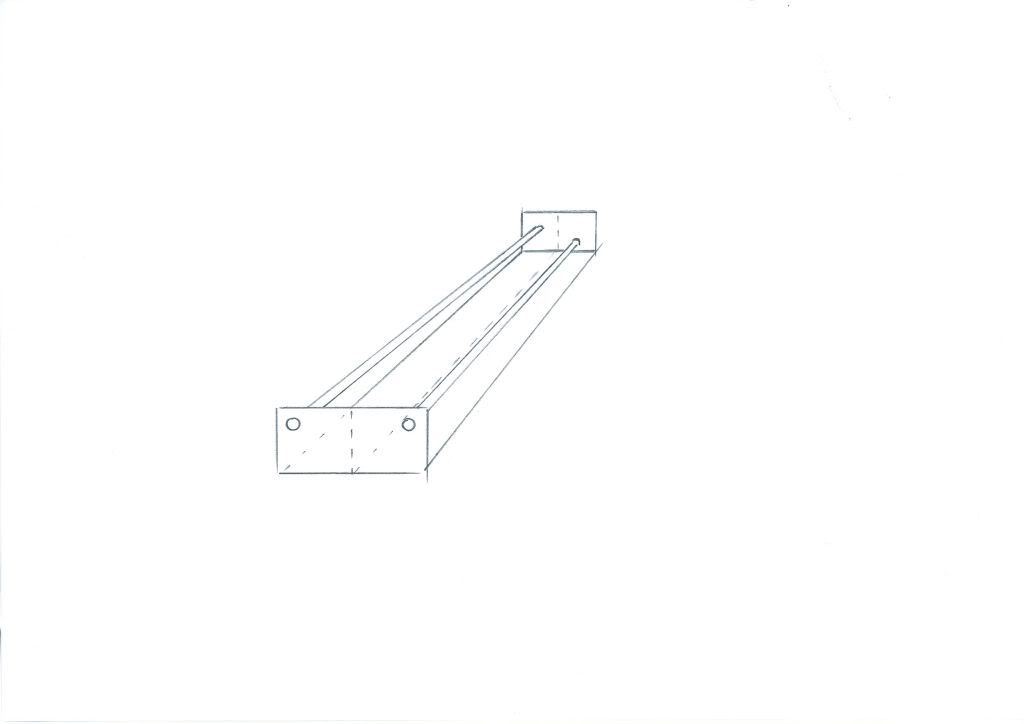




 ) make the ends the same, and put a pivot point in the middle of the anchor plates, so the angle of the rotation can be controlled in both ends.