• TalkBass has been independent since 1998. Add your voice.
    Create a free account to reply to discussions, view embedded media, and browse with fewer display ads.
    Join freeLog in
    Want zero display ads or expanded classifieds tools? Compare plans.

have the D's toppled the SVT's?

You're right about this kind of "gigging musician". This kind of touring guy doesn't necessarily have a ton of money to throw at new gear....find what works, pay for it and stick with it. And when you're already loading a full band in including bigass bass cab every day the advantages of a class D head are minimal.

But then there's the whole other segment of "gigging musician" you're ignoring who are working sideman jobs around town taking cabs, parking and walking, doing an afternoon rehearsal and an evening gig. Class D amps are actually a pretty big deal to this significant segment of the population of "gigging musicians".

I appreciate your perspective but it doesn't represent the whole pie.
I never said it did. However, I maintain that those who actually make enough to live off music are a minority. The type of musician you describe is common on talkbass, but while I'm not exclusive as to crowds I hang with (I go to open mics, am down to watch just about any kind of band if they're playing well), seems less so to me out in the real world. Not insignificant, by any means. But not the majority, either.

Do I know some people who use the tiniest amps they can? Sure. But they're outnumbered by the people who don't really care about whether the amp is micro or not, they just want it to sound good. Not an insignificant number of bassists I know switched at some point from guitar, often after they'd been using tube amps already, so to them it was only natural to seek the same sort of gear. Many buy their stuff used, and on the used market, while this will eventually change, lead sled solid state amps and traditional tube amps are quite widely available. And with the latter especially, can also be repaired quite easily.

I'm not ignoring the people who want micros. I just don't think they're as big a chunk of musicians as they are of talkbass.
 
But then there's the whole other segment of "gigging musician" you're ignoring who are working sideman jobs around town taking cabs, parking and walking, doing an afternoon rehearsal and an evening gig. Class D amps are actually a pretty big deal to this significant segment of the population of "gigging musicians".
Yeah, absolutely. I bet these musicians are a minority though, outside of a few areas (NYC? Nashville? New Orleans? LA?) where there's a lot of session or side work. I live in Boston which is like ground zero for music school students and I still see tube amps all over the place...

But even if they aren't a clear minority compared to regular band musicians, you still can't generalize their specific need for portable class D gear as if it applied to bassists across the board!
 
  • Like
Reactions: 10cc and Sartori
There is probably another kind of bassist still sticking to big tune rigs, people like myself who don't play out more than once in a while, and who often play gigs in rooms without decent or any PAs

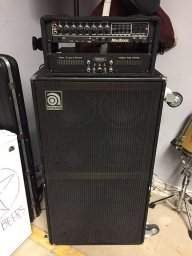
For me gigging is still a joy and not a job, and I always bring my SVT whwn it's right for the gig and the stage. Nothing gives me more pleasure than standing in front of it, plug and play tone of the gods and pure pleasure to hear and feel it effortlessly support the band and slot in the mix.

When my Eden dies you can be sure a lightweight modern amp will replace it as my backup, but I've resisted amp GAS until now because I simply don't need one yet.
 
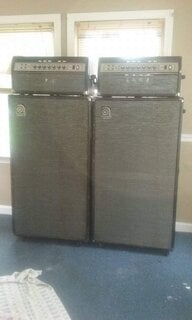
IMG_0676.JPG
I tried a few of the lightweights but I always missed the real deal. The last few years I've used nothing but SVT's.
 
Technology keeps advancing, just like these smartphones that can do more, and faster than a desktop pc could do 5 years ago
I can't figure how my micro amp uses 23 watts and puts out supposedly 400 watts at 8 ohms and stays cool.
I can help you with this...

So a class D/SMPS amp rated at 400 watts "RMS" has a power input rating required by the safety testing agencies based on the AVERAGE power output of 1/8-rated power. So, doing the math on a typical 85% efficient amp:

400W x 1/8 = 50 watts x 85% efficiency is 59 watts AC input. This would be the minimum AC input power that could be marked on the chassis (assuming the amp is rated at 8 ohms)

Now what I suspect you are seeing is that the amp's output power power is not rated based on RMS voltage but peak voltage (power would be correctly called peak power, even though it may not be defined in the marketing literature) so in that case the math would be:

400 watts peak power x 1/2 = 200 watts "RMS" power

200W x 1/8 = 25 watts x 85% efficiency is 29 watts AC input. This would be the minimum AC input power that could be marked on the chassis (assuming the amp is rated at 8 ohms)

This is pretty close, but it shows the concept.

Now the rated AC input power rating is allowed to be based on greater than 1/8 rated power IF the amplifier is designed, intended and marketed to be operated in greater than 1/8 average power conditions, but the minimum number is as I outlined in the math above. The purpose of this number is to help in coordinating the average load on a circuit, has nothing to do with audio.

Hope this helps.
 
I feel bad for the stubborn SVT herd, they don't know what they are missing. Don't be so quick to underestimate solid state/ class D amplification. Once you step away from the rest of the SVT sheeple, you may just be surprised
I dunno about the rest of the sheeple in this thread, but I've owned/played all sorts of class D gear: Ampeg PF, Orange, Stewart, Euphonic Audio off the top of my head, and more A/B solid state heads than I can count...

Some of them sounded pretty good but none were in the same league as an old SVT. And (aside from the weight/cost and maybe some preamp features that have nothing to do with class D vs. tube) none of them did anything you couldn't do with a decent tube head. ¯\_(ツ)_/¯
 
I feel bad for the stubborn SVT herd, they don't know what they are missing. Don't be so quick to underestimate solid state/ class D amplification. Once you step away from the rest of the SVT sheeple, you may just be surprised

Larry, that's a pretty broad brush you are painting with. 2 years ago I purchased a reissue V4B to use as a nice amp to have in my home studio. 100 watts, 40 lbs tubes, never leave the house blah blah blah. Well it comes with me as often as possible and leaves my Jule M700 sitting at home. Over 25 years I've owned an SVT, GK, Eden, WW, Mesa, EA, Epifani, AI, Glockenklang among others and I've had an opportunity to play just about everything else. For me it's a matter of actively choosing what I think sounds best and being okay with it's less convenient form factor.

The Glockenklang was the best of SS and My Jule Monique M700 is very nice. Tone hammer, streamliner fell way short in my book. The Subway and Drarkglass seem to be the only thing worth trying at this point but I haven't really been motivated based on past experience.

My point is I know exactly what the compromise is and for me it's not worth it, don't take that to mean I criticize others that make another choice.
 
I feel bad for the stubborn SVT herd, they don't know what they are missing. Don't be so quick to underestimate solid state/ class D amplification. Once you step away from the rest of the SVT sheeple, you may just be surprised

I guess I must be one of the SVT "sheeple" but I don't think i would have even posted here if the title hadn't have been: Have the D's toppled the SVT's?
I disagree with that and I guess a lot of us do, that is the premise of this discussion not are they BETTER than SVT's. I've played through D's and while they are nice and are very light, I don't see myself using them exclusively anytime soon unless (as a few people pointed out), I move to NYC or another big city and get to my gigs in taxi cabs. But then again my wife is from Lima, Peru and I've done a lot of gigs there (another huge city) and I do use taxis and have schlepped my SVT and a couple of 15"s to the gigs there too. I just make sure to hail a Toyota station wagon.


I can help you with this...

So a class D/SMPS amp rated at 400 watts "RMS" has a power input rating required by the safety testing agencies based on the AVERAGE power output of 1/8-rated power. So, doing the math on a typical 85% efficient amp:

400W x 1/8 = 50 watts x 85% efficiency is 59 watts AC input. This would be the minimum AC input power that could be marked on the chassis (assuming the amp is rated at 8 ohms)

Now what I suspect you are seeing is that the amp's output power power is not rated based on RMS voltage but peak voltage (power would be correctly called peak power, even though it may not be defined in the marketing literature) so in that case the math would be:

400 watts peak power x 1/2 = 200 watts "RMS" power

200W x 1/8 = 25 watts x 85% efficiency is 29 watts AC input. This would be the minimum AC input power that could be marked on the chassis (assuming the amp is rated at 8 ohms)

This is pretty close, but it shows the concept.

Now the rated AC input power rating is allowed to be based on greater than 1/8 rated power IF the amplifier is designed, intended and marketed to be operated in greater than 1/8 average power conditions, but the minimum number is as I outlined in the math above. The purpose of this number is to help in coordinating the average load on a circuit, has nothing to do with audio.

Hope this helps.

Not sure if average folks (average bass players) do really understand this exercise completely.
I'm pretty sure most players believe that they can reach "clean" rated output power with a bass guitar as well.
So a 1/8 consideration to calculate down the average at the wall may be accepted as kind of a foolish marketing game/trick.

I think that an 1/8 consideration is not so bad but, in real practice with MI application bass guitar can be assumed to higher numbers, lets say 1/4 at most within an audible "clean" average power range.

The term audible "clean" is choosen thoughtful cause not every clipping artefact is audible.
And there are a lot of variables that affect the attainable perceived "clean" average power.

Never the less within audible clean power range it's definitely impossible to get just the rated clean (sine) power if a real instrument or audio program material is used.
pro PA amplifier manufacturers are often blamed at forum discussions for "foolish" ratings cause they sometimes rate output power about twice as high as AC line requirement.

Addressed to the average
A steady sine wave is charaterized by 3dB crest, there is no dynamic cause the signal is steady.
A bass guitar consists of giant dynmic and even the steady note (which is most responsible for average) is characterized by a crest number way bigger than 3dB
 
Last edited:
Yeah, absolutely. I bet these musicians are a minority though, outside of a few areas (NYC? Nashville? New Orleans? LA?) where there's a lot of session or side work. I live in Boston which is like ground zero for music school students and I still see tube amps all over the place...

But even if they aren't a clear minority compared to regular band musicians, you still can't generalize their specific need for portable class D gear as if it applied to bassists across the board!

There are sidemen in every city. You seem to be under some misapprehension as to what those gigs are and who's doing them. Pit band gigs, corporate gigs, sideplayers for artists and leaders who don't want or can't keep a regular band....this **** is going on EVERYWHERE.

And it isn't at all about whether or not you're still "seeing" tube amps. As long as they do what class D amps can't you will always see tube amps. My original statement was that a lot of players who prefer tube amps (myself included) still use class D amps sometimes. That's all....and it's the truth.

Not only am I a musician I've been a lighting designer for many years. Between those two gigs I've worked every venue in this city and toured a fair bit. My opinions are based on a broad view of everything from bars to soft seaters to arenas all over the US and Canada and talking to a lot of touring guys about what it's like where they live. What exactly do you think touring players do between tours to pay the bills?
 
Looks like this debate is mainly over semantics. Have the D's toppled the SVT?

All the SVT guys rightfully point out that no D's reproduce the magic SVT tube tone.

The D guys point at weight, power, portability, costs, and defends, rightfully so, the tone capabilities of the D's.

The rest of the world would probably just point at sales trends.

So what is the real question tone or everything else?

Personally I think that there will be tube amps as long as there's one still glowing but that more peeps are going to buying D's by a mile. In that respect the D's win. Just too easy. Put me in that crowd, call me a lazy, cheap, no-toned bassist. I'm good with that!
 
  • Like
Reactions: Sartori
class-D can provide some more of "clean" juice that I sometimes miss with my svt when powering my smallish 212.
svp-pro tube pre + class-D of course sounds different versus svt head but, to be fair within really clean power range at living room loudness (when there is real headroom) those different power amps don't make a ton of difference in tone.
The difference becomes more audible at the edge (when still audible clean) when the sound becomes somewhat compressed (but actually clipping is present) and so the instrument itself "feels" way better dynamically balanced (so it levels the average more evenly between different strings and notes).

At the other hand the smooth of dynamics can also be reached with proper setting of the preamp svp-pro but, the interaction with the cabinet is clearly audible different within real power headroom.

edit,
of course I know my spelling English is in need of getting used to
 
Last edited:
Disclaimer: I've posted above that I don't think the SVT is going anywhere and happen to enjoy playing them when I get the opportunity.

That said, and just for the sake of tossing stuff around, I wonder how many players who gig their SVT have actually put one of the new gen micros on the 810 cab for a gig just to see what happens. Because a) I had my brain reset when I put my Shuttle 9 on a Berg 610 a bunch of years ago (and promptly sold my tube head and gigged that funny looking rig for more than a year); and b) the newer bunch of micros, such as the Mesa, the Genzler, and the Berg are actually pretty impressive.

I recently acquired the Berg. VERY impressive little box.

Mainly, it's just important to keep in mind that comparing the SVT on an 810 to a Tonehammer on a 112 isn't the right way to look at the situation.
 

Latest posts