• TalkBass has been independent since 1998. Add your voice.
    Create a free account to reply to discussions, view embedded media, and browse with fewer display ads.
    Join freeLog in
    Want zero display ads or expanded classifieds tools? Compare plans.

Heavy vs. light power section

Dragonlord

Rocks Around The Glocks
Aug 30, 2000
2,573
464
46
Greece, Europe
I play an Eden WT550 into Schroeder cabs. I picked it up, among other reasons, because of the relatively light weight and portability. Recently we put our gear into our own studio, so I started thinking about amps without thinking about the weight much.

I've read Jorg's list of favourite amps with his cabs and he has the Aguilar DB750 first and Glockenklang heads second. Both of these have a massive and heavy power section. I've also seen many times TBers saying that light weight amps can't match the "oomph" of some heavier ones (I'm talking about SS amps here, not tube). The Crest CA9 gets a lot of love despite being a monster, when there are far lighter amps with all the power one could need.

So, what do you think? Is this for real or an urban legend? Mind you, I don't care much about more volume; I mean at the same volume, what are (in general) the differences between a light and a heavier power section? I'm looking for a full, punchy, "kick you in the stomach" sound and I'm looking at the Carvin B1500 and Glockenklang Heart Rock versus iAmp800 and Thunderfunk 550B (I know that the first two have way more power, but I don't intend to run any of these amps at their very limits, so I'm looking for a sound comparison at volumes that all four amps can reach).

If you agree that heavier power sections sound "bigger", what do you think causes that? Is this because of restrictions of the newer technology, that is you must sacrifice this for the less weight, or is it because the newer technology isn't just "there" yet, but getting closer year by year?
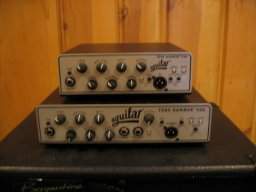
 
It's definitely not an urban legend... a big, high quality, heavy transformer seems to provide more deep, powerful low end response to my ear.

However, there are two confounds in your thinking. First, these larger heavier amps do usually put out more power than their lighter counterparts, so it's at least partially about wattage. Second, it is volume based IME.... at moderate volumes, my Thunderfunk has just as much ooomph as the big Heart Rock. It's only when you get in a big room and really turn it up that you can hear the difference.

So, I don't think you would hear much of a difference in the situation you are talking about. Yes, all the amps you describe sound different... the Glock sounds like the Glock, the WT550 sounds like an Eden, etc., etc.

So, if you aren't talking about very high volume playing, IMO, you are in the very nice position of finding an amp that has the tone and voicing you are looking for. That might be a 4 pounds amp or a 43 pound monster!!!!

K
 
Well, on the other hand, let's say we compare two power amps with similar wattage... QSC PLX2502 is 2500W bridged at 4 ohm and weighs 21 lbs, and QSC RMX2450 is 2400W bridged at 4 ohm and weighs 44.5 lbs... why would someone go for the RMX? Mind you, I don't have any experience with these amps nor do I know any other differences they might have, but the wattage is the same, so if wattage and volume are the main reasons for the tone improvement of a big amp, why would anyone want to carry double+ the weight if the power output is the same? Note that these amps are coming from the same company, so the power ratings should be more or less comparatively accurate.
 
Well, on the other hand, let's say we compare two power amps with similar wattage... QSC PLX2502 is 2500W bridged at 4 ohm and weighs 21 lbs, and QSC RMX2450 is 2400W bridged at 4 ohm and weighs 44.5 lbs... why would someone go for the RMX? Mind you, I don't have any experience with these amps nor do I know any other differences they might have, but the wattage is the same, so if wattage and volume are the main reasons for the tone improvement of a big amp, why would anyone want to carry double+ the weight if the power output is the same? Note that these amps are coming from the same company, so the power ratings should be more or less comparatively accurate.

Actually, again, if you reread my post, I've found that amps with big heavy power supplies to actually sound fuller, deeper and punchier at HIGH volumes, even with the same wattage. Part of it is how much of that wattage is delivered throughout the entire frequency range of the signal, the 'headroom' available, etc.

However, again, the lightweight switching power supplies seem to be improving. For example, the larger Berg IP's have a very lightweight class D amp with switching power supply, and they put out the massive ooomph.... so things are changing.

However, given the products that are out there right now, there seems to be a general linear trend between weight and ooomph.

Here's one of my infamous continuums of amps and their ability, in my experience, to generate a very strong, loud, punchy, quick, deep low fundamental from the bass guitar at high volumes... from 'weak to strong into a large 4ohm cab'... (again, not really volume, more 'substance' of the tone when cranked up and played down low and aggressive... think of slapping an open E string with the amp cranked up).


Walter Woods
AI Focus

Mesa Walkabout
EBS350

Glock Soul

EdenWT405 and 550
AG500

Thunderfunk
EBS650

SWR900

iAmp800
EdenWT800
MPulse600

Mesa M2000

DB750
CarvinB1500
Glock Heart Rock


Of course, there are many other heads out there, but these are the ones I've actually heard at loud volume and have direct experience with. If you look at the spec's, there is a very low correlation with published wattage, but a very high correlation with weight!

IMO of course.

K
 
Great! Somehow I had missed this list... great info, thanks!

BTW, my personal amp search aside, I'd like to see more replies in this topic about how close are lightweight amps to the sound of their heavier uncles, if you think that they will be 100% "there" soon etc. Especially from people in the industry, like the guy from QSC for example, who have first hand experience on where things are going.
 
Although a heavier amp of equal power may push more bottom than a light amp, I've had personal experience with a more powerful but lighter amp providing more bottom. If you want to compare amps, be sure to match the gains and switch off any filtering.

If lightweight amps are weak at producing bottom, then why are so many used to push pro touring subs?

Remember a pro amp will almost always meet its specs - but that doesn't stop one amp from exceeding its specs by more than another amp. Which is why worrying about having too much power is futile because you don't actually know how much power your amp will develop into the reactive load of your cab.

Distortion can thicken up the mid-bass and make it sound louder - but is that better bass?

Alex
 
Although a heavier amp of equal power may push more bottom than a light amp, I've had personal experience with a more powerful but lighter amp providing more bottom. If you want to compare amps, be sure to match the gains and switch off any filtering.

If lightweight amps are weak at producing bottom, then why are so many used to push pro touring subs?

Remember a pro amp will almost always meet its specs - but that doesn't stop one amp from exceeding its specs by more than another amp. Which is why worrying about having too much power is futile because you don't actually know how much power your amp will develop into the reactive load of your cab.

Distortion can thicken up the mid-bass and make it sound louder - but is that better bass?

Alex

Alex,

I can only comment on all in one heads... as you mention above, pre/power amp component rigs can be very different, and it's been posted many times by Bob Lee that there is no inherent reason a lightweight amp can't sound exactly like a heavy one.

However, at least up to now, this hasn't really been the case, at least with all in one bass heads IMO.
 
I've had a light weight amp that seriously let me down (PLX), some heavy amps that sounded amazing but were backbreakers (CA6, CA9), and some mid weight amps with plenty of punch that were a manageable carry (Edens, SWRs). What I've got now is a 30-odd lbs head that has huge depth and plenty of power reserves. I don't know how they're doing it, but the Mesa M-Pulse 600 kicks.

I'd personally steer toward that middle group.
 
I've had a light weight amp that seriously let me down (PLX), some heavy amps that sounded amazing but were backbreakers (CA6, CA9), and some mid weight amps with plenty of punch that were a manageable carry (Edens, SWRs). What I've got now is a 30-odd lbs head that has huge depth and plenty of power reserves. I don't know how they're doing it, but the Mesa M-Pulse 600 kicks.

I'd personally steer toward that middle group.

I'm familiar with the MPulse... so I'll add it to my list... great amp!
 
I do not find a difference in volume per se but in "support" of the note, especially where there exists bigger spikes in power needs (say the attack of slapping). To me, there seems to be a lag in the attack of the "light" amps.

Over the last year I have been able to compare an iAMP800 (toroidal power transformer) against a Stewart 2.1 (switching)based rack setup, and (again, to my ears) I am convinced this difference exists. I did not match gains or any such science so my conclusions are most probably flawed, but I sure think I heard and felt a difference.

That said, I doubt very much that audiences can tell such things, especially at rockin' volumes. While I have swung over to the "toroidal power transformer" crowd, I have my limits for how much weight I will trade for these subtleties of tone.


That's exactly what I was trying to communicate from my list. For example, the Walter Woods is MUCH louder than the EBS350... but not that much different in the actual 'support' of the note, even though the Walter is rated at three times the wattage!
 
I'd really like to see some accurate impulse testing of these ideas. It's all too easy for bassists to believe that what sounds better to them is quantitively better or more accurate to the original signal, when in fact the natural compression or distortion from an amp could be colouring the tone beneficially. If you then know what you really want you can go about getting it in a more effective way.

AccuGroove have been a great case in point of this - their cabs claim to produce huge low end extension, people hear it, like it, and are convinced that's what they need. In reality their cabs produce a whole wodge of output higher up the frequency spectrum, and very little down in the low note fundamentals. People like that big 80Hz output and that midrange hump and multiple driver colouration, whilst they actually think they like big 30Hz output and flat response - because inaccurate benchmarks (i.e. their specs) are used to understand what's going on.

And thus you end up with a warped reality amongst these forums.

Stick a 40Hz square wave through these rigs, record it with a reference mic, and then we'll see which amps and cabs come closest to matching input and ouput.

Alex
 
I'd really like to see some accurate impulse testing of these ideas. It's all too easy for bassists to believe that what sounds better to them is quantitively better or more accurate to the original signal, when in fact the natural compression or distortion from an amp could be colouring the tone beneficially. If you then know what you really want you can go about getting it in a more effective way.

AccuGroove have been a great case in point of this - their cabs claim to produce huge low end extension, people hear it, like it, and are convinced that's what they need. In reality their cabs produce a whole wodge of output higher up the frequency spectrum, and very little down in the low note fundamentals. People like that big 80Hz output and that midrange hump and multiple driver colouration, whilst they actually think they like big 30Hz output and flat response - because inaccurate benchmarks (i.e. their specs) are used to understand what's going on.

And thus you end up with a warped reality amongst these forums.

Stick a 40Hz square wave through these rigs, record it with a reference mic, and then we'll see which amps and cabs come closest to matching input and ouput.

Alex

Speakers are a whole other complicated mess!!!!
 
Speakers are a whole other complicated mess!!!!

Yes, but they interact with the amps, and suffer the same issues with reproduction (though to a massively larger degree). You can't assess the ability of an amp without giving it a realistic reactive load to drive.

Something to bear in mind; not so long ago Jim B decreed that only 'lead-sled' amps should be used with his cabs. Then he started using Class D + SMPS amps in his active cabs. What had changed? The technology certainly hadn't because the amp modules in his cabs were on the market years before he made his prior anti-lightweight comments. Now I'm not questioning Jim's honesty - he's one of the most legitimate guys in the business and makes a top-quality well engineered product. But it does go to show that although the world may not be a perfect sphere, that doesn't make it flat.

Alex
 
Yes, but they interact with the amps, and suffer the same issues with reproduction (though to a massively larger degree). You can't assess the ability of an amp without giving it a realistic reactive load to drive.

Something to bear in mind; not so long ago Jim B decreed that only 'lead-sled' amps should be used with his cabs. Then he started using Class D + SMPS amps in his active cabs. What had changed? The technology certainly hadn't because the amp modules in his cabs were on the market years before he made his prior anti-lightweight comments. Now I'm not questioning Jim's honesty - he's one of the most legitimate guys in the business and makes a top-quality well engineered product. But it does go to show that although the world may not be a perfect sphere, that doesn't make it flat.

Alex


+1.. that's why it's important to base the type of comments I'm making on a number of things:

1) Multiple cabs with each head, but the same multiple cabs for comparability

2) Large room, loud volume playing... all the stuff I hear between these heads TOTALLY breaks down in the basement... MUCH less difference in small rooms than big ones among heads to my ears

3) Similar to cabs... multiple basses, but again, the same group of basses for comparison.

4) Again similar to the above.. multiple rooms but the same multiple rooms.

When you apply a good ear and some discipline in how you listen to this stuff, consistent differences do emerge that, at least to me, are represented in my list.

Where you start to get into trouble is attributing the differences to one certain thing... wattage, type of power supply, voicing, etc. These things all work together (i.e., how the lowest bass EQ knob is voiced, etc.) to result in all these heads sounding different.

That's why it's so stunning to me regarding the relatively high, linear correlation between the weight of the amp and the 'presence, punchy, and fullness' of the low end.

I have a feeling that, whether due to DSP's, better switching technology, etc., etc., that this 'weight to punch' positive linear correlation will be reduced in the future. That will be a very happy day for me:D

Edit: and again... I'm only really talking about current executions of existing all in one heads.... is it the switching power supply that makes the Walter sound a little thin.... who knows!... but it does. Is it the massively heavy transformer that makes the Glock HR sound bigger, fuller and more massive than enything I've ever personally heard.... who knows... but it does!!! So, again, my list and comments are based on real world experiences... which of course can be flawed... so again... IME in a big way!

Fun discussion!
 
I've heard differences among power amps. But only in sighted tests.

But in double blind tests, going by sound alone and not knowing which amp I was listening to, those differences always managed to vanish.

If you believe A to be better than B, even if A=B, A will sound better to you.
 
I've heard differences among power amps. But only in sighted tests.

But in double blind tests, going by sound alone and not knowing which amp I was listening to, those differences always managed to vanish.

If you believe A to be better than B, even if A=B, A will sound better to you.


I would think this would be true for similarly spec'd power amps (I think I quoted you above :-) ). However, there are SO many other differences in integrated heads, that they all do sound quite different, and have quite different volume and low end response that does not always seem to correlate to the pure published spec's.

Regarding believing.... the biggest wish of my bass playing life is that my 7 pound amp sounds as full as my 40 pound one!!!!! Unfortunately, at least for some playing styles at loud volumes, wishing does not make it so!

K
 

Latest posts