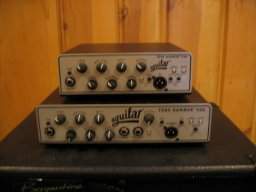
As far as the earlier posts concerning perceived differences.....
it seems to be reasonably well established that people's ears are very crummy meters...... You hear on a sliding scale, that depends on your attitude, mood, what you had for breakfast, did you drive to the test at 75 mph with the top down.... etc. No absolutes, except maybe pitch, for some.
It is equally well established, I think, that ears are really good at detecting "changes" and "balance".
If a sound changes timbre or loudness, you are attuned to notice it.
One "decibel" is supposed to be the minimum perceived difference in volume in "ideal" conditions, but I believe that was with certain test signals. One can often hear a smaller change, depending on the person and the test signal. Or one may be unable to discern a one dB change, with some other test signals.
Another thing is "balance". Musically attuned people have been able to notice a relatively minor "slope" in the overall frequency response. That is, bass down relative to highs, or the reverse, mid up, etc..
Not "how much" down or up, but the fact that the sound is darker or brighter.
So if someone notices a particular amp sounds "less bright" than another, it may not be BS, they may be responding to a somewhat minor slope in response.
It makes sense that we would hear like that. The shuffling of leaves or snapping of twigs at a distance (not as much of a threat) would be important to distinguish from the bright snappy sound of something stepping along very close to you.
If you responded always as if it were a close threat, you'd wear out from pure nervous fatigue in the wild. So the ability to distinguish is in us.
Not surprising if we can use that to hear differences in speakers or amps or whatever.
I agree, most amps if intended to be "flat" are quite flat, at least at small signals. The power response "may" be different, depending.
Speakers vary, there isn't one really flat commercially available practical speaker, just ones that are pretty good. And their power response AND basic frequency response, distortion, etc, varies with level, level history, etc, etc.....
Lightweight amps vs heavy?
Well, the better (in terms of sustained power) the lightweight amp is, the heavier it likely will be. And some other detail design choices have a lot to do with it also, as does cost, etc.
A lightweight SMPS type amp with no cost limits could be made to equal ANY other amp made, using any technology. And it would ALWAYS BE LIGHTER. it definitely would not always cost less, or even the same.