I'm in no way advocating them but do chemicals help to get it? Because they apparently played quite a role in the evolution of the genre.
The highpoint of the “herbal assisted” genre is probably 4’20”, a free jazz tribute to John Cage.

TalkBass has been independent since 1998. Add your voice.
Create a free account to reply to discussions, view embedded media, and browse with fewer display ads.
Join free Log in
Want zero display ads or expanded classifieds tools? Compare plans.
I'm in no way advocating them but do chemicals help to get it? Because they apparently played quite a role in the evolution of the genre.
Do you really need to "understand" music to enjoy it? If so, then we're only playing for other musicians. Now that I think of it, that's sadly often the case.
I can’t help but think that the question “help me understand free jazz”, hasn’t even been addressed. Nobody can help you I’m afraid is the only answer and I’m not being pedantic. Musical and visual art both demand only an emotional response, you hear it or you see it it and you react subjectively. You’ve already listened to the music you are asking about and you’ve experienced your reaction to it. You can perhaps understand the reasons you reacted the way you did to the experience. Art should not and does not need education on the part of the listener or viewer. It is possible to understand some of the processes involved in creating art but to understand the art is a different thing altogether. Understanding the creative process can even get in the way of listening to, or viewing art, in an uninhibited way. Artists can only ask the listener or viewer to listen or look, there’s really nothing else they can do. If you want to go to school to understand how you might create art yourself that is a very different question. There are such things as music and art appreciation classes and that is different again. Even putting music into the context of when and where it was created, or who created it, doesn’t alter the fact that an emotional response to the sounds you hear is all that matters. Henry Purcell or Harrison Birtwistle, Pops Foster or Mono Neon, you listen and you react. Art in its purest sense and particularly more abstract art is a universal language, I suppose because it doesn’t need translating or understanding. It simply asks for an emotional response and we’ve all got emotions. Art that requires an explanation is bad art.
The most valuable art and music to me in the last three decades is art that leaves me with questions and not answers.
Common sayings that let you off the hook for making an effort or doing any work are bad sayings.Art that requires an explanation is bad art.
In reply to ZootSaxes who said (pst #164) “I don’t know why so many people wanna get into semantic arguments about the nature of art”. I would say firstly, I don’t want to to get into any arguments. I was hoping for an exchange of views and secondly, it’s because we are discussing an art form and the nature of that art form. Semantics, well that’s just because there are a lot of words flying about here, it’s inevitable.
Then Zoot said, “Perhaps because this is still ‘the internet’ and NOT reality”. My answer is no, the exact opposite, I am interested in the nature of my art, because this is my reality as an artist and certainly not the internet speaking.
Finally from Zoot, “Life and Music are like an “open world” video game, from a certain perspective. Just because you can VISIT the ‘water temple’ doesn’t mean you’re ready to PLAY it until you get that dang ‘hookshot’, ya dig?”
First of all I apologise for not coping with the social media, posting/liking/quoting protocols very well. I’ve tried but got it all very wrong and have had to delete and edit my posts. (old dog, new tricks, etc). I’ve been a talkbass member for a while, but only an observer until recently, so please forgive my old fashioned steam driven quotation methods.
In reply to ZootSaxes who said (pst #164) “I don’t know why so many people wanna get into semantic arguments about the nature of art”. I would say firstly, I don’t want to to get into any arguments. I was hoping for an exchange of views and secondly, it’s because we are discussing an art form and the nature of that art form. Semantics, well that’s just because there are a lot of words flying about here, it’s inevitable.
Then Zoot said, “Perhaps because this is still ‘the internet’ and NOT reality”. My answer is no, the exact opposite, I am interested in the nature of my art, because this is my reality as an artist and certainly not the internet speaking.
Finally from Zoot, “Life and Music are like an “open world” video game, from a certain perspective. Just because you can VISIT the ‘water temple’ doesn’t mean you’re ready to PLAY it until you get that dang ‘hookshot’, ya dig?”
My response to that is, no I’m sorry but I don’t dig, I haven’t the slightest idea what you mean.
Damon Smith says, “The "elitist", "insider" digs are just silly”. Firstly they are not on my part, digs or silly, they are valid discussion points and secondly Damon doesn’t seem to understand what being an elitist or behaving in an elitist manner is. It doesn’t mean knowledge or commitment, it means a superior attitude towards those “not in the know” and implies exclusion.
Only a sentence later Damon says the listener must be part of the process, this after saying about elitism, “It is really one of the best things about it” (post#63).
I believe that elitism is a damaging and destructive thing in any art form and particularly minority interest art forms.
With reference to the free jazz/trad jazz connection mentioned earlier, in days gone by there was a whole set of musicians in this country (UK) who played both styles in a really earthy instinctive way. The free/bop connection always seemed less convincing to me.
In reply to EdS who asks about comparisons with visual abstract art, I feel it is a valid comparison and there have been many collaborations between the two art forms over the years. It’s difficult to pin down what makes it valid because of the imprecise nature of these things, but those comparisons definitely help to explore what this music is about. It’s also interesting to ask how visual art from different schools and eras relates to music from different genres and times? I agree totally with what Ed says about looking at Pollock and Rothko. I think a lot of people experience exactly that, particularly because these two artists are so widely viewed.
In my Art School days, I always found being instructed to learn the craft of the art a difficult thing and rallied against it. I just wanted to get on with it and create. I felt exactly the same about music. I soon realised how counter productive this was to creating as I wanted to and found out the hard way when I started playing with improvising musicians (Harry Beckett, Tony Marsh, Lol Coxhill, Gordon Beck, John Taylor, etc) that I wasn’t up to the job and my “method” didn’t work, I needed to learn the craft. However, I still stand by my 20 year old self in thinking that if a three year old creates the same image as Picasso, then those images have exactly the same worth. I feel exactly the same about music and particularly about improvised music. That Art is not to be “understood” is still my feeling.
What I don’t understand as a Social media newbie is why these questions on a thread like this have to be addressed by some in such an adversarial manner. Everybody here, practitioners and listeners alike, seem invested in the subject so all should be given equal respect. When I talk to my friends and colleagues, artists, musicians, audiences and concert promoters, about such things (and unlikely as it may seem, I do), I’m looking to share individual insight and actually there is a lot of insight on this thread. But I’m not looking to be “swatted down” (quote, Damon Smith post #98). Perhaps this what ZootSaxes meant by “this is still the internet”? I wish we could sit around a table and talk, we might understand each other a little better.
Damon also says in his recent post (#185), “Common sayings that let you off the hook for making an effort or doing any work are bad sayings”.
My response is threefold, Firstly a listener or viewer should not be required to do any “work”, other than listen or view, it’s the artists job to do the work for them. Secondly, if you are talking about a musician or artist “doing any work”, then surely that doesn’t need to be said, hopefully we are all working hard. Finally, I’m not on any kind of hook to be let off, my “common saying” is also my measured opinion. Again Damon, why so adversarial? Your response to my opinion sounds just as generic as mine, but also deliberately provocative. It is exactly what I was talking about earlier, I won’t take offence because you tend to spray words around in such a scatter gun manner that I’m not sure if you intend offence. There is another “common saying” which I also believe and that is that “Art should speak for itself”. Or another, “Art should stand on its own two feet”. Common sayings are not necessarily cliches and often have more than a grain of truth in them.
I completely understand why several people have said that research into the art and artist gives them a greater understanding and even enjoyment of the process and the work. However, I feel that if you apply this to the listening experience, it becomes more intellectual and less visceral, less pure. If the listener is to do any work, then it should be to not think about what they are listening to.
We all know what Damon means when he says “Not holding on to any of the points in this post is a great way to move toward an understanding of Free Jazz & Free Improvisation”. But from my perspective that supports my views about emotion in creating and responding.
“Making art and music that gets a predictable emotional response from human beings is pretty straightforward and really just involves a frothy mix of known quantities and repetition.” Damon, who said anything about “predictable emotion”? I thought we were discussing free jazz and improvised music. The very nature of improvised music is hopefully it’s unpredictability. Emotion is just as unpredictable.
One more comment on the subject of an emotional response to Art if I may. Some years ago I visited an extraordinary exhibition by Edvard Munch and had an almost overwhelming emotional response, much the same as I had once at a Francis Bacon exhibition. I needed (if I was going to get through the day) an emotional antidote. Fortunately there was another one man exhibition nearby featuring Howard Hodgkin, he gave me the alternative emotional response I was hoping for. At no time was I looking for questions or answers, but something much deeper. I can never forget the Munch, but thank heavens for Hodgkin.
The written word is a totally inadequate and frustrating medium to discuss the deeper impacts of visual and musical art. But we keep trying and fail every time.
I’m sorry about the long, long and now even longer post, but one thing leads to another.
ps. Zoot and Damon and many others have also posted things that do share real insight that I have appreciated and I’m very pleased to have read.
Some jokes write themselves, apparently.It is a pretty lower middle class art form
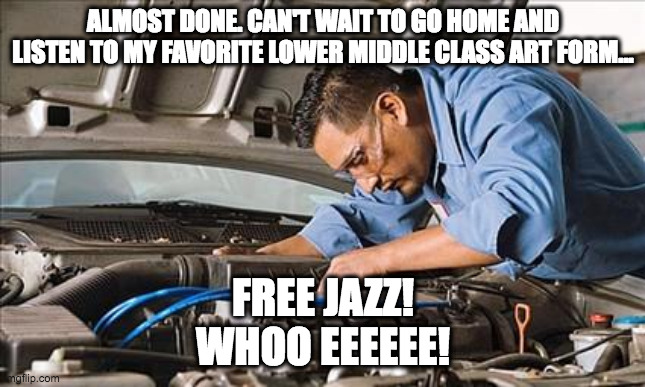
Some jokes write themselves, apparently.
IMFO, of course.
Sheesh.
OK, I will. - Let me know when Anthony Braxton appears at the Grand Ole Opry.I went right from a warehouse to my gigs for years. You can joke about that all you want.
You missed a couple of others that I'm on, FYI, but that's OK.We don't get called for the Matrix reloaded soundtrack, but we get to make more than one album!
In all seriousness, most of the progenitors were generally scuffling on the lower east side and living pretty rough. A handful, like Coltrane, Shepp, Ornette and Cecil Taylor made decent money playing, Cecil Taylor and Bill Dixon were from upper middle class families. The German and UK players were generally working class, except for Schlippenbach, some of the Dutch were well off. In the US some of the late 70s and 80s players had degrees, some of the old masters got nice teaching gigs. My generation tended to come from punk & noise which is pretty low class. In the last decade we are seeing more rich kids from liberal arts colleges, but it wasn't the norm until then.OK, I will. - Let me know when Anthony Braxton appears at the Grand Ole Opry.
You can update discogs!You missed a couple of others that I'm on, FYI, but that's OK.

It is good to give it the respect, but if you are hearing that deeply into it, it is likely you could play it if you want to. Part of what tends to vex people is there is mix of simplicity and complexity in getting started playing it. Yes, you can just do it, thought it is often more than what we expected out of the gate.Glad I made the effort. It was like learning a new language, a very complex one, and very rewarding. I couldn’t play it if I worked on it 100 years.
There are some people playing in Little Rock around a saxophonist named Chad Fowler.
An old bass student of mine played there yesterday, funny enough. Not playing free jazz of course...OK, I will. - Let me know when Anthony Braxton appears at the Grand Ole Opry.

If you have no idea what a composer/songwriter/performer is trying to do, how are you going to enjoy the music?


