• TalkBass has been independent since 1998. Add your voice.
    Create a free account to reply to discussions, view embedded media, and browse with fewer display ads.
    Join freeLog in
    Want zero display ads or expanded classifieds tools? Compare plans.

Help me understand

I think the venues you are talking about and experiencing are quite different from the venues @blacey and I are talking about. Generally, the smallest venue I worked in over the last 10 years of my career was 1000 seats and went up from there. I specialized in the 1000 - 4000 seat venues for the most part. With the amount of money changing hands over ticket sales (could be from $25k to $250k), things are handled very differently from your description. Starting with load-in between 9am and noon for a 8pm show. A 14 hour day at our pay scale results in a different level of cooperation (usually).
Probably.
But those are giant venues most of us will never play. So doesn't that make them the exception and not the rule?
 
why do so many of us obsess over these nuances in tone of these different amps if that element of the sound doesn't make it to the audience? What is your take on all of this?
"obsessing" is an attempt to control. many players would like to control what they think the audience should hear. some of them don't care what "everything" sounds like when mixed together. the 'whole is greater than the sum of the parts' is too big a concept to "control" without 'anxiety'. so they settle for trying to control what they can. preferences (e.g., brand loyalties) are a version of settling.
 
Probably.
But those are giant venues most of us will never play. So doesn't that make them the exception and not the rule?
When you learn and understand how and why something is done with better results, even if it's not as common in the venues you play, it becomes a way to change and improve your outcome.

Look at it as an opportunity to get better results.
 
When performing any gig that has FOH, the bass amp is essentially relegated to monitoring duty. The FOH engineer needs a sound that can be easily sculpted, EQ-wise at least, to sit appropriately in the mix. Given the different EQ needs of the house vs the stage, it makes sense then to send a DI signal that is Pre-EQ. I know this is not a universal solution but one opted for by many bassists and sound guys.

Yes. I always send pre-EQ signal, unless told otherwise.

My main question to you is this: given all of these factors, why do so many of us obsess over these nuances in tone of these different amps if that element of the sound doesn't make it to the audience?

I wouldn't say that I obsess over nuances of my amps' tone...but yes, I spend time and money trying to make my amps sound the way I like. The reason for that is that I enjoy hearing it/listening to it while I'm playing. Music is my hobby so I try to have as much fun as possible. I leave it to the sound tech to take care of my sound for the audience...

Before you judge what I've written know that the situation I described is my own. I've just recently become really irked by it - I generally like the sound I get from my amp, but why wouldn't it be preferable to have a sound that is as close as possible to what the audience is hearing?

In light of all this, I understand why many players are moving to ampless setups and why speaker sims have gained in popularity. It's a reliable way to get that speaker coloration and baked-in amp tone to the FOH without the hassle of mic bleed and disparate EQ settings. Particularly for guys who do a fair amount of recording, especially with plug-ins, I can see why one would want to get that tone out into a live setting.

What is your take on all of this?

As I said above, I enjoy listening to my amps on stage and I trust the sound tech to make me sound good in FOH. But you made me thinking: I might start using cab sim more often...especially for those gigs where: 1. our band takes care of PA (there is no sound tech), or 2. I use IEM.
 
  • Like
Reactions: Al Kraft
My main question to you is this: given all of these factors, why do so many of us obsess over these nuances in tone of these different amps if that element of the sound doesn't make it to the audience?

Before you judge what I've written know that the situation I described is my own. I've just recently become really irked by it - I generally like the sound I get from my amp, but why wouldn't it be preferable to have a sound that is as close as possible to what the audience is hearing?
Obsession over the bass rigs sound is the security blanket factor. I don't think very many bassists would be happy to hear the same signal from their cabinet as what is being used by front of house. What is heard 100 feet out from the stage is very different compared to what is heard 8 feet from the cabinet. The sound tech has to Eq according to the room interactions and inverse square losses over distance. The result possibly could be very thin sounding and harsh compared to what the bassist really wants to hear from his rig.

If a musician isn't happy with what they hear on the stage, it becomes difficult for them to be relaxed and perform at their best.
 
Something no one has mentioned yet, is that it is natural for the audience to hear sound from the stage. That means amps. In huge Aged Horse venues, the perspective and size makes monitors a must. For a smaller venue, it sucks to hear the music from the sides of the stage.

I bring amps, but I only play small places...
 
  • Like
Reactions: DJ Bebop
What if this gig is huge FOH and the next is a small club? I want my fans to hear the same sound big and little.
Plus you learn how to play well with others acoustically.
The Stones did a small club gig years ago during a US tour. Wyman was with them then and used a B-15. Why lose that skill and intimacy?
Having your sound is noticeable to a sound person. I regularly get mic’ed and DI.
 
  • Like
Reactions: DJ Bebop
When you learn and understand how and why something is done with better results, even if it's not as common in the venues you play, it becomes a way to change and improve your outcome.

Look at it as an opportunity to get better results.
Where's the opportunity if you are playing bars and clubs?

There is one 1000+ seat indoor venue I could reasonably anticipate a blue moon gig with a full sound system and professional engineer.

The sound tech has to Eq according to the room interactions
if the room is EQ'd to sound good with a record there should be very little to do to a bass cab sound that sounds good 4ft in front. Local guys that don't get that their room has a 80hz resonance and try to tell me my bass is boomy get my goat.
 
if the room is EQ'd to sound good with a record there should be very little to do to a bass cab sound that sounds good 4ft in front. Local guys that don't get that their room has a 80hz resonance and try to tell me my bass is boomy get my goat.


You start with with the speakers flat and recorded music may sound fine. Then you turn the mics on and it's a whole new ball. As you turn up the gain, the system will tend to ring at resonant frequencies. The solution is to notch out the offending frequencies in order to reduce how much energy you pump into the room at resonant frequencies. It doesn't fix the problem, but in my experience it typically evens out tone and improves clarity quite a bit.
 
Local guys that don't get that their room has a 80hz resonance and try to tell me my bass is boomy get my goat.
I had this same problem one time during a sound check with an inexperienced sound tech. It was in a small/med sized local bar and it was obvious to me that the booming problem wasn't my bass/amp/cab. As a musician and engineer I could both see and hear that the problem was coming from the acoustic guitars (yeah I know, big suprise). The problem was further exacerbated by the corner of the room with all hard surafces we were standing in and very high monitor levels. I simply turned the volume to zero on my amp and pulled the bass cable out of the input...I choose not to argue with inexperienced people who are more arrogant than their ability would justify.

After we played a little more the gent came over very angry and told me I had to turn down the bass. I then pointed to my volume control (at zero) and the cable end on the floor, played a few notes on the bass that no one could hear, and then asked the guitars to play a few notes. The problem was suddenly obvious to all and I walked over to the mixer and corrected the problem very quickly.

Just as we as musicians need to take advice/direction from sound techs with more experience than us, sometimes you may get a less experienced indivdual running sound who could stand to listen to a musician who may be a little more experienced. IME success in the live sound/live band environment is built on respectful dialogue and all parties being willing to listen from the perpsetive that someone else could be right.
 
Where's the opportunity if you are playing bars and clubs?

There is one 1000+ seat indoor venue I could reasonably anticipate a blue moon gig with a full sound system and professional engineer.
I think you either didn't understood what I posted, or are being intentionally difficult.

There are several of us here that have given the opportunity to learn more about how audio is done at the higher levels and in bigger rooms. It shouldn't be lost on you or anybody else that we are generally in agreement because that's how it's done. I/we also explain why, and the benefits it brings as well as the pitfalls of not following the ways of the industry. Many of these benefits and pitfalls apply all the way down the food chain, which is exactly why I mention them.
 
There is an enormous selection of amps and cabs out in the market right now. The laws of competition dictate that every amp or cabinet needs to have something that makes it different or 'stand out' in order to appeal to a particular cohort of players. People describe a "Mesa" sound or "Ampeg" or "Aguilar" sound, etc, or some amps or cabs have particular features, like the voicing control on the Genzler amps, for example. Some amp designers even aim to stand out by making amps totally uncolored and neutral sounding.

When performing any gig that has FOH, the bass amp is essentially relegated to monitoring duty. The FOH engineer needs a sound that can be easily sculpted, EQ-wise at least, to sit appropriately in the mix. Given the different EQ needs of the house vs the stage, it makes sense then to send a DI signal that is Pre-EQ. I know this is not a universal solution but one opted for by many bassists and sound guys.

As I understand it, in most amps a pre-EQ signal essentially goes straight from the input jack to the DI, bypassing the circuitry that 'colors' or gives the particular 'flavor' of that amp to the signal (not to mention the organic tone shaping effect of the speaker that is essential to capturing the essence of many signature bass tones). Looking at the schematic for the Mesa D-800, for example, this seems to be the case. (Please correct me if I am wrong on these last two points) Assuming this is correct, coloration of the basic sound to the ears of any listener hearing only the sound from FOH is caused by the bass, any effects between and bass and amp such as a compressor, and finally by any inherent tone and EQ shaping done at the mixing board. The bass amp itself is just a conduit to the mixing board. The exception to this would be the transformers in certain DIs, such as the Jensen found in some high end bass amps like Demeter, or Cinemag (REDDI). Even then, there's not nearly as many options for transformer based coloration relative to the inherent 'flavor' of the many amps on the market.

To most of our audience then, our amplifier is essentially the PA system - something while not perfectly flat, is designed with transparency in sound amplification, not coloration.

My main question to you is this: given all of these factors, why do so many of us obsess over these nuances in tone of these different amps if that element of the sound doesn't make it to the audience?

Before you judge what I've written know that the situation I described is my own. I've just recently become really irked by it - I generally like the sound I get from my amp, but why wouldn't it be preferable to have a sound that is as close as possible to what the audience is hearing?

In light of all this, I understand why many players are moving to ampless setups and why speaker sims have gained in popularity. It's a reliable way to get that speaker coloration and baked-in amp tone to the FOH without the hassle of mic bleed and disparate EQ settings. Particularly for guys who do a fair amount of recording, especially with plug-ins, I can see why one would want to get that tone out into a live setting.

Thanks for reading. What is your take on all of this?

I would say the vast majority of TBers are gigging smaller venues where FOH is not even needed or used for instruments. I'm sure there are many folks playing larger venues but I would guess small venues greatly outnumber large venues.

I play in several projects which are loud classic rock, blues trio, and acoustic duo. For most of these projects I rarely need FOH for my bass even when playing outside.

I have cultivated or honed a concept where I prefer primarily vocals coming out of the FOH and let bass, drums (we have the loudest drummer on the planet), and guitars come from the stage. What I like about this setup is guitars sound so much better through a cranked tube amp than a horn. On occasion we may play a venue where we need to get some kick drum in the PA and add some bass guitar as well but it’s rare. You can be heard by a couple thousand people with just vocals in the PA and everything else from the stage. Now mind you we are performing classic rock and are not doing the kick drum/bass heavy type shows.

Rock Band PA:
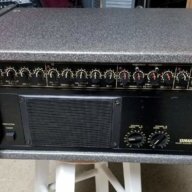
Yamaha 512SC 1000 watt PA head
X2 Mackie Thump15BST - Powered Mains
X4 Yamaha CB10 – Passive Monitors

Blues Trio PA:
Yamaha 512SC 1000 watt PA head
X2 Yamaha CB10 - Passive Mains
X2 Yamaha CB10 – Passive Monitors

Acoustic Dou
Yamaha StagePAS 600

We have much more PA gear but these little setups get the job done well. The Yamaha CB10’s has been a game changer for us and we absolutely adore the 512SC Head. We have much larger boards, cabs, subs but we just don’t need all that gear. At one point we were running a larger board, 4 powered tops, two powered subs, and four Powered 15 EV cabs as monitors, we discovered we just don’t need all that. Now if your playing to 20,000 perhaps you need more PA though that is where you will need DI and yes at that point the stage amp is useless but maybe needed for monitoring unless your using IEM. I have a pair of 6 drive Ears and my wireless setup for those occasions and they are nice.

Edit: P.S. I run sound and use a wireless to walk the room/venue works great for us. I do not need a sound tech for any of our engagements nor would I put up with one that was arrogant and seems to have the need to express his superiority constantly.
 
Last edited:
  • Like
Reactions: DJ Bebop
if the room is EQ'd to sound good with a record there should be very little to do to a bass cab sound that sounds good 4ft in front. Local guys that don't get that their room has a 80hz resonance and try to tell me my bass is boomy get my goat.
Don't forget the bass cabinet is also a source of sound exciting resonances in the room. If it's providing excessive low frequency, short of re-adjusting the bass rig, FOH will likely pull all the lows off the bass strip in an attempt to get the bass sounding as it should at front of house mix position.
 
I had this same problem one time during a sound check with an inexperienced sound tech. It was in a small/med sized local bar and it was obvious to me that the booming problem wasn't my bass/amp/cab. As a musician and engineer I could both see and hear that the problem was coming from the acoustic guitars (yeah I know, big suprise). The problem was further exacerbated by the corner of the room with all hard surafces we were standing in and very high monitor levels. I simply turned the volume to zero on my amp and pulled the bass cable out of the input...I choose not to argue with inexperienced people who are more arrogant than their ability would justify.

After we played a little more the gent came over very angry and told me I had to turn down the bass. I then pointed to my volume control (at zero) and the cable end on the floor, played a few notes on the bass that no one could hear, and then asked the guitars to play a few notes. The problem was suddenly obvious to all and I walked over to the mixer and corrected the problem very quickly.

Just as we as musicians need to take advice/direction from sound techs with more experience than us, sometimes you may get a less experienced indivdual running sound who could stand to listen to a musician who may be a little more experienced. IME success in the live sound/live band environment is built on respectful dialogue and all parties being willing to listen from the perpsetive that someone else could be right.

Whenever there's a booming bass note, everyone turns to me, and it's never me. It's a guitarist. However, I admit occasionally my lows have been too loud, generally when I'm on a platform. I run an Ampeg BA210 flat with a passive P, but when it sits on a platform in the sanctuary, that can make the unusual bass traps of that space even worse.
 
  • Like
Reactions: Al Kraft