You might be right.What is your take on all of this?

TalkBass has been independent since 1998. Add your voice.
Create a free account to reply to discussions, view embedded media, and browse with fewer display ads.
Join free Log in
Want zero display ads or expanded classifieds tools? Compare plans.
You might be right.What is your take on all of this?



Well I can't tell that it's perfect everywhere but I have a wireless and I make a point of walking the room while we are playing our sound check before starting and I'll again walk the room near the end of the second set when the place is about as full as it's going to get. People can suck up a lot of sound! So it may not be perfect, but it's pretty good.
As I mentioned I primarily run my EQ flat with a little boost at 250Hz. I used to absolutely dial in the room for every place we played, but I don't really do it like that much anymore. Rather when we do our sound check if something sounds too boomy or too brittle, I'll find that frequency and fix it instead of going through the "dial in the room" routine I used to do. I don't usually check right up against a wall because you get hit with the sound from the stage and the sound from the bounce off the back wall all at the same time.
I used to always dial it in because I could check it pretty quickly with the one semi-parametric on my Eden Nemesis amp. I'd just turn the boost up to 3 o'clock and have someone slowly move the frequency selector for me while I played a run that went from low on my E string up to at least the octave on my G string.
That put about 10db of boost on each frequency as it was rolled by. If one of them all of a sudden got louder than the rest (it would just pop!), then I applied some cut there to pull it back in line. If one of them all of a sudden got quieter than the rest, then I would make a note to add some boost there. With my WT500/800, I now have 3 semi-parametrics and each one covers an octave of sound with overlap on the ends. So it takes longer but has more granularity to where any problems are, plus I can fix more than one if two or more of them are a problem.
I used to do this as far from my amp as my cord would take me, but with my wireless I can now go as far as 200+ feet. So I usually check it at the back end of the dance floor and first row of tables first. Got to make sure the dancers have good sounds so they'll keep dancing! If it's a wide room I'll move behind the last tables and move back and forth. It's not perfect but it does make a difference.
Now @Wasnex you are far more knowledgeable than most sound techs I've dealt with and I would indeed trust you to make the best choices for the house. So, I'd tell you that I have dialed in a little boost in the low mids at ~250Hz and set everything else flat and then leave everything up to you. You could use your headphones on the board to hear the sound from my DI that I'm after and then make any adjustments you need to in order to reinforce that sound in the FOH. I've just had too many folks who didn't know what they were doing mess up sound when they had complete control over it, so I apologize for being a bit skeptical of soundboard techs and my insistence on NOT sending a pre-EQ signal to FOH. Some of them are soundboard techs in name only and some are very skilled.
 .
.
On big systems with lots of sub capacity (like an outdoor rig), it's not uncommon for the wash off the subs to cause a player to cut the low end around 60-100Hz) to compensate for the perception of the wash which results in a thin tone sent to FOH if sent post eq.



Totally great if you only play well-staffed, totally pro gigs with awesome sound-checks and the time they require. Most of us do not. I'm really happy for you but your example doesn't work for probably 90% of us.Hmmm... I have a few comments:
• I virtually NEVER send a pre-EQ signal to a board. That is primarily because I don't trust most soundboard technicians to sculpt their EQ to match my sound. So I send them a post-EQ DI signal. I do depend upon them to compensate for any room anomalies, but if they haven't done so by the end of the first set, I'll adjust my amp's EQ to compensate (my amp has three semi-parametric EQ's that will let me cut or boost pretty much any frequency I desire.So considering the above, it is very important to me to have an amp and cab that will give me the sound I want. And, I expect any sound tech to reinforce that sound NOT reinvent it. Additionally when I play outdoor festivals I prefer that they mic the cab so they know they are getting the sound that I want them to have. It's simple to run the mic on one channel and the DI on another one. Recording studios that are either big enough or have enough isolation booths to keep bleed over between tracks from being a problem will often take a DI signal and mic the cab. Then they can balance the sound they get between the two of them to get a good sound for the recording.
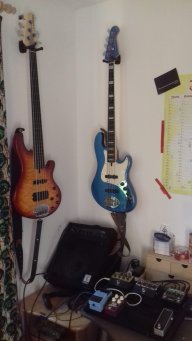
I use a Passive MIA Jazz Bass with Maple neck and normally run both my volume knobs and the tone knob all the way up. I now use LaBella tape-wound flats although I used to run Blue Steel and then Black Beauties on it. I also typically run my amp with about 3-clicks of boost at ~250Hz and all the rest of the EQ flat. With either DNA or Eden amps/cabs, that gives me "my" sound. The little bit of boost ~250Hz gives me good definition in the mix and plenty of thump in the chest. If the room has some acoustic anomalies, I can compensate for that, but my intent is to get my overall sound to be flat with a little bit of boost at ~250Hz.
If I'm forced to plug into the board without my amp, I'll use my WTDI, which is a DI box with a built-in Eden preamp and adjustable compressor. Can't boost ~250Hz on that DI box as the mids toggle between either 500Hz and 2.2KHz. So I toggle it to 500Hz and add a little boost. Both 250Hz and 500Hz give a good sound and add definition (clarity) in the mix, but I prefer to boost ~250Hz when I have the option.
I do NOT depend upon the sound tech to sculpt the sound of my bass. I DO depend upon him to reinforce MY sound so everyone else is hearing what I want them to hear. This is not the sound guys bass sound...it is mine and I am very protective of it. Having said that, I make sure I let those sound techs know what I expect AND I tell them how I'm getting it. If they know what they are doing, they are fine with that and will just compensate for the acoustics of the room, not the tone of my bass. Most boards that have a "low-mids" control on your channel, are not set up to boost specific frequencies of low-mids. I can do that with my amp so I do.
• You also misunderstand a bit how a Pre-EQ DI signal works. It doesn't "necessarily go directly from the bass input to the balanced out. It goes through a lot of electronics besides that, it just bypasses the EQ section. In an Eden Hybrid amp, that is a very important distinction because those Eden hybrid amps use a tube in the impedance-matching circuitry operating within very specific parameters to add the warmth to their sound that they are known for. Bypass that and you'd lose that warmth.
That is not bypassed, so you still have that warmth to the sound. I also have an Eden Nemesis amp which does not have a hybrid preamp but rather an entirely FET front end, and there is definitely a noticeable difference in the sound between the two. It does not have the warmth that my WT amp does.
That signal also has to go through the gain section to get the best gain level to use with the specific bass you have plugged in. The correct gain setting will get you a strong, clear, extremely low distortion signal to send to the power section of the amp, or out the DI. Eden and DNA amps also have DI level controls in most of their amps. If the signal is a little weaker than what the sound board needs, they can adjust the DI level without influencing anything else. Now days quite a few amps do that.
So although you have the general idea correct that you are trying to send an uncolored signal to the board, it definitely does NOT just go from the input jack to the DI output. Having said that, perhaps you may find one that does but that would be really unusual.
Also, I think you may be overestimating how prevalent "ampless" bassist are. If you look at that TB poll that @Passinwind mentioned, out of 635 votes when I just checked, 85.8% responded that they HAD to use an amp. I'm one of those. Throughout most of the gigs, the guitars and sometimes drums will run through our own PA or an FOH system, and I am expected to cover my part with my own amp and cab(s). My DNA and Eden gear is more than up to it, so I have no problem with that.


There is an enormous selection of amps and cabs out in the market right now. The laws of competition dictate that every amp or cabinet needs to have something that makes it different or 'stand out' in order to appeal to a particular cohort of players. People describe a "Mesa" sound or "Ampeg" or "Aguilar" sound, etc, or some amps or cabs have particular features, like the voicing control on the Genzler amps, for example. Some amp designers even aim to stand out by making amps totally uncolored and neutral sounding.
When performing any gig that has FOH, the bass amp is essentially relegated to monitoring duty. The FOH engineer needs a sound that can be easily sculpted, EQ-wise at least, to sit appropriately in the mix. Given the different EQ needs of the house vs the stage, it makes sense then to send a DI signal that is Pre-EQ. I know this is not a universal solution but one opted for by many bassists and sound guys.
As I understand it, in most amps a pre-EQ signal essentially goes straight from the input jack to the DI, bypassing the circuitry that 'colors' or gives the particular 'flavor' of that amp to the signal (not to mention the organic tone shaping effect of the speaker that is essential to capturing the essence of many signature bass tones). Looking at the schematic for the Mesa D-800, for example, this seems to be the case. (Please correct me if I am wrong on these last two points) Assuming this is correct, coloration of the basic sound to the ears of any listener hearing only the sound from FOH is caused by the bass, any effects between and bass and amp such as a compressor, and finally by any inherent tone and EQ shaping done at the mixing board. The bass amp itself is just a conduit to the mixing board. The exception to this would be the transformers in certain DIs, such as the Jensen found in some high end bass amps like Demeter, or Cinemag (REDDI). Even then, there's not nearly as many options for transformer based coloration relative to the inherent 'flavor' of the many amps on the market.
To most of our audience then, our amplifier is essentially the PA system - something while not perfectly flat, is designed with transparency in sound amplification, not coloration.
My main question to you is this: given all of these factors, why do so many of us obsess over these nuances in tone of these different amps if that element of the sound doesn't make it to the audience?
Before you judge what I've written know that the situation I described is my own. I've just recently become really irked by it - I generally like the sound I get from my amp, but why wouldn't it be preferable to have a sound that is as close as possible to what the audience is hearing?
In light of all this, I understand why many players are moving to ampless setups and why speaker sims have gained in popularity. It's a reliable way to get that speaker coloration and baked-in amp tone to the FOH without the hassle of mic bleed and disparate EQ settings. Particularly for guys who do a fair amount of recording, especially with plug-ins, I can see why one would want to get that tone out into a live setting.
Thanks for reading. What is your take on all of this?

There is an enormous selection of amps and cabs out in the market right now. The laws of competition dictate that every amp or cabinet needs to have something that makes it different or 'stand out' in order to appeal to a particular cohort of players. People describe a "Mesa" sound or "Ampeg" or "Aguilar" sound, etc, or some amps or cabs have particular features, like the voicing control on the Genzler amps, for example. Some amp designers even aim to stand out by making amps totally uncolored and neutral sounding.
When performing any gig that has FOH, the bass amp is essentially relegated to monitoring duty. The FOH engineer needs a sound that can be easily sculpted, EQ-wise at least, to sit appropriately in the mix. Given the different EQ needs of the house vs the stage, it makes sense then to send a DI signal that is Pre-EQ. I know this is not a universal solution but one opted for by many bassists and sound guys.
As I understand it, in most amps a pre-EQ signal essentially goes straight from the input jack to the DI, bypassing the circuitry that 'colors' or gives the particular 'flavor' of that amp to the signal (not to mention the organic tone shaping effect of the speaker that is essential to capturing the essence of many signature bass tones). Looking at the schematic for the Mesa D-800, for example, this seems to be the case. (Please correct me if I am wrong on these last two points) Assuming this is correct, coloration of the basic sound to the ears of any listener hearing only the sound from FOH is caused by the bass, any effects between and bass and amp such as a compressor, and finally by any inherent tone and EQ shaping done at the mixing board. The bass amp itself is just a conduit to the mixing board. The exception to this would be the transformers in certain DIs, such as the Jensen found in some high end bass amps like Demeter, or Cinemag (REDDI). Even then, there's not nearly as many options for transformer based coloration relative to the inherent 'flavor' of the many amps on the market.
To most of our audience then, our amplifier is essentially the PA system - something while not perfectly flat, is designed with transparency in sound amplification, not coloration.
My main question to you is this: given all of these factors, why do so many of us obsess over these nuances in tone of these different amps if that element of the sound doesn't make it to the audience?
Before you judge what I've written know that the situation I described is my own. I've just recently become really irked by it - I generally like the sound I get from my amp, but why wouldn't it be preferable to have a sound that is as close as possible to what the audience is hearing?
In light of all this, I understand why many players are moving to ampless setups and why speaker sims have gained in popularity. It's a reliable way to get that speaker coloration and baked-in amp tone to the FOH without the hassle of mic bleed and disparate EQ settings. Particularly for guys who do a fair amount of recording, especially with plug-ins, I can see why one would want to get that tone out into a live setting.
Thanks for reading. What is your take on all of this?

My main question to you is this: given all of these factors, why do so many of us obsess over these nuances in tone of these different amps if that element of the sound doesn't make it to the audience?


When performing any gig that has FOH, the bass amp is essentially relegated to monitoring duty. The FOH engineer needs a sound that can be easily sculpted, EQ-wise at least, to sit appropriately in the mix. Given the different EQ needs of the house vs the stage, it makes sense then to send a DI signal that is Pre-EQ. I know this is not a universal solution but one opted for by many bassists and sound guys.
As I understand it, in most amps a pre-EQ signal essentially goes straight from the input jack to the DI, bypassing the circuitry that 'colors' or gives the particular 'flavor' of that amp to the signal (not to mention the organic tone shaping effect of the speaker that is essential to capturing the essence of many signature bass tones). <snip> What is your take on all of this?

There is an enormous selection of amps and cabs out in the market right now. The laws of competition dictate that every amp or cabinet needs to have something that makes it different or 'stand out' in order to appeal to a particular cohort of players. People describe a "Mesa" sound or "Ampeg" or "Aguilar" sound, etc, or some amps or cabs have particular features, like the voicing control on the Genzler amps, for example. Some amp designers even aim to stand out by making amps totally uncolored and neutral sounding.
When performing any gig that has FOH, the bass amp is essentially relegated to monitoring duty. The FOH engineer needs a sound that can be easily sculpted, EQ-wise at least, to sit appropriately in the mix. Given the different EQ needs of the house vs the stage, it makes sense then to send a DI signal that is Pre-EQ. I know this is not a universal solution but one opted for by many bassists and sound guys.
As I understand it, in most amps a pre-EQ signal essentially goes straight from the input jack to the DI, bypassing the circuitry that 'colors' or gives the particular 'flavor' of that amp to the signal (not to mention the organic tone shaping effect of the speaker that is essential to capturing the essence of many signature bass tones). Looking at the schematic for the Mesa D-800, for example, this seems to be the case. (Please correct me if I am wrong on these last two points) Assuming this is correct, coloration of the basic sound to the ears of any listener hearing only the sound from FOH is caused by the bass, any effects between and bass and amp such as a compressor, and finally by any inherent tone and EQ shaping done at the mixing board. The bass amp itself is just a conduit to the mixing board. The exception to this would be the transformers in certain DIs, such as the Jensen found in some high end bass amps like Demeter, or Cinemag (REDDI). Even then, there's not nearly as many options for transformer based coloration relative to the inherent 'flavor' of the many amps on the market.
To most of our audience then, our amplifier is essentially the PA system - something while not perfectly flat, is designed with transparency in sound amplification, not coloration.
My main question to you is this: given all of these factors, why do so many of us obsess over these nuances in tone of these different amps if that element of the sound doesn't make it to the audience?
Before you judge what I've written know that the situation I described is my own. I've just recently become really irked by it - I generally like the sound I get from my amp, but why wouldn't it be preferable to have a sound that is as close as possible to what the audience is hearing?
In light of all this, I understand why many players are moving to ampless setups and why speaker sims have gained in popularity. It's a reliable way to get that speaker coloration and baked-in amp tone to the FOH without the hassle of mic bleed and disparate EQ settings. Particularly for guys who do a fair amount of recording, especially with plug-ins, I can see why one would want to get that tone out into a live setting.
Thanks for reading. What is your take on all of this?
This is a complex question with no simple answer.There is an enormous selection of amps and cabs out in the market right now. The laws of competition dictate that every amp or cabinet needs to have something that makes it different or 'stand out' in order to appeal to a particular cohort of players. People describe a "Mesa" sound or "Ampeg" or "Aguilar" sound, etc, or some amps or cabs have particular features, like the voicing control on the Genzler amps, for example. Some amp designers even aim to stand out by making amps totally uncolored and neutral sounding.
When performing any gig that has FOH, the bass amp is essentially relegated to monitoring duty. The FOH engineer needs a sound that can be easily sculpted, EQ-wise at least, to sit appropriately in the mix. Given the different EQ needs of the house vs the stage, it makes sense then to send a DI signal that is Pre-EQ. I know this is not a universal solution but one opted for by many bassists and sound guys.
As I understand it, in most amps a pre-EQ signal essentially goes straight from the input jack to the DI, bypassing the circuitry that 'colors' or gives the particular 'flavor' of that amp to the signal (not to mention the organic tone shaping effect of the speaker that is essential to capturing the essence of many signature bass tones). Looking at the schematic for the Mesa D-800, for example, this seems to be the case. (Please correct me if I am wrong on these last two points) Assuming this is correct, coloration of the basic sound to the ears of any listener hearing only the sound from FOH is caused by the bass, any effects between and bass and amp such as a compressor, and finally by any inherent tone and EQ shaping done at the mixing board. The bass amp itself is just a conduit to the mixing board. The exception to this would be the transformers in certain DIs, such as the Jensen found in some high end bass amps like Demeter, or Cinemag (REDDI). Even then, there's not nearly as many options for transformer based coloration relative to the inherent 'flavor' of the many amps on the market.
To most of our audience then, our amplifier is essentially the PA system - something while not perfectly flat, is designed with transparency in sound amplification, not coloration.
My main question to you is this: given all of these factors, why do so many of us obsess over these nuances in tone of these different amps if that element of the sound doesn't make it to the audience?
Before you judge what I've written know that the situation I described is my own. I've just recently become really irked by it - I generally like the sound I get from my amp, but why wouldn't it be preferable to have a sound that is as close as possible to what the audience is hearing?
In light of all this, I understand why many players are moving to ampless setups and why speaker sims have gained in popularity. It's a reliable way to get that speaker coloration and baked-in amp tone to the FOH without the hassle of mic bleed and disparate EQ settings. Particularly for guys who do a fair amount of recording, especially with plug-ins, I can see why one would want to get that tone out into a live setting.
Thanks for reading. What is your take on all of this?