Ya'll talkbassers please let me know if my wife ever logs on and starts inquiring into the value of my basses lol
...so, I should stop PMing her?
Too bad. We were really close on a price this afternoon. Ah, well.

TalkBass has been independent since 1998. Add your voice.
Create a free account to reply to discussions, view embedded media, and browse with fewer display ads.
Join free Log in
Want zero display ads or expanded classifieds tools? Compare plans.
Ya'll talkbassers please let me know if my wife ever logs on and starts inquiring into the value of my basses lol

Agreed, but where did you see a hootenanny button? I'm still looking.

Curious why you think it has a "different body"?it has a Fender Jazz Bass neck but a different body
Guess I need to look harder
 . Interesting that Fender used pearl for the last dot necks. Also, I've seen late '65 jazzes (neck date) with binding & blocks, so even Fender doesn't have the lowdown on everything they made...
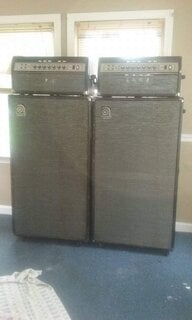
Does your husband know you are researching his bass for value?

It looks like a '66 neck to me. They transitioned to the pearloid dots during '64 and to bound and blocked necks during '66. The decals were emplaced atop the finish until the TV style logos came into use during the latter 60's so they weren't the most resilient as evidenced by the photo of my '64 below.
I've attached a screenshot of what I consider to be the most definitive source: Fender itself, and a link to that source . . .
Invalid Link Removed
View attachment 4276685
View attachment 4276686
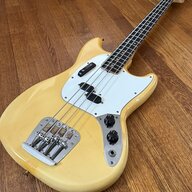
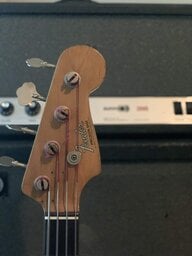



Thank you. I don't think we'll go to the bother of disassemble it, it was more out of curiosity. Someone stopped my husband in London's Denmark street when they saw the Bass as they said it was unusual so we were curious to find out. I guess it will remain a mistery!

...so, I should stop PMing her?
Too bad. We were really close on a price this afternoon. Ah, well.



Ya'll talkbassers please let me know if my wife ever logs on and starts inquiring into the value of my basses lol

I'd help her out. Maybe she'll give me a great deal that I can't pass onYa'll talkbassers please let me know if my wife ever logs on and starts inquiring into the value of my basses lol
.

Its a very modified bass.
It looks like it started as a 65 Jazz, and one that was at least refinished and several changed parts. But the top shape of the headstock has been sanded and is now out of proper shape. Wrong pickguard. And that neckplate with no F logo and that serial range tells me its a bogus plate.
No screw holes under the pickguard for the finger rest...so is either a refin with plugged holes, or might not even be a 65/66 body at all.


