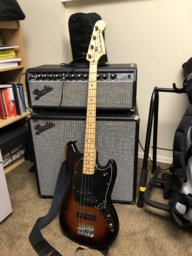
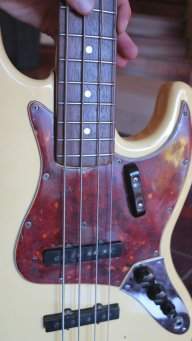
So, this might get technical...
Active circuits could boost voltage, amperage, or both. I think the primary advantage of a small, onboard amp would be to provide amperage that a passive pickup cannot provide. Just because it can does not mean it will. Amperage is a measure of electron flow where voltage is the force that causes the electrons to flow. The third element in the equation is resistance. The equation is known as Ohms law and looks like I=V/R, I being amperage or current, V being voltage and R being resistance. This isn't the whole story because we're dealing w/ alternating current, but it's close enough.
So, if a passive bass has a certain output voltage level(determined by the magnets and coils in the pickup) and the amp has a certain input resistance, then I is the ratio of those. If the input resistance of the amp is very low, then I becomes very high. The pickups may not be able to generate sufficient I, the pickups become loaded and you get distortion. By adding an active circuit in there(specifically a voltage buffer which does not boost voltage, but does give current gain), the current required by the amp is provided by the battery, not the pickups themselves, you alleviate that distortion. This is probably how most active basses are built.
However, that's not the only reason for an onboard preamp. Long cable runs introduce resistance and capacitance into the circuit. This is also detrimental to the sound in a variety of ways. Put simply, you want to "overpower" that resistance and provide a higher signal to the noise in the cable(ie increase signal to noise ratio).
Going back to Ohm's law, a longer cable will have a higher R(in conjunction with the amp). If V does not increase, I will be lower and may not be sufficient to drive the amp cleanly. So an output stage to increase voltage may be part of the preamp.
If R doesn't change(same cable, same amp) this should increase the volume. However, it's entirely possible that your amp, as overpower protection attenuates the incoming signal to a certain level before feeding to it's preamp or power amp sections. Thus you wouldn't hear any significant difference in volume in the end. If the active electronics in the bass are good, it wouldn't surprise me if it sounded better, just not louder. On the other hand, if you don't have a long cable run, and your amp and passive bass are well matched, the passive bass could sound better because it doesn't have limitations of some active circuits.