• TalkBass has been independent since 1998. Add your voice.
    Create a free account to reply to discussions, view embedded media, and browse with fewer display ads.
    Join freeLog in
    Want zero display ads or expanded classifieds tools? Compare plans.

High Pass Filter (HPF) and Low Pass Filter (LPF) Mega Thread

i have earplugs, its already too loud in our small room ;)
don´t have to be much louder, but i hope to cut through better with a clearer signal...

and as i understand my amp should have a little more power left for the audible
frequencies by not having to deal with that low mud, right?
The best way to cut through is to turn everyone else down.

As many TBs have found out, it's VERY expensive to win a volume war.
 
Last edited:
Thanks @agedhorse . Do you think using the wireless and a HPF will affect the corner as you described when using multiple HPF's in cascade? I'm asking because we rehearsel with cables but perform live with wireless, and is good to know what to adjust or not.
Yes, but it depends on their frequencies and slope how much they will interact. If you have one at 30Hz and another at 60Hz, the 60Hz filter will tend to dominate.
 
In recording, people tend to apply pass filters when mixing after the tracks have been recorded and they are in the digital domain. Frequencies can be analysed and digital filter breakpoints and attenuation slopes can be set with great precision. These digital filters can outperform many. Sometimes filters are chosen because of their quality vs where in the process they are used.

Filters serve different functions. They can help eliminate problems such as line related noise or conflicting frequencies between different sources. High passing the bass can also remove low end energy content that doesn't need to be present because it adds low end mud. It helps focus the frequencies to bring out and make the bass sound louder in the mix. This brings clarity, you hear the bass.
 
Last edited:
i have earplugs, its already too loud in our small room ;)
don´t have to be much louder, but i hope to cut through better with a clearer signal...

and as i understand my amp should have a little more power left for the audible
frequencies by not having to deal with that low mud, right?
The frequency sculpting has the main effect. A little extra power doesn't hurt but the relationship of volume to power is calibrated on the dB scale. Double the power nets a maximum of 3dB, all else being optimal.
 
Busking, battery power, HPF, Zoom B3


@brianrost
I bought a (Roland) Cube Street EX and out of the box it was OK for bass guitar but not ideal.

The problem was not so much volume but trying to keep it from farting out as I raised the volume.

Used an fdeck HPF pedal a few times to control the low end before trying my Zoom B3 with a preset made up of a crossover (used as a HPF), a limiter (to control peaks) and an amp sim.

The basic sound of the EX is clean like a PA, so the amp sim makes it sound like a bass amp. I normally don't like using compression, but the limiter gives me more usable volume so it's worth it.

I found the COSM guitar models were useless for bass.

I use one channel for a vocal mike, one for my bass.

I bought a bunch of (Panasonic) Eneloop Pro rechargeable batteries and can get through 4 hours with no low power warning, but I bring spares anyway.

Because it uses (8) AA cells, the amp is much lighter than those using lead-acid batteries.

The B3 is one of the few digital pedals that will run off batteries (the current B3n does not), I use Eneloops for that too.

I run my EX on full power to keep up with a guitarist running his EX on half power. We are able to match volume with a drummer on a minimal (kick, snare, hihat) kit. I think the 50 watt power claim is wishful thinking, my guess it's more like 25 watt RMS split between the two channels.

The bag is way overpriced but is useful as a rain cover.

Invalid Link Removed
 
Last edited:

@agedhorse:
With the HPF early in the signal path, subsonic signal can interact with the control signals on gates, compressors, dynamic filters and dynamic eq. Pro audio pieces deal with this within the sidechain as well as the main audio path by dedicating hpfs as needed.

Also, if significant subsonic signal levels occur, clipping of these subsonic can create audible artifacts that are generally unwanted as they are not musically related.

This is why it's usually more successful to deal with subsonics before they enter the signal path.
 
Last edited:
  • Like
Reactions: lowplaces
got the hotone gate this week, and just tried it with the band.
mission accomplished, finally cut through better with my clean signal :thumbsup:
great pedal but really tiny

IMG_0217.JPG
 
Although I currently use a Carl Martin Contour & Boost for a sweepable HPF/LPF unit, I like the overall concept of the L.R. Baggs Align EQ with selectable HPF and built in EQ.

I'd rather see a 40/60/80 HPF option than the ones chosen and a couple of minor EQ-point changes, but I understand this is from their Acoustic Series. Still - if I see one whilst out & about, I'd give it a spin.
lrbaggs-align-equalizer-fr-web.png
 
Last edited:
Cool!

What are the specs of the gate?

How does it clean up your tone?

lo-cut from 40 - 120 hz
hi-cut from 5k - 15k
and noise gate

the cut of everything below 40hz makes the low end much thighter and better audible.
hi-cut doesn´t have much effect, i think. (or are there frequencies left in that range on a bass?)
noise gate has a fancy lighted knob (but also nice to remove some finger noise and humming)
 
  • Like
Reactions: Stumbo
lo-cut from 40 - 120 hz
hi-cut from 5k - 15k
and noise gate

the cut of everything below 40hz makes the low end much thighter and better audible.
hi-cut doesn´t have much effect, i think. (or are there frequencies left in that range on a bass?)
noise gate has a fancy lighted knob (but also nice to remove some finger noise and humming)
Man, How small is that thing? It looks tiny!
 
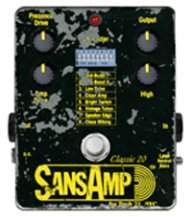
Why so low for the LPF? Tech 21 has heard 810e cabs before :D
Our designer picked 3 kHz because that is kind of a midpoint "sweet spot" for that function. The roll off starts at that point and attenuates a 12dB per octave. You can easily raise that point to 6 kHz by using the 18dB mid shift as well as lower the LPF. Don't get hung up on the numbers, just use your ears. Even with a typical guitar speaker, the high's will start to roll of around 5 kHz (like the 810e you referenced) but much higher frequencies are still present but are attenuated.
 

Latest posts