Yes Thanks it is the same effet.
But in a wah pedal the amont of boost at the peak is fixed
Why ?
Inside joke. You'd have to read through many posts...
Broughton Audio Super Thread

TalkBass has been independent since 1998. Add your voice.
Create a free account to reply to discussions, view embedded media, and browse with fewer display ads.
Join free Log in
Want zero display ads or expanded classifieds tools? Compare plans.
Yes Thanks it is the same effet.
But in a wah pedal the amont of boost at the peak is fixed
Why ?
Too true. Not only stepping on the kick but also ruining the FOH mix....Sometimes I think guitar players should also use a HPF...edit, same consideration is valid for keys as well.


What's the point of some of these units having volume controls? The last thing I could envision is wanting to adjust sound (particularly accidentally with my feet) another place in my signal chain.

You often need it to offset the signal gain reduction that results from the pass filtering. The more you filter out, the more of a boost you need to get your signal back to the level it started at (assuming that is what you want).
Too true. Not only stepping on the kick but also ruining the FOH mix.
HPFing idiots.

... and guitarists or keyboarders violating the bassists frequency range will be punished in public with no less than 4hrs forced listening to John Denver songsIn a perfect world, musicians in a band would get frequency range assigned like, for example, mobile operators...


I swear that once I read here a post of someone doing a LPF with the parametric eq of a zoom multi-effect (b1on, ms60b, b3n... Whatever) but I lost this post
So, how can I cut all frequencies higher than 6khz using the parametric eq of these pedals (or any parametric eq)?
Parametric:
20 Hz - - 5kHz \/ 7k - 20k
LPF
20 Hz - - 5kHz \___
You may want to check out: HPF and Compressor: how to use them, together - or not?I'm hoping for some advice with the placement and interaction of my Fdeck HPF3 and Empress comp. I have these at the end of my signal chain due to using a lot of synthy effects, including octavers and filters which increase low frequencies and resonance in the signal. I was running the Fdeck last for speaker protection but am about to move it before the Empress to additionally stop low frequencies from over-triggering the comp. The Empress also has a sidechain which can be used for the same purpose. For bass, Empress suggests making a DIY 100Hz HPF by soldering a 3.9nF capacitor into a pancake plug, and plugging this into the sidechain jack. There's a thread about it here.
My question: is there any advantage or significant difference using the 100Hz pancake HPF in the Empress's sidechain vs. running the Fdeck HPF3 before the Empress with the sidechain empty?
Both will help stop low frequencies from triggering the comp (pancake somewhere below 100Hz, Fdeck 12 dB/octave from 35 Hz down, plus another 12 db/octave adjustable from 35-140Hz). But if I understand correctly, any unwanted sub-sonic lows will pass through uncompressed with the pancake sidechain setup and the Fdeck would still be needed after the Empress to clean them up. If that's the case, is it better to just put the Fdeck before the Empress and be done with it?
I think you answered your own question, HPF in sidechain allows more lows to pass through by reducing the amount of compression triggered by the lows. So it solves a different problem then the HPF being applied to the audio signal.I'm hoping for some advice with the placement and interaction of my Fdeck HPF3 and Empress comp. I have these at the end of my signal chain due to using a lot of synthy effects, including octavers and filters which increase low frequencies and resonance in the signal. I was running the Fdeck last for speaker protection but am about to move it before the Empress to additionally stop low frequencies from over-triggering the comp. The Empress also has a sidechain which can be used for the same purpose. For bass, Empress suggests making a DIY 100Hz HPF by soldering a 3.9nF capacitor into a pancake plug, and plugging this into the sidechain jack. There's a thread about it here.
My question: is there any advantage or significant difference using the 100Hz pancake HPF in the Empress's sidechain vs. running the Fdeck HPF3 before the Empress with the sidechain empty?
Both will help stop low frequencies from triggering the comp (pancake somewhere below 100Hz, Fdeck 12 dB/octave from 35 Hz down, plus another 12 db/octave adjustable from 35-140Hz). But if I understand correctly, any unwanted sub-sonic lows will pass through uncompressed with the pancake sidechain setup and the Fdeck would still be needed after the Empress to clean them up. If that's the case, is it better to just put the Fdeck before the Empress and be done with it?
Thanks man, I did see that post. I understand the concept of HPF before comp to give the comp a 'cleaner' signal to work with. It's more the nuances 'HPF before comp' vs 'HPF in sidechain' I was wondering about. I realise they're different applications of a HPF, but was wondering how different the results are.You may want to check this out: HPF and Compressor: how to use them, together - or not?
Haha yeah fair call, I thought much the same thing after I posted it. Ok, so two different problems, two different solutions. Thanks you bothI think you answered your own question, HPF in sidechain allows more lows to pass through by reducing the amount of compression triggered by the lows. So it solves a different problem then the HPF being applied to the audio signal.

 In the context of my little adventure in Oregon, I'm happy to report that a single Crazy8 was more than I needed.
With all the interest in HPFs and LPFs these days, it's time to put together all the info TBrs need to make an informed decision about purchasing one or both.
HPFs and LPFs are tailored equalizers that significantly attenuate (make much quieter) muddy/sub-sonic lows(HPFs) or clanky/janky highs(LPFs) in amps that are turned up, help tame boomy stage and venue acoustics, help protect speakers from over excursion (speaker cone movement beyond its limits) and will get you to love your B string or down tuning even more.
If you ONLY play quietly at home through an amp, you may not need an HPF and/or LPF. It WILL help headphones and recordings.
A little known fact is that PAs, guitar players, keyboard players and kick drums(FOH or run through their own amp) can improve their tone and reliability (and the mix) by using an HPF. Guitar players would benefit from an adjustable HPF set much higher than a bass player, around 100hz-120hz.
If you would be so kind to post your success stories (or not), warnings, pics, settings, rigs, amps, cabs, applications, basses, builders, prices, links, etc. it will be very helpful and educational.
All questions, comments, pics, fans, owners, potential owners, passersby, builders, designers and sound engineers are welcome!
I thank you as do all TBrs learning about these great tools in our quest for the best tone for metal! I keed, I keed.
Maybe not.
TERMS
HPFs are also known as Rumble, Sub-Sonic or Low-Cut Filters. Filter as in "filter out". Sub-sonic means below an acceptable audible level.
The terms High Pass Filter and Low Pass Filter are somewhat unintuitive.
HPFs do not just deal with highs or treble.
An HPF lets frequencies above a set level pass. For bass, it's usually frequencies around 35hz for fixed level HPFs and between 25hz-160hz for adjustable HPFs. These frequencies are chosen by the designer/builder.
LPFs do not just deal with lows or bass.
An LPF lets frequencies below a chosen level pass, usually between about 5khz to 15khz. They let higher lower frequencies than those pass. LPFs are usually adjustable. These frequencies are chosen by the designer/builder. For the user, depending on your sonic goals, your ears pretty much decide on which frequency to use.
For adjustable filters, the frequency level you choose depends on a few variables: bass, amp, cab, band instrumentation, venue, effects and your ears.
Limiter : Different than an HPF/LPF, is a circuit that limits the maximum level of a signal. It's a circuit that allows signals below a specified input power or level to pass unaffected while attenuating the peaks of stronger signals that exceed this threshold. Limiting is a type of dynamic range compression. Clipping (audio) is an extreme version of limiting. Many amps have Limiters built in.
OPERATION
HPF/LPS run on very small amounts of current in pedal format (switchable or always on) and are usually hooked up between the instrument and the input jack, in the amp effects loop or between a preamp and power amp. They are usually powered by batteries or low-voltage power supplies(wall warts).
Many amps have fixed frequency, always-on HPFs built in, though some being adjustable with a knob on the front of the amp. Some effects have an HPF or LPF built in.
If you have other effects, placement in the signal chain depends on your sonic goals and your ears. Check out the TB Effects Forum for more info on this topic.
Why you need an HPF
Part 1
@Mike Arnopol, MAS Cabs
From: Is this good? Boom Bass Cabinet
Most cabs that say 30hz---are down more like 20db at 30hz. But--your perception about 30hz extension is valid . The reason is that almost all cabs claiming this are reflex cabs. Here's the problem with that extension with a reflex cab:*
1. most of the information at that frequency is coming out of the port. That quality of bass is very poor and uncontrolled. The great home hifi speaker designer John Dunlavy told me " I don't want to hear any bass coming out of a port." Ported enclosures are a cool compromise--you can get loud, have a small enclosure, and have good efficiency. A compromise is in the bottom octave or so. A sealed box that actually goes that low will have a much better quality of bass---but they will be huge, won't go as loud, and would be low efficiency.
2.All of the drivers that I know that aren't designed exclusively for subs--all of the woofers used in bass cabs---have a free air resonance of 40 to 50 hz. They don't work well under that.
3.Most reflex cabs are tuned (typically) in the 42 to 50 hz range. What this means is that any frequency under that tuning frequency--the speaker behaves as in free air. Which means that it's flopping around aimlessly.
What this means is that when you play a note under that tuning frequency--typically under 42hz (or higher in many cases) The speaker is just flopping around trying to reproduce that note.
What happens is that since the cone movement is uncontrolled, the second harmonic (octave) is being reproduced poorly as the cone is uncontrolled.
The second harmonic is what we key off of for pitch. That second harmonic then is boomy and uncontrolled. This is the reason that many guys (correctly) say that having that extension causes too many problems on stage---not the fact of reproducing 30hz.
People should use a HPF set to around 40hz. All of a sudden the B string tightens up and you lose the boom. Running a reflex cab without a HPF will result in a crappy B string sound .
There are however, some cabs that are of a different design that don't unload and can reproduce the B. When you hear a cab that goes that low and play on the B string---all of a sudden it sounds and feels like the other strings. The fundamentals in that range---while not really needed for an effective B string--do add a pretty neat cushion that does not get in the way.
*Note: A bass reflex system is a type of loudspeaker enclosure that uses a port or vent cut into the cabinet and a section of tubing or pipe affixed to the port. This port enables the sound from the rear side of the diaphragm to increase the efficiency of the system at low frequencies as compared to a typical closed box loudspeaker or an infinite baffle mounting.
Part 2
@agedhorse, designer, MESA, Genz Benz
from: 8 ohm cab question
There are different metrics used by different manufacturers (and even different models within a brand) that might be used to describe exactly the same power.
For example, on an amplifier that is rated at 500 watts "RMS", it is also going to be capable of delivering 1000 watts peak, because the mathematical definition of the peak voltage of a sine wave (used for ratings) is 1.414x the RMS voltage, and when this 1.414 factor is squared in the power equation, it results in 2x.
The same thing applies to speakers, but with an added twist based on some old colloquial information that you may not be aware of.
Speakers tend to be rated in two ways, the first being the same "RMS" (or continuous average) and peak that we discussed above for amplifiers.
The second way, which is more common in the pro audio industry, is 'RMS", "program" and "peak... the meanings being different here.
"RMS" is the same, program is defined as 2x the RMS value and comes from when speaker manufacturers were very conservative in their ratings and clipped/compressed program is excluded, and peak which is defined as 2x the program power or 4x the peak power.
So, a speaker rated at 500 watts "RMS" might also be rated at 1000 watts "program" or "2000 watts peak.
Which units that are being used is often left to the imagination (or the marketing departments). Also, most speaker power ratings are based on a "must survive, damage allowed) time period of 2 hours. When you extend this test to say 200 hours it's common to see a 1/3 reduction in power rating.
Another factor is that the (speaker) mechanical part of power handling starts falling rapidly at low frequencies (often below 60Hz), right where the biggest demands are placed on them. At say 30Hz, the power handling might be only 50% of rated speaker power.
The challenge is that you have an amp like the Subway, which is rated at 400 watts RMS into 8 ohms, and somebody buys a "500 watt" cabinet thinking that it will be fine BUT it's 500 watts "program" or only 250 watts "RMS" and maybe not so fine. It's even worse if these numbers are peak units.
Therefore, it's not anywhere near as easy as it seems, and this is one big reason IMO why many cabinets fail through no direct fault of the user.
@fdeck, builder, hpf V3
You can go as low as you want with any speaker diameter. What you give up when you try to do that, is volume.
There's a rule of thumb in speaker design: Small, loud, low. Pick any two. As a result, speakers made with smaller drivers tend to sacrifice low end so they can still reach acceptable volume. Or, they use a larger number of small drivers to approximate the behavior of a single large driver.
Part 3
Why do I do this to myself...
I've changed my rig so often that I end up dumping gear that I need later on. Discovered at two gigs recently that I once again need a HPF. I'm pushing my amp into limiting on the low end at some stupid loud gigs. After proudly proclaiming that a HPF isn't necessary, I'm now regretting the two that I've sold. Should have just left in mu rig the whole time, dummy.
Why you need an HPF/LPF
Broughton HPF LPF question
I'm interested in getting one of these for a couple reasons. I have and like using an HPF to tame the boom in a lot of rooms/rigs, and I have recently discovered that I like using a LPF to help me dial out some of the crispy treble, while keeping the upper midrange fullness that I like for fingerstyle playing and soloing.
Question is: is the HPF as effective as my Fdeck V3? AND, does the LPF work in the way I mentioned?
Can I use it to shelve out some of the string noise-y, hissy, clanky sound that is not readily tame-able with most traditional treble controls?
How steep is the curve on the shelf?
thanks for any input.
@Asure Skies, Builder, Broughton Audio says:
The HPF and LPF are both 12 dB per octave butterworth response filters. I use the LPF in the way that you describe: to filter out ultra high frequencies (string noise, fret buzz) but still keep the lower treble/upper mid frequencies.
@JimmyM says:
So how come nobody ever complains about guitarists wanting to control what goes out to the PA? Or keyboard players?
But dang, a bass player wants to do it, and bass players line up to tell them they're egomaniacs and jerks and they need to leave everything up to the sound tech? Wow, what a beaten-down bunch of shlubs!
How dare anyone tell me what to do! It's my show, not theirs! I refuse to be beaten down into the status quo! I'm always happy to listen to competent people if they think I'm doing something that's making their gig impossible, but I've had too many try to take me down a road that I don't want to go.
Examples:
---I hate tweeters on electric bass and have told the sound tech of my disdain for them. But the sound tech loves the sound of guys like Marcus Miller and Victor Wooten (I do too but not for my thing), therefore I end up with tweeter frequencies in the PA.
Low pass filter is for them.
---In our band, if you have too strong frequency response below 60 hz or so, it creates mud. But the sound tech is younger and grew up with hip hop and EDM and loves those frequencies and pushes them hard despite me being quite vocal about not liking them.
High pass filter is for them.
---I have had sound techs tell me I need to plug my bass straight into a DI, despite my use of effects.
When I tell them that I use effects and want them in the PA, I have been told things such as "You will not have effects in my PA" or "We'll set up a mic for your cab and blend them," then they never turn on the mic.
Well sorry...but when you're on my gig, that is MY PA until the gig is over. So you're getting effects in the DI and you will like it. Don't worry...between my professional use of effects and my H and LPF, your speakers are safe, Mr. Sound Tech.
But when you demand that the guitarist doesn't use effects, then and only then will I take your demand that I plug my bass straight into the PA seriously.
On the other hand, our sound tech yesterday showed me his iPad with my channel pulled up...he says, "Man, I have to add a lot of bass to your channel to make it sound right out here" and shows me the graph with a hump at 100 hz. I explained to him that I usually try to send him a fairly flat signal that he can easily tweak as he needs, other than my H and LPFing. Then I told him that I loved how it sounded in the house (and you're darn tootin' that I go out there and check it out, so I know exactly what it sounds like), and he gave me the thumbs up.
So you can see I'm very cooperative and leave a lot to the sound tech's discretion. But H and LPFing and effects are non-negotiable. Those who know what I want don't care, and those who do care don't get a choice in the matter. Isn't it enough that I gave up my awesome Heil mic and went to a DI? What do you want? Blood?
Why you need an LPF
NPD: Broughton Audio Low Pass Filter
@JimmyM says:
So every now and then, I lament the sorry state of what's available in the way of speaker simulation (high dollar rack stuff, sims married to larger pedals that do other things, etc.), and one day I was commenting how Markbass was missing the boat by not putting their VLE (Vintage Loudspeaker Emulator) control in a 1590a box and selling it, and I said, "First indie pedal builder who does it gets my money." Welp, Josh Broughton (Azure Skies) was the first one.
It's a low pass filter (obviously) that gives you a gradual sloping rolloff of highs without affecting the other frequencies, allowing you to emulate the freq response of tweeterless cabs, which is a must for as much overdrive as I use. All the way left is full highs up to 16khz, all the way right cuts highs above 160 hz.
I found my favorite 5k rolloff somewhere between 9:00 and 10:00 (have to experiment a little more to find it exactly), which is very similar to how the VLE behaves.
Close enough for rock and roll...I strap it to the board and take it right to the gig.
Other than the 5k rolloff I had dialed in, it was dead transparent, so I was quite happy...
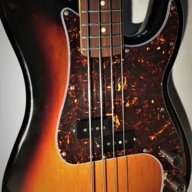
What a incredible piece of information, Thank You! I know this now but where was this info 35 years ago, you younger bassist have all this, and more, information that we never had, we just did the best that we could with our ears, and when that didn't work their was always booze and drugs to make it sound better!! This is great info, Use It!!
!Back in the day, my rig was at first a Hofner (see avatar) and then a Fender Jazz and a Sunn 2000(120w) with one of the big 2x15 JBL D140 cabs. I sure could have used an HPF back then. No mid control. I had an additional 200s cab for awhile and it really took it up a notch. Still, no way to carry both cabs.You said 35 years ago. In my case it's been over 50 years and HPF's were an unknown back then. I am guessing that drivers back then (and possibly even amps) were not capable of producing those low frequencies. We were dealing with 60 to 100 watt amps (tube and solid state) and drivers like the JBL D140F. I don't recall problems with booming and even without booze and drugs, we made do. I believe the amps and drivers of today are capable of a lot more and I use an HPF. Even with my hearing problems, an HPF with my equipment (see signature), is necessary. I am open to correction, however