TL;DR Version:
- Begin on something, then get a decent #1 (chronological and not preferential ie “my #1”) No more than $1000, you won't readily grasp the quality differences above that or will focus on the wrong things like knobs and which string spacing is “best”. When you're ready to step it up (as OP):
- Start with $1300-1800 or so. Prepare to buy bass #2 by having your whole budget PLUS consider selling #1 to fund #2, but get the budget first and sell before you buy. Buy used. you are learning what quality gets you and what is in your head. Don’t get attached, take care of your gear, save documentation, learn how to properly setup and maintain everything yourself. You should be able to adjust a truss rod with ease but be nervous about doing fretwork on your own; at same time, you understand what fretwork is and when it should be considered (ie what a high fret is, maybe how a bad saddle reacts and sounds comparatively, but especially when it’s those / similar and not incorrect action / relief). At this budget, bad fretwork is much less common than in the case of #1. But it happens, more so with used basses.
- Prepare to buy #3 by saving another $1800 AND eventually sell #2 for a $2800-$3600 budget ready to fund bass #3: the “wife” ;
this bass most often highlights one or maybe two of the following three “ideals” many seasoned players eventually fall within as far as what drives their buying habits (generally speaking of course):
A. Ideal Playability
B. Ideal Tone
C. Ideal Aesthetics
Price range: $2800-$3600
at this level, bad fretwork is unacceptable as are neck issues in general unless YOU messed something up. Pickup height, action, straight vs slight relief, plucking pressure, every nuance of your playing can be either defined fully in this build or at minimum you will be unrestrained by limits of your canvas. especially if you’ve bonded with just one instrument, you will have a set comfort point by now, and over time your playing will have developed to take on a well relatively permanent spectrum of mannerisms and muscle memories that make up the amalgam that is “your style.” No need to dress it up more than that, it’s simply the sonic blueprint that your hands have on any given instrument or amp. Distinguishable outside the timbral traits of the physical wood and electronics combo; that said, setup impacts tone way more than people assume.
For many this is actually “the first wife” and there’s nothing wrong with that but I studied economics and am strongly ruled by the belief that any purchase other than the “ideal” (at that particular point, at least) results in loss of funds and/or time you could be developing a singular relationship with one specific bass. With good care, a more nonchalant acquisition approach provides generally acceptable wallet hit if you find a buyer, plus the addition of experience. But as a younger guy for much of my “professional” career, my budget was often limited or slow to build up. It took me about 1.5 years to gather the additional $2K I saved before undergoing each big bass swap. I also didn’t know at the time that my #3 would be the only bass I would use for an entire decade, during which my playing would change and develop tremendously outside of what my young might have planned for at the time.
Personally, I recommend you hit up Pete Skjold for a Stage Series build. That being said, depending on your level of comfort and in some cases only years later, you may be ready for #4 aka the dirk diggler (cause it’s a pretty big effin deal)
I believe $3600 is the magic number , perhaps a bit higher in the past couple years due to some big developments in the bass world. But above that, the law of diminishing returns begins to take effect and above $5500 you will only have taste preferences but no real advantage of one over another except in terms of electronics and aesthetics / fandangled trendy bs [like kaoss pads and finger envelope triggers or whatever that stuff is (answer: gimmicky and presently of little use compositionally for bassists and composers in general; stuff like that is the Skrillex formant growl of 2009 production, millennial pink in 2018 hs/college campuses nationwide, the painfully forced Joe Dart atrophied neck jab of 2017 onward – we get it, you’re really feeling it man; power to the people, you know, and free Tibet and thundercat is god and hoppus sucks and flats or gtfo and mustang headless shortscale purple bass club and all that – ur an individual yes u r)
(I am not Spalding Gray )
So I've lived by this since I was started semi-pro gigging at 15 on the san diego jazz circuit (leonard patton, peter sprague, bob m and Duncan moore et al, cool dudes with chops to share and unmatched willingness to accept squirrelly teenage hippies, but I digress) and thought it might be of value if condensed and shared concisely (hindsight: it wasn’t)
Buy the best bass you can afford - only one. your minimum goal is around $1750. go used, always. invest in a good DI and ignore all notions of tone and stupid poopie like "your style"; it'll happen if you're a player worthy of owning one of the subsequent instruments
After a few early years on an Ibanez, I started on double bass and got a '97 Warwick fretless (#1) that aided in intonation and ear development but never vibed feel-wise, and honestly I dislike bright basses and this one was flamed maple body + ebony fb so, despite being 14 and not fully understanding it, I didn't like the sound. I started gigging actively by high school and at 16 got my first "good" bass, a Modulus FB5 (#2). I had played hundreds of gigs on it by the time I was 18. I always took meticulously good care of it, kept all original invoices etc. I came to dislike the sound and feel it lacked resonance and warmth in certain key frequencies, though I had no qualms feel-wise and at the time couldn't identify the exact frequency range I disliked nor what I liked. That was bass #4.
I toured with a grindcore band using the Modulus and my first Ibanez as my emergency backup (actually used once :/ i never left without at least two 9v ever again) until 2008, when I went to college (partially on a music scholarship). I spent part of the money on a double bass (#3*) and within 4 years had fractured my right wrist for the first of what would be 3 total breaks across wrist and hand, along with increasing issues from carpal tunnel in both wrists, and following a single summer of being unable to hold a bow, I lost my ability to play arco double competently nor the muscle ability to redevelop meaningfully as a jazz double player like i'd hoped without further damage to wrists. Stopped playing double. Still have the bass. Lesson: Don't go too big for your britches and know when to commit and when to hack it as long as acceptable. TB can rationalized otherwise; I have a $6K electric bass and I firmly believe there are times such an investment is 100% reasonable. At the same time, I used a large scholarship to justify a beautiful italian bass I did not deserve to own by merit (take that, scholarship committee) nor would grow into as I rationalized would eventually happen. and it cost more than my Skjold Drakkar that I spec'd out entirely for myself and which brings me joy and a smile every time i see it. point is: which funds were used more effectively, you know?
Anyway, 2008 I discover college and chemicals and the joys of being "exotic" (in a town where , swear to god my first night in town our waitress said quite plainly "well, that school is for the rich kids whereas ____ has a lot of ______ers" - I actually spat out my bite of food in laugh-shock; she was my age and working at a Chiles.) During this time, I experiment largely with my amplifier and use of pedals - important development periods where the quality of the Modulus was more than capable of keeping up though I had clearly lost some allure with the bass itself. In the long run, this is healthy. Play guitar, buy a banjo, sell your amp for a modeler if that blows your hair back - you will strengthen as a player and better inform your future choices in terms of instrument, and may find yourself at some interesting conclusions. roll with it, it's crazy how fast something sweet af one day is passe in no time
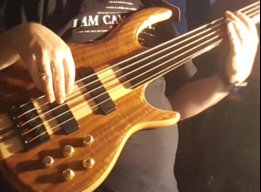
A caveat about my #3 - a 2006 Skjold Pro Series Deluxe with neodymium reverse P's, a maple/white wenge neck + black limba body, and the best damn preamp ever designed. this is essentially the same bass as what dave dyson uses and is very bright, forward, and hi-fi. the playability of it, and all Skjolds, is unsurpassed by even equally good builds by Fodera and MTD. but it is damn picky about strings. without the flats, I practically remove the entire treble band before I find the honky sound reasonable. with flats, it's the most versatile session + recording machine around. point is, I insist on dressing up a brunette as a platinum blonde to be satisfied. and the "playing" is good - but perhaps know what you like before that final commitment? perhaps i'm wrong. I played that Skjold exclusively from 19-29 - literally the only piece of gear (along with two red George L's patch cables) I still had ten years later.
Lesson: one good investment, for each 2-3 years it remains without needing upgrade or replacement, is equal to buying another bass of about $1750 total or, alternatively, annually compounded $800 every year. Consider this: a well-chosen custom build not only affords the fluid player-tool relationship we all want with our bass(es), but oft-overlooked is the potential for developing a relationship with the luthier. Pete Skjold is a wizard among men and I thank god I had him to plant ideas in my head at 19 and when I was ready 10 years later, his skills had gotten cleeeean. Pete, as a dude, is one of the coolest guys and I consider it an honor to still work and talk shop with him as recently as yesterday afternoon for example
it was only due to increasingly difficulties from carpal tunnel that I acknowledged the inevitability of having to reconsider my 35" 5 as my exclusive bass; I'd have to find at least a practice backup of a shorter scale to match my 5'7 frame and frail wrists. the 35" was an extension of myself and every muscle memory but it was starting to hurt me in a distinctly noticeable way - stringskipping and independent "snap response" of my touch. Like suddenly I had to control rubber band triggers to coordinate. left hand holds up, right was bitching out fast.
It's lucky that I, largely out of necessity, found my Skjold to be a cherished friend when life was more turbulent than any starry eyed nerd expects at 21 and ruminates on the night before they turn 30. Don't mistake my verbosity for the suiflatuphilia* of self-satisfaction of some enlightened ass, I'm just an academic writer by trade and find it calming so I tend to write most right before I fall asleep, much like people that call their out of town bf/gf or watch 2.5 episodes of 90 day fiance or get their rocks off or something. enjoy, hopefully there's something needle of value in that haystack of what I imagine David Foster Wallace might write if he found himself meandering an empty campus after smoking a handrolled pcp cigarette using the SAT reading section as a rolling paper. Kill’em. Sounds like the wired ass meanderings of a college sophomore with a c- average and an affinity for brett easton ellis and adderall... on his second adderall of the night. Can’t you see it? "i play bass. i'm dark and moody. i've read 6 pages of infinite jest but insist it's my favorite book"
Brought to you by the letter 31hz, being stuck in head, Covid loneliness, and cannabis sativa cultivar “Jack Herer”