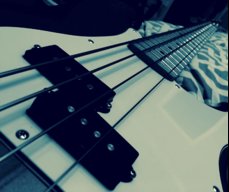
Hotter pickups are usually done by putting more winds on the coils. That makes the pickups higher in impedance, which also means it's very sensitive to capacitive loading. Change your cable, your sound changes. Also, the fact that your volume control is in the middle between the pickup inductance and cable capacitance means that your tone changes when you change the volume control. I find this to be a less than desirable situation.
My basses use hum cancelling pickups, wired in parallel. That lowers the impedance by quite a bit, which fixes the issues with loading and the volume control being a tone control. It raises another issue, though - most folks that have tried parallel wiring say it sounds "thin". It does that, but only if you don't take one more (rather simple) step. Adding a loading capacitor before the volume control "unthins" the sound - you can choose how "fat" it sounds by the choice of a capacitor value - instead of forking out $100 (sometimes more) to try a differently wound pickup, you can change a 50 cent capacitor, and have the same effect (except in this case, you actually KNOW which way it will go).
So, forgive me if I don't really care how hot a pickup is - I get the sound I want, I have volume controls, so I can get as loud as I need, and I've got a more consistent, more usable instrument doing things this way. Hotter pickups made sense in the 1940's when all there were were noisy tube amps, and you had to get your signal over that noise. It's no longer 1940, we can do things differently (and better) now.







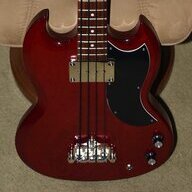


 Alan Entwistle Neos were installed for a massive transformation of the bass. Output had a huge boost but unlike the overwound Duncans the boost came via the Neodymium magnets. Wire count on the Entwistles is quite normal , around 9k for the split-P so no muddiness.