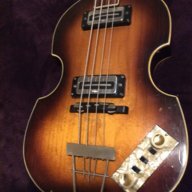
In case anyone else thinks the standard Hofner control panel is a bit limited, here's one way you can rewire it to open up a new sound palette. After quite a bit of experimentation, I've reached what I consider an ideal wiring scheme for my Hofner. Basically, it's wired like a Jazz Bass: V-V-T (using the existing switches), plus a special variation for the bridge pickup.
The
Rhythm/Solo and
Bass On switches work together to offer four positions that affect both pickups. After quite a bit of experimentation, I've settled on no cap, .0068uF, .03uF, and .062uF (one could leave the stock .1uF cap and resistor in that position and thus preserve all the stock settings while adding the others). The .0068uF cap imparts a really woody sound with a hint of that hollow grunt a P-bass has; this and the .03uF cap (warm and full but not lacking mids) are my standard settings. The .062uF cap (actually a .047 and a .015 in parallel) is my dub tone.
The
Treble On switch affects only the neck pickup: a .01uF cap wired in series can be switched in and out of the circuit. Stock wiring does this, too, but when switching in the cap, the neck pickup gets switched off, which negates the real benefit of the inline capacitor: it dramatically improves the pickup blending. I can run both pickups full up, without any weird interactions--just rich full tone with excellent articulation. But if I want to solo or favor the neck pickup (especially with one of the treble cut caps engaged), the sound is much better
without the inline cap.
This diagram shows the basic idea, although it differs a bit from my final wiring. I think the pickups sound best when they share the same tone caps, so my wiring no longer has the 22nF cap connected to the
Treble On switch. (That allows me to simply switch the .01uF cap in or out. Also, there's no need for the yellow wire running from input bridge PU to the switch.) The other two switches are now wired in parallel to the output, like a Jazz Bass (the red wire connects to the yellow and green wires), which makes the tone capacitors affect both pickups. Also, the capacitor values are the ones listed above, not the ones shown.
In the end, it still sounds like a Hofner, just with an expanded tonal palette.