
Enjoy the benefits of a premium membership!
Upgrade Account
-
TalkBass has been independent since 1998. Add your voice.
Create a free account to reply to discussions, view embedded media, and browse with fewer display ads.
Join free Log in
Want zero display ads or expanded classifieds tools? Compare plans.
You are using an out of date browser. It may not display this or other websites correctly.
You should upgrade or use an alternative browser.
You should upgrade or use an alternative browser.
Double Bass Hole in the Heart (5 String) Double Bass idea.
- Thread starter Oscar Stern
- Start date
- Status
- Not open for further replies.
More options
Who Replied?Nobody is going to know unless someone has both the resources and motivation to prototype the idea, so the discussion is mostly conjecture. But I suspect it can't be all gains; there is a finite amount of energy available from the string, and changing the response of the body can only move how that energy is distributed. So it seems to me that any design change which increases the projection at the fundamental frequency of lower notes might also diminish response in other ranges and lose something we valued about the sound of the conventional design. And more fundamental isn't always useful on low bass notes - look at all the threads about high-pass filtering on both sides of this forum.
It's an interesting idea, but I'm not sure about the OP's conviction that it's a certain way to improve the instrument.
It's an interesting idea, but I'm not sure about the OP's conviction that it's a certain way to improve the instrument.
Last edited:

I think the concept might be interesting in a EUB.
I'll risk showing my ignorance here - Do EUB's have sound posts?

Dare accepted, thanks!I Dare any of this Thread's participants to visit the YT channel of Mr. Oscar Stern.
I Double-Dog Dare you.
Yer' welcome.
I'll admit not listening to any of it but the list is impressive. You are a busy man Mr. Stern.
Trying to get more fundamental from a DB is 1.) Not going to be solved by driving the back plate harder . 2.) Is because the volume of the cavity and the size of the vibrating plates are too small, as has been known at least somewhat for oh, maybe 300 years. 3.)Is less fundamental really the problem ?
OP, on the size of violin family and may other innovations , physics and engineering of string instruments, you should start with Carleen Hutchins and then look into the string instrument physics and engineering research groups around the world since.

Uh…wouldn’t depriving the soundpost of contact with the nodal point under the bridge foot result in less direct excitement of the belly and therefore less sound?
There is such a thing as too much weed, folks.
There is such a thing as too much weed, folks.
Testing it would require potentially damaging an expensive instrument, with little evidence of any upside. What's to like?I guess I don't understand the total negative feedback to this idea.
Not that I know of, but there are several with downsized tops and soundchambers. Like an Eminence for instance.I'll risk showing my ignorance here - Do EUB's have sound posts?
But isn’t the point of this design that it has no staple? The treble bridgefoot replaces the staple and has no effect on the top, while the low side has it’s leverage amplified. That might be interesting if you want to try to build an EUB with a bit of bloom.
Not that I know of, but there are several with downsized tops and soundchambers. Like an Eminence for instance.
But isn’t the point of this design that it has no staple? The treble bridgefoot replaces the staple and has no effect on the top, while the low side has it’s leverage amplified. That might be interesting if you want to try to build an EUB with a bit of bloom.
We might be having a language difference, I'm not sure what "staple" refers to and I honestly don't know much about EUBs.
But, my understanding of acoustic doublebasses and other violin family instruments is that the soundpost tensioned between the table and the back are integral to the sound. The premise of this design is to essentially eliminate the soundpost. Or if you prefer, pin a soundpost to the back and not have it contact the table at all. If there is not a soundpost in an EUB, I'm not following how this design would apply, but again, it's not an area of expertise for me.

that is what I have been thinking this whole time.
i feel like putting the bridgefoot on top of the soundpost is going to significantly change the sound. my understanding is to make the top (table) vibrate to produce the bulk of the sound. if the bridgefoot is on the soundpost and not the top, wouldn't it vibrate less?
i couldn't see how this, 'hole in the heart" idea would be better but i'm no expert.
i feel like putting the bridgefoot on top of the soundpost is going to significantly change the sound. my understanding is to make the top (table) vibrate to produce the bulk of the sound. if the bridgefoot is on the soundpost and not the top, wouldn't it vibrate less?
i couldn't see how this, 'hole in the heart" idea would be better but i'm no expert.
So, Odin help me, I've gone off and researched this more than I should have. It is not a new idea and it has been tested, tinkered with, and developed at for a very long time. One resource said "11th century", but I think that's probably relating it to older instruments that don't much resemble ours. Let's say over the last ~100 years.
I found this exact discussion in a violin luthier's form and it went more or less like ours has and included one consistent participant who I will not name. But, fair to say that those experts' opinions closely paralleled our experts' opinions with a few exceptions. 1) unlike doublebasses, there are $40 violins to experiment with and they get given or thrown away frequently and 2) however old this history is, the only claimed success and benefit of it was making a student level, child's size violin sound less like a violin and more like a viola. This is useful if you want to have a orchestra for very young people that includes viola parts, because it is difficult for very young people with very small hands to play violas. There is the problem to which this appears to be a solution.
I think it is VERY revealing that no one seems to suggest that regular sized violas would benefit from this design. Nowhere else in this research even mentions the idea that basses or any other violin family instrument would benefit from this design.
They do make scaled down basses to enable children to learn. They don't sound the way that we want our basses to sound, but unlike the scenario above with the children's viola, they sound like a bass in the context of a youth orchestra. We are able to teach children on smaller basses and then graduate them up to roughly 3/4 basses, give or take, as they grow.
I don't see anything outside of this thread and parallel threads in other places to suggest this would make any full sized instrument and definitely not basses better in any way. I couldn't find any players or builders advocating for expanding this modification to applications other that creating a viola sounding instrument from a child sized violin.
I don't need to have the last word and I don't personally have the luxury of ignoring this conversation, but I don't know what it would take for me personally to change my mind short of someone building it. I am not going to lock this thread, though, because if for some reason this topic even needs to be discussed again, I don't want a 2nd thread on it.
I think it would be great to get back to our regularly scheduled programing, though.
I found this exact discussion in a violin luthier's form and it went more or less like ours has and included one consistent participant who I will not name. But, fair to say that those experts' opinions closely paralleled our experts' opinions with a few exceptions. 1) unlike doublebasses, there are $40 violins to experiment with and they get given or thrown away frequently and 2) however old this history is, the only claimed success and benefit of it was making a student level, child's size violin sound less like a violin and more like a viola. This is useful if you want to have a orchestra for very young people that includes viola parts, because it is difficult for very young people with very small hands to play violas. There is the problem to which this appears to be a solution.
I think it is VERY revealing that no one seems to suggest that regular sized violas would benefit from this design. Nowhere else in this research even mentions the idea that basses or any other violin family instrument would benefit from this design.
They do make scaled down basses to enable children to learn. They don't sound the way that we want our basses to sound, but unlike the scenario above with the children's viola, they sound like a bass in the context of a youth orchestra. We are able to teach children on smaller basses and then graduate them up to roughly 3/4 basses, give or take, as they grow.
I don't see anything outside of this thread and parallel threads in other places to suggest this would make any full sized instrument and definitely not basses better in any way. I couldn't find any players or builders advocating for expanding this modification to applications other that creating a viola sounding instrument from a child sized violin.
I don't need to have the last word and I don't personally have the luxury of ignoring this conversation, but I don't know what it would take for me personally to change my mind short of someone building it. I am not going to lock this thread, though, because if for some reason this topic even needs to be discussed again, I don't want a 2nd thread on it.
I think it would be great to get back to our regularly scheduled programing, though.
Well, the theory would be that reducing the stiffness of the bridge support would lower the "natural frequency" of the bridge movement, thus enhancing the fundamental at the expense of upper partials. The FFT presented did support that theory. I put "Natural frequency" in inverted commas because we're not talking about a classical resonance where there's one resonant frequency.
When you support the treble side of the bridge by the back only, that's less stiff than supporting it by the back and the front of the instrument. Furthermore, when you tie the front and back together, they're going to move together - at least near the sound post - which does not create as much pressure variation as if they're not moving together - as in theory would happen if you decouple them.
Obviously the actual vibrations of the plates and the air enclosed in the box are very complex, but to me the theory of why this could help reinforce fundamental frequencies of low notes is plausible. Most of the "anti" comments have either focused on the fact that to test it involves making an irreversible modification to a (relatively) expensive instrument (true) or on the idea that "if no one's done it yet, it must be of no value (not necessarily true).
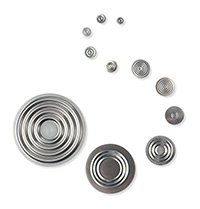
A practical matter of supporting the bridge foot, allowing it to be decoupled from the top, while not having it sway back and forth, could potentially be addressed by using a "convoluted diaphragm" attached to the top and supporting the bridge foot/top of post - thus allowing vertical movement with minimal side to side movement.
As I said, I've been somewhat surprised at the immediate full scale negative response to this idea. Definitely not open-minded.
When you support the treble side of the bridge by the back only, that's less stiff than supporting it by the back and the front of the instrument. Furthermore, when you tie the front and back together, they're going to move together - at least near the sound post - which does not create as much pressure variation as if they're not moving together - as in theory would happen if you decouple them.
Obviously the actual vibrations of the plates and the air enclosed in the box are very complex, but to me the theory of why this could help reinforce fundamental frequencies of low notes is plausible. Most of the "anti" comments have either focused on the fact that to test it involves making an irreversible modification to a (relatively) expensive instrument (true) or on the idea that "if no one's done it yet, it must be of no value (not necessarily true).
A practical matter of supporting the bridge foot, allowing it to be decoupled from the top, while not having it sway back and forth, could potentially be addressed by using a "convoluted diaphragm" attached to the top and supporting the bridge foot/top of post - thus allowing vertical movement with minimal side to side movement.
As I said, I've been somewhat surprised at the immediate full scale negative response to this idea. Definitely not open-minded.
I don't think anyone's proposing you start drilling holes in your bass; this would be an experiment undertaken by a manufacturer. In companies where people make things, they prototype stuff all the time and it's a cost of doing business.Testing it would require potentially damaging an expensive instrument, with little evidence of any upside. What's to like?
It may well, but keep in mind that - at least in the vicinity of the soundpost - the back and front are coupled together. so when both sides are moving together, they can't compress between them the air located in that region of the box. On the other hand, if you decouple them, now the back and front can move separately (at least in that vicinity) creating (theoretically) an INCREASE in the pressure variations in the air in the box. Which is what creates the sound. (A double bass in a vacuum makes no sound.)Uh…wouldn’t depriving the soundpost of contact with the nodal point under the bridge foot result in less direct excitement of the belly and therefore less sound?
There is such a thing as too much weed, folks.

There are EUBs, mostly with a small resonance chamber that have soundposts. The Eminence has one, at least in the removable neck version, it is fixed in position by foam glued around it at top and back.I'll risk showing my ignorance here - Do EUB's have sound posts?
One version of the MK has (or had) a vibrating top, fixed at top and bottom, and a piece of wood that you can slide up or down that has the function (relative to the bridge foot) of a sound post.
I don't think anyone's proposing you start drilling holes in your bass; this would be an experiment undertaken by a manufacturer. In companies where people make things, they prototype stuff all the time and it's a cost of doing business.
If you're interested in this, you should research it. I did. It's not a new idea, it has been studied and prototyped over an extended period of time.

I like to hypothesize, so a couple of thoughts:
I suppose the effect of the idea could be mimicked a little by placing a soundpost straight under the G side bridge foot (a little!).
My theory about the effect of the idea is that no vibration is transferred to the top by the G string foot. Leaving it all to the E string foot, probably emphazising deep frequenzies, and perhaps a less complex sound.
The resonanse frequenzy of the top will ofcourse also be lowered by removing the soundpost "fix point", think node or harmonic/flageolette.
I do not feel convinced any of this would be particularily beneficial to the overall sound.
I suppose the effect of the idea could be mimicked a little by placing a soundpost straight under the G side bridge foot (a little!).
My theory about the effect of the idea is that no vibration is transferred to the top by the G string foot. Leaving it all to the E string foot, probably emphazising deep frequenzies, and perhaps a less complex sound.
The resonanse frequenzy of the top will ofcourse also be lowered by removing the soundpost "fix point", think node or harmonic/flageolette.
I do not feel convinced any of this would be particularily beneficial to the overall sound.
I’m sorry, you’re right about the language. ‘Stapel’ is the dutch word for soundpost. I must have inadvertently used that and autocorrect probably turned that into staple.We might be having a language difference, I'm not sure what "staple" refers to and I honestly don't know much about EUBs.
But, my understanding of acoustic doublebasses and other violin family instruments is that the soundpost tensioned between the table and the back are integral to the sound. The premise of this design is to essentially eliminate the soundpost. Or if you prefer, pin a soundpost to the back and not have it contact the table at all. If there is not a soundpost in an EUB, I'm not following how this design would apply, but again, it's not an area of expertise for me.
So my point was: this technique does not really involve a soundpost. A soundpost is a fulcrum the bridge uses to move the top. This ancient design does not do that.
Well, if your post above accurately reflects your research, it sounds like the concept hasn't been discussed in the context of double-basses, which have similar issues to tiny violas - not enough bass response, due to small body.If you're interested in this, you should research it. I did. It's not a new idea, it has been studied and prototyped over an extended period of time.
"...I don't see anything outside of this thread and parallel threads in other places to suggest this would make any full sized instrument and definitely not basses better in any way. I couldn't find any players or builders advocating for expanding this modification to applications other that creating a viola sounding instrument from a child sized violin...."
Absence of evidence is not the same thing as evidence of absence.
Don't get me wrong; I'm not saying I'm convinced the idea is the greatest thing since sliced bread; just off the cuff I'd guess there's a 5% or less chance that there would be any value in it, or that any benefits wouldn't be outweighed by negative effects. But the stone-wall negativity to the concept strikes me as a bit unusual. Why this reaction?
So, in conclusion, Oscar, you have the entire community’s full support and encouragement to try this out on any bass of your choosing and report back your findings in detail, graphs and all.
- Status
- Not open for further replies.


