• TalkBass has been independent since 1998. Add your voice.
    Create a free account to reply to discussions, view embedded media, and browse with fewer display ads.
    Join freeLog in
    Want zero display ads or expanded classifieds tools? Compare plans.

Holly and Ebony Rick

Rats! My Crapsman router only has a 1/4" shank, which is probably part of my problem. It seems to work fine with short bits, I've had quality of cut issues with anything longer than 1". I may have to bite the bullet and get a better router, all the accessories available for it are junk plastic too. Sigh.... More $$$ into this obsessive hobby.
 
Rats! My Crapsman router only has a 1/4" shank, which is probably part of my problem. It seems to work fine with short bits, I've had quality of cut issues with anything longer than 1". I may have to bite the bullet and get a better router, all the accessories available for it are junk plastic too. Sigh.... More $$$ into this obsessive hobby.

Two words.....

Porter Cable
 
A slight pause in the action on this one. A couple things that I worked on though.

I'm working out how I want to cut the heal. Because I really haven't done something like this before, I want to make sure I get this right. So I'll be doing experiments on blocks of wood until I get something I like. I'm getting close, as you can see in the piece of Ash.

Also,

@HaMMerHeD - I put a 6" radius cut in one of my scrapers. I was messing around with it a bit. I like this tool, but I think I'll be wanting a smaller radius.

Rick19.jpg
 
Update

Been pondering what pieces of wood I could use to create a test neck and body center. I came up with this

The African Black Wood are finger boards that have knots in them. The Black Limba has a lot of worm holes.

Cut the wood moments ago. I'll be gluing this up tonight, and start shaping out tomorrow.

(This is only a test)

Rick20.jpg


Link Removed
 
  • Like
Reactions: kkaarrll
Great looking build! I have a friend build a Dreadnought guitar from holly and it was beautiful! I swore some day I would make an instrument from it, still haven't got around to it. Personally I've never found much use for concave radiused scrapers, I find them difficult to control and prefer to make flexible scrapers, you might want to give one a try. I did a quick tutorial on making them HERE, and showed using one in a post HERE which also happens to talk about carving the heel, which is very similar to a Rick heel. Good luck with the build, can't wait to see the wings glued on!
 
Update,
Working on building up a "pre" build just so that I get everything straight. Don't want to mess up the Holly.
As I alluded to above, I have some pieces of African Black Wood and Black Limba, that have defects.

Here's the glue up.
Rick21.jpg


And here are the building pieces. Now that I've gone thru and validated my mfg process, I can start on the Holly. I'll be using the The Black Limba version a little later in the project to test out another idea I have. BTW, The Black Limba version will be headless.

Rick22.jpg
 
Update:

Here's a look on how I'd like to approach the fingerboards on this build.

My intent is to cut scraps of wood left from the body, into the triangle shapes for the FB. After I do that, I would put a binding on, then an epoxy finish, and everything would be dandy.

The question I have is....Should I inlay the light pieces of wood into the FB, or should I cut the pieces of the FB to shape,(about 17 Pieces) and glue them together?
I will be putting a binding on the neck.
Rick23.jpg
 
Can you explain a bit more what you mean by the second option?

Sure.

Imagine the pieces of paper as pieces of Blackwood, the same thickness as the Limba. I'm thinking of gluing the individual pieces down to the neck until I get a complete fingerboard. I would set it so that the line of the triangles that runs perpendicular to the center line, and would actually be the location where a fret were to be if this was a fretted instrument.

I'm thinking this would be much easier to fabricate and less room for f'ing it up, as opposed to cutting out a section on the FB with chisels and routers, and then setting the Limba in. I'm also contemplating putting the FB pieces on a thin substrate before actually gluing that assembly to the neck.


Rick24.jpg
 
Update:

Here's a look on how I'd like to approach the fingerboards on this build.

My intent is to cut scraps of wood left from the body, into the triangle shapes for the FB. After I do that, I would put a binding on, then an epoxy finish, and everything would be dandy.

The question I have is....Should I inlay the light pieces of wood into the FB, or should I cut the pieces of the FB to shape,(about 17 Pieces) and glue them together?
I will be putting a binding on the neck.
Rick23.jpg
You would have to make it impossible for the triangle to shift otherwise it could throw off intonation, I would atleast glue it to a substrate then glue it to the neck.
 
Last edited:
Sure.

Imagine the pieces of paper as pieces of Blackwood, the same thickness as the Limba. I'm thinking of gluing the individual pieces down to the neck until I get a complete fingerboard. I would set it so that the line of the triangles that runs perpendicular to the center line, and would actually be the location where a fret were to be if this was a fretted instrument.

I'm thinking this would be much easier to fabricate and less room for f'ing it up, as opposed to cutting out a section on the FB with chisels and routers, and then setting the Limba in. I'm also contemplating putting the FB pieces on a thin substrate before actually gluing that assembly to the neck.


Rick24.jpg
I would not do that. It means that you have air gaps clear down to the main neck beam, you're missing the continuous fingerboard wood that is normally there below the level of the bottoms of the frets. This means that the neck will be likely to be significantly more flexible, since the beam stiffness is proportional to the cube of the cross section. So for example, if you lose 10% of the wood thickness of the neck that might have been provided by that FB wood that would normally be below the frets, the stiffness will only be 0.9^3 = 73% of what it "should" be. Yes this is neglecting the contribution of the frets, but that is entirely dependent of the accuracy of your slot widths and the thicknesses of the fretwork tang.
 
  • Like
Reactions: Will_White
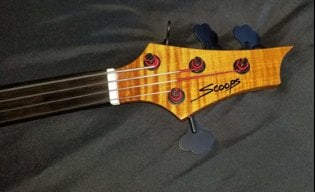
Scoops
Are you using the standard 3/8" thick Ric fingerboard depth? Even using full width inlays by 1/8" thick, you still have a solid 1/4" of fingerboard thickness under the inlays. In order to work with the stock Ric bridge, the fingerboard on a 4001/4003 is nearly 1/2" above the plane of the body.